






Born and raised in Madrid, Maite is an actress and singer, now on the director’s chair for the first time. She graduated from the Musical Theatre Conservatory Program at the American Musical and Dramatic Academy (NYC). Her role in award-winning short Olvido (Marina Badia and Jorge Vico, 2017) is a major highlight. She earned a Latin ACE Award and an HOLA Award.
Maite also stars in her directorial debut Mariana Ant, co-directed by Rubén Pascual Tardío, which premiered at the Cerdanya Film Festival. The short film follows the footsteps of a woman who thinks that she’s an ant.
…
.
Paul Risker – Why filmmaking as a means of creative expression? Was there an inspirational or defining moment for you personally?
Maite Uzal – Mariana Ant has been my debut in many fields: script, directing and producing…but not in acting. I decided to make a short film to give myself work, given that I was going through a dry spell in terms of acting gigs. I had a teacher in acting school (thank you, Dan Daily!) that warned us that such dry spells would happen and that we shouldn’t sit down waiting to be hired but create our own work instead. So that’s what I did.
PR – What was the genesis of Mariana Ant?
MU – The script was initially submitted to a short film contest: a short film rally called Buñuel Challenge in Teruel, Spain. Many of the elements that appear in Mariana Ant were dictated by the rules of the contest. For example, it had to be inspired in Buñuel’s The Discreet Charm of the Bourgeoisie [1972], include a ham, include iconic locations of the city, etc. These rules were what ignited my imagination. The script was rejected by the contest, so I set out to do it on my own.
PR – The film is filled with colourful characters. Could you describe the thought process behind writing these and the collaboration with the actors to bring them to life?
MU – Mariana Ant is a satiric fable, so I wanted the characters had to have a larger-than-life allure to them so that they would make a clear impact in very little screen time (it’s a short film after all!). All the actors were on board with the idea because they immediately grasped this concept and they fully embraced the theatricality of the piece. The challenge was to do that but knowing that, in their universe, this fictional region of Thorbat, these characters really existed. We had to be very careful not to mock a certain stereotype or try to imitate anyone to try to secure laughs or any sort of emotions from the audience.
The goal when collaborating with each actor was to make each character specific and real in their bodies letting the actor layer what I had in mind with their very own personality. As a result, some of the actors created exactly what I was expecting, which is fantastic, and others created something a little bit different, but that was even better than what I had in mind initially, because they surprised me with their take on the character. Both scenarios were ideal for me, and they served the story well, which was the priority at all times.
PR – Inspired by surrealists including Buñuel, Lorca and Dali, are there any specific references the audience should look out for, or did you honour them more in spirit and explore surrealism through your own voice?
MU – I wasn’t trying to explore surrealism in and of itself. I didn’t set out to make a surrealist movie. I was highly influenced by Buñuel because he’s one of my favorite filmmakers, so what I really tried to do was to be one hundred percent true to myself, my imagination and my instincts. I did try to pay homage to the brief moment in time when Lorca, Buñuel and Dalí collaborated, when they set aside their differences and put their talent to work in a creative endeavor: that’s why I borrowed from the three geniuses, but not to achieve a surrealist movie but as a tribute to tolerance and to that brilliant, fleeting instance of artistic collaboration in spite of political and personal differences.
A few examples of these borrowed elements are: the presence of the ants, the character of the Stylite, directly taken form my favorite Buñuel movie, Simon of the Desert, the fact that the first conversation between the doctor and Mariana’s mother as an adult barely makes any sense because they’re not listening to each other (inspired by the way some characters communicate in the Exterminating Angel), verse’s of Lorca’s poetry woven into the dialogue (intro and end of the narration, part of the interview between the Doctor and Mariana, the Doctor’s prophecy about Mariana’s “illness”).
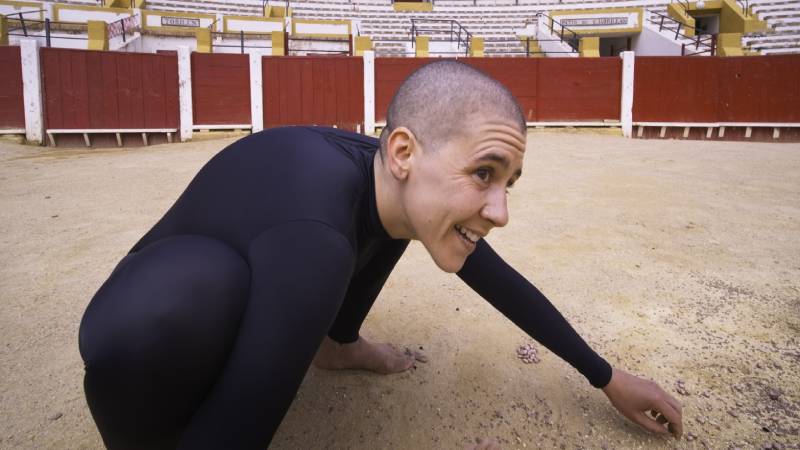
PR – The cinematography creates a sense of scale and emphasises the quirky and surreal humour. Can you discuss your approach to the film’s visual aesthetic and how you layered this with words and music?
MU – The person to better explain this would be our cinematographer, Isamel Issa, who I will always address on and off set as “The Wizard”. And what better way to address him given that this is a Once Upon a Time [Alexander Hall, 1944] scenario. The references I had in mind in terms of visuals were the old classics and a series of paintings by Joaquin Sorolla called Visions of Spain (run to the Hispanic Society in NYC to see them), and the crew, captained by Issa, made it happen. I also wanted to convey a sense of trepidation, of the heightened emotion that we experience as kids when we’re told a story and we’re just so excited: an excitement and awe in discovery that sadly we don’t experience as often as adults. And that’s what I tried to do with the technical script in terms of camera and with the words and the music. Also, extremely important, in postproduction when coloring the film (José Oner).
Additionally, the music had to transport us back to the golden age era of film where you were hit by this massive orchestra right from the get-go, from the opening credits, almost overflowing the screen (if one could say that) with emotion. There’s literal Lorca poetry in the dialogues for God’s sakes! I insisted that most of the music be recorded live by an orchestra because and I couldn’t be more grateful for Sergio Jiménez Lacima and his team because they took my musical “vision” to the exact place I had dreamed of (to be fair, an even better one than in my dreams).
PR – You said that “the best statement that I could write is in the lyrics of the song that plays during the final credits”. Why is this and what meaning does the song I Don’t Care hold?
MU – It’s a very personal and forward acknowledgment of how peculiar this project is. I wanted to make it very clear that, no matter what other people may think about it, I am fully satisfied with what I did because it’s exactly what I set myself out to do. It doesn’t aim to please nor has it been made taking into account how it was going to be received. Is there a place to do that in film? Of course, why not. Would I prefer that people be entertained and have positive things to say about the project? Naturally, I’m not a masochist. But if none of this happens, in this case, I’m truly okay with it.
PR – Could we describe Mariana Ant as resembling a dream or existing on a dream logic?
MU – Yes, most definitely. I would be very happy to know that someone who watches the movie has the feeling that they just dreamed this story, or that they were a very special guest of honor at our dream.
PR – Is one way to push at cinema’s boundaries, to prioritise imagination over narrative cohesion, and do you hope that Mariana Ant encourages this?
MU – I do hope so but always keeping in mind that narrative cohesion and unity of code are, precisely, the boundaries that even the wildest of imaginations should stick to. If I have failed in that department, I only hope to learn from my mistakes. But that is, only after I have taken the full risk of failing, having my imagination be the main engine that drives the project.
PR – Do you think Mariana Ant has a creative fluidity that will offer audiences a different experience on each viewing?
MU – I certainly hope so. Mariana Ant has many layers that can only be unveiled after a certain number of viewings, whatever those may be. The flavors it has to offer cannot be identified the first time you watch the film. And that is intentional.
PR – How do you look back on the experience of making Marianna Ant?
MU – As a gigantic learning experience and a rollercoaster filled with every possible sentiment you could experience as a creator: pride, trepidation, fear, impostor syndrome, gratitude, frustration, doubt, determination, certainty, disappointment, affirmation, confirmation, utter joy and despair… all rolled up into one.
…
.
Maite Uzal is pictured at the top of this interview, as snapped by Shirin Tinati. The other image is a still from Mariana Ant.


