






Nestor Lopez is a film director and producer born in Leon (Spain) in 1992. He is the founder of production company Filmakers Monkeys. In the past decade, he has produced and directed countless short films, and won multiple prizes. His latest creation Seeds from Kivu – which gives voice Congolese rape victims, while also highlighting the accountability of global consumers – won 2025 Goya Award for Best Documentary Short Film.
…
.
Paul Risker – What was the genesis of the film, and what compelled you to believe in this project?
Nestor Lopez – The origin of the film goes back quite some time. It has been eight years since we began working on Seeds From Kivu. I am a filmmaker who wants to make films for a wide audience, films that leave an impact, that go through people. At the same time, I believe cinema carries a responsibility, and that its power can be used to make the audience look at places they might not know, or even feel uncomfortable looking at, but where looking is necessary. For all of those reasons, I always try to create cinema that speaks from this place.
When I discovered the work of Dr. Mukwege and the Panzi Hospital, it was a before-and-after moment in my life. Initially, the film was going to be about him, but through the research process, the story shifted toward the true protagonists of the conflict, the women of Kivu and their survival.
PR – Given the adage that first and last impressions count, do you give particular thought to the opening and closing scenes of your film
NL – When I’m working on a documentary, I do think very carefully about the beginning. It’s practically the first thing I conceive for each project. I work on the opening a lot, and it’s usually the scene I’m most eager to shoot. The ending, however, I do not plan. In documentary filmmaking, I believe the ending is something that must find you, not the other way around. The best documentaries are those you start without knowing how they will end; that is the true magic of cinema. I let myself be guided by the story. I know what drives me to make the film, and eventually I find where it needs to land.
PR – How important was it to allow for pauses, enabling the audience to sit with the experiences described and allowing the film to breathe?
NL – It is absolutely essential in this story. The emotional impact is so strong that the audience needs moments of pause in order to absorb it without disconnecting from the narrative. At the same time, these pauses allow us to draw comparisons between what is seen and what is heard, creating metaphors and new layers of meaning that help us achieve the cinematographic language we are aiming for.
PR – One of the interesting juxtapositions in Seeds From Kivu is the subjects talk directly to camera, and in other moments the camera observes their conversations with others. What is striking is the way you transition between the two, as if you’re threading together a shared conversation. Any thoughts?
NL – Very good observation. One of the aims of the film is dialogue, the transformation of people and realities through the dialogue that an image can generate. Making the images speak to one another was one of the most carefully crafted aspects of the mise-en-scène, as well as creating a universe in which there is no single point-of-view. The women look in different directions when they speak, the doctor looks directly at us, some characters never look at anyone, others only look at the person beside them… This was essential to create a space where we are not all looking in the same direction.
PR – There’s a noticeable style to the cinematography, whose handheld framing has a jagged feel. Please discuss.
NL – The idea behind the roughness of the cinematography was to create a sense of closeness to the characters. I don’t want the audience to look at what’s happening from the comfort of their seat, but to feel like they are part of it, because, in a way, we all are. For that reason, this raw quality plays a fundamental role in the story. The handheld camera serves to place us in a first-person perspective: at times observing, and at other times living what is happening.
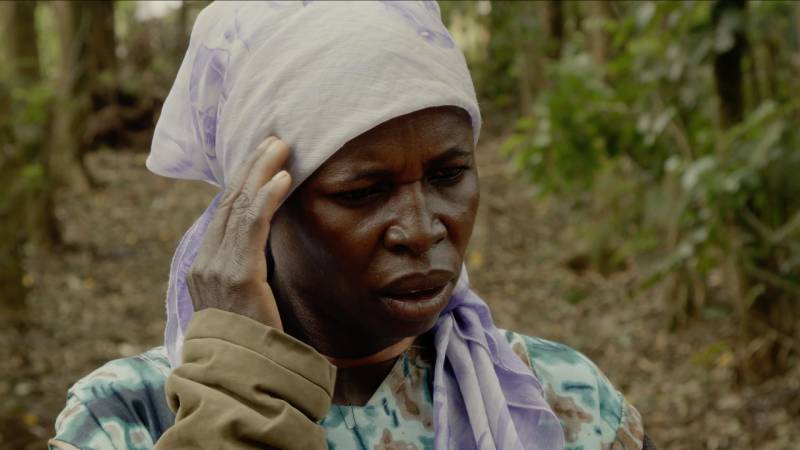
PR – At one moment, the doctor breaks the fourth wall and talks about the minerals contained in our phones that are exploited, leading to rape and massacre. What are you hoping to achieve from audiences?
NL – It’s a direct gaze of confrontation. This is a film meant to have an impact. I’m a bit tired of the idea that looking into the camera in documentary interviews is treated as some kind of taboo. Here, I decided that this gaze should directly engage the audience’s emotions, just like Sebastião Salgado does in The Salt of the Earth by Wim Wenders [2014]. It creates a direct and powerful connection. As a director, I remove myself from the frame, it is only the doctor and the viewer.
PR – You create journey that begins in despair and finds hope. Or, if not hope, then it acknowledges the resiliency of the women that have been subjected to horrific ordeals. Is this an accurate observation?
NL – We were not searching for hope, but it is a film about resilience. It is a story about what human beings are capable of when everything has collapsed. Moving forward with your life is a way of resisting violence. The film needed to find that space. Continuing with life is what truly matters, because then you have made violence meaningless, you have proven that love is the way forward.
PR – What are your hopes for the feature film and how will the experience of making this short influence what the feature becomes?
NL – This project was born as a feature film, but the difficulty of shooting in a war zone made us think that a short film made more sense, to avoid spending many years on it, and in the end, look… eight years just for the short film! So in the end, this is a project that has accompanied me throughout my life. The short has had a long run and has been shown in an incredible number of places and screenings: the Vatican, the UN, the Goyas, etc. Without a doubt, it will help the feature film; the industry and the public are eager to know more about this story. But the feature is different: it is a geopolitical thriller that will delve deeper into the causes of the conflict and into the major powers of the market.
PR – Given the film’s subject matter and that you’re developing this into a feature, please discuss filmmaking as a transformational experience.
NL – Without a doubt, cinema is a life-changing experience. The power of images and sound can stir a person’s emotions to the point of transforming them. Cinema changes lives; it is the greatest communication tool that exists.
PR – Is it possible for cinema, and films like Seeds from Kivu, to change the world?
NL – I hope so. It is one of my wishes, although I focus on making the best film possible. But of course, the goal is to try to change things. Filmmakers work with sight and with sound. We have the power to turn the spectator’s head so that they look and listen to the place where we are situating them. To me, cinema is a pickaxe and the world is a wall: with the pickaxe, we open a hole in the wall and invite as many people as possible to look through it. Perhaps, out of the thousands who look, one of them will have the will to take the first step. A point-of-view on things changes the world and our perceptions. And cinema is a point-of-view, and therefore, a place from which to change things.
…
.
Nestor Lopez is pictured at the top of this article. The other image is a still of Seeds from Kivu.


