








Running within the laid-back yet vibrant framework of the REC Tarragona International Film Festival (December 3rd to 8th, 2025), RECLab has long positioned itself as one of Europe’s most distinctive and creator-centred development environments. Set against the Catalan city’s seaside calm, the initiative acts as a counter-model to the high-pressure, transactional ecosystems that dominate many market events. Here, filmmakers and producers slow down, sharpen ideas, and build genuine connections across four sections: RECMatch, RECPush, RECVision and Primer Test.
This year’s edition largely confirmed the lab’s reputation for intimacy and experimentation, while adding something harder to engineer: an unusually cohesive group energy. Across interviews with participants, organisers, tutors and sales agents, a consistent theme emerged – 2025 is the year when RECLab feels like a collective reset, a moment to breathe, to rethink the industry’s hardened mechanisms, and to rediscover the human side of collaboration.
Click here in order to find out more about RECLab.
…
.
A creative start-up culture – without the pressure cooker
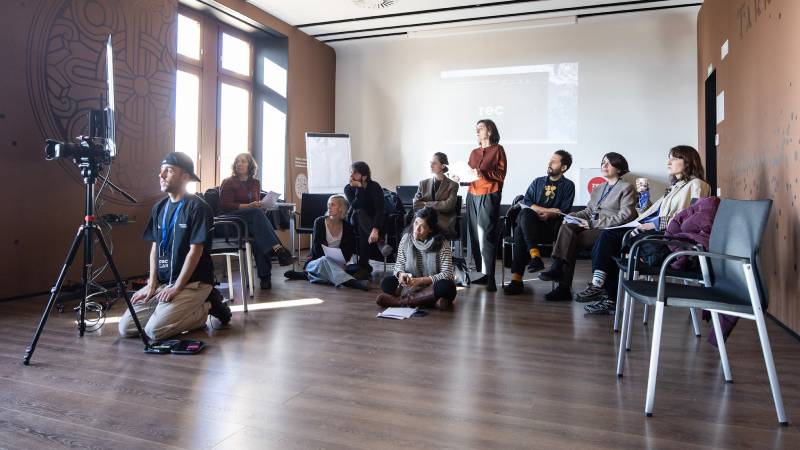
RECPush, the lab’s producer-focused sidebar, once again proved to be its emotional anchor. Unlike many development programmes, RECPush deliberately deprioritises pitching, packaging and financing. Instead, it focuses on the producers themselves – their personalities, working methods, long-term trajectories, and their capacity to build trust.
“The most important thing about RECPush is that it’s a programme for producers”, says coordinator Marika Kozlovska. “We select people based on where they are in their career and how open their spirit is. We reverted the usual model: first get to know each other personally, before entering production and making mistakes”.
The element of surprise plays a key role. Participants do not know in advance which activities they will undertake – only that they must “bring comfortable clothes and a good mood.” Kozlovska avoids revealing details, but notes the programme always pays close attention to mental health: “it’s the end of the year, people are tired. This year the group was magic—curious, diverse, committed. It felt like a puzzle coming together”.
For emerging Spanish producer Pau Pérez, the approach was revelatory. “I was afraid of being too young for the place—I’m just 28”, he admits. “But what I found was a really welcoming small community that gave me hope for my path in the industry. Being able to know the people behind the producers before establishing a business connection is a huge plus”.
Another RECPush participant, Maximiliano Bolados Jara, echoed the sentiment: “This space is really reading what’s going on in the market. In other places there’s no room to breathe. RECLab gives time to take a break, connect with ourselves and find co-producers not just as partners, but as friends and human beings. There should be more places like these.”
For Bolados Jara, the one-on-one meetings were unexpectedly productive – precisely because they were embedded in this slower rhythm.
German–Slovenian producer Sarah Valerie Radu (Matadoras Film) also emphasised RECPush’s intimacy: “You quickly get to know each other on a personal level, which creates a very open and positive energy. The exchange has been incredibly generous”. With Matadoras currently producing Sophia Mocorrea’s debut feature Marriage by Abduction, Radu spoke of leaving RECLab with a new network “to return to in the future”, and a clearer sense of how diverse producers can support each other’s growth.
Meanwhile, Argentine-Italian creative producer María Eugenia Lombardi described RECPush as “unlike any other festival or training space”. Diversity, she argues, is its real engine: “Networking happens organically; we’re not talking about cinema all day long – and somehow that’s exactly what lets us rethink ourselves as producers and storytellers.”
She highlighted one of the programme’s philosophical underpinnings: “Personal bonds matter more than anything else. If we don’t take care of each other as human beings, there won’t be much business to take care of either”.
.
RECMatch: directing actors, testing methods, creating emotions
If RECPush focuses on the producer as a human being, RECMatch focuses on the director’s creative process – particularly their relationship with actors. Filmmakers bring scenes from their projects and workshop them with actors, guided by movement coach Amanda Brennan and actress-producer Clara Larraín, who designed the format.
Writer Mo Scarpelli, working alongside filmmaker Jorge Thielen Armand on their new project Poem of a Phantom, found the experience uniquely fertile. “RECLab feels like a safe, open space for creativity,” she says. “We brought a scene to try out, and the workshops stimulated enriching methods and exercises we’ll use in preparation and on set.”
Their project marks a shift: although they have historically worked with non-actors, the new film relies on performance to build a “vibrant and surprising mosaic of Caracas”. RECLab helped them explore this change. Scarpelli adds enthusiastically: “it’s a truly open environment – working from inside a cathedral certainly helps! And the days are packed… with good local wine to finish us off at night”.
Spanish writer-director Laura Gómez, who previously attended the programme as an actress, praised RECMatch’s innovative structure: “I’ve never seen anything like this at other festivals. As an actor, I’ve participated in many theatre workshops – this feels just as helpful for film. The intimacy of the environment makes the process incredibly enlightening”.
For Gómez, the lab also offered concrete industry guidance: navigating an ambitious Spanish co-production, clarifying the visibility strategy, and identifying potential partners. “I was hoping to find a clear path towards the right producer”, she says. “RECLab has definitely taken me closer”.
.
Prime Test: a strong slate of WIPs
The Primer Test section, devoted to work-in-progress screenings of Spanish titles, was described by several experts as particularly strong this year.
Alief sales agent Miguel Govea praised the selection as “outstanding,” highlighting titles such as Wolff Girls, Agreste and Radio Pati. The atmosphere, he noted, was “young and fresh with a strong focus on dialogue and shared experiences”, and he admitted he already has “an eye on a couple of projects at script stage” from other sections – suggesting tangible business results. For director Adrià Guxens, presenting a project still in the making, the value was immediate. “We have some shooting left, so feedback on the cut is crucial,” he explained. “We now have room to prepare the rest of the shoot based on the experts’ perspective.”
Guxens underscored the horizontal nature of the conversation: “It’s very constructive. Some of us knew each other before, so it’s a nice homecoming, but we’re also forming new relationships”. He noted that the Tarragona context – the fact that everyone remains physically close in a small town – intensifies the sense of creative community.
Helmer Alejandra Cardona, presenting Mind Control, agreed that the range of expertise in the room allowed for “very broad and enriching feedback”. Discussions extended beyond editing to festival positioning, visibility, and partner matchmaking. “Since it was the first time we presented the project, we had many doubts about how an international audience would understand it,” she says. “The feedback has been incredibly valuable.”
Producer Joan Carles Martorell, presenting The Convulsions (fresh off an Audience Award win in Tallinn’s Work-in-Progress section), emphasised the thematic commonalities across the films screened: “We saw five films in one day – very different, but all depicting a world that is broken: lawfare, family traumas, psychosomatic reactions, union defeats…”. He seeks not only contacts, but also a post-production award the project “really needs”.
.
RECVision: rural cinemas, micro-festivals and a success story
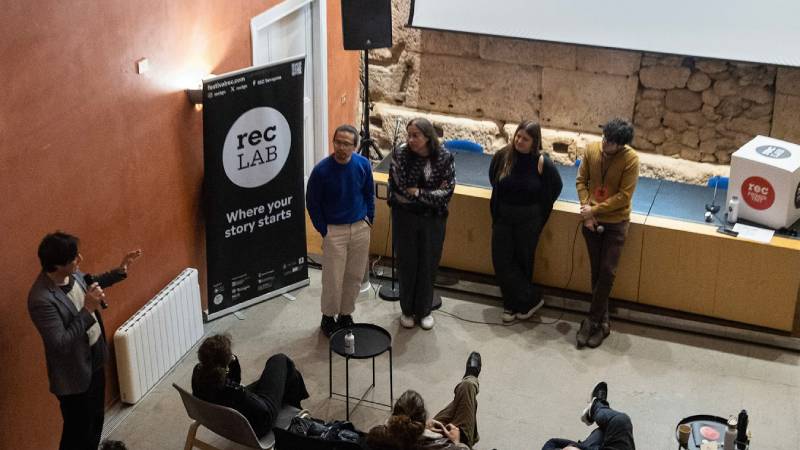
While the Lab is often discussed in terms of talent development, RECVision remains one of its most original – and quietly impactful – pillars. Led by Jana Wolff, it supports non-profit or volunteer-run organisations committed to expanding access to arthouse cinema in rural or underserved areas.
“RECVision is rare,” Wolff stresses. “It reminds us to look not only at the films to come, but also at the audiences who will watch them”. Selected entities this year included Barcelona’s senior-focused festival La GRAN Pantalla, Ascaso’s “Smallest Film Festival in the World,” Cineclub Almocita in rural Almería, and the reborn Cineclub ACIC in Mallorca.
Participating organisations receive advice from international experts and are integrated into the RECVision network. But the programme is also proud of its growing track record of concrete results. A standout success story comes from last year’s Catalan initiative Victoria & Savoy, which won the RECVision Development Grant. The project established a partnership with a Barcelona festival that had invited Béla Tarr. Victoria & Savoy’s organiser then arranged a 35mm screening of a Tarr film in a small village, with the director in attendance. The event drew audiences from Barcelona and Madrid, ending with a community paella.
Ascaso festival co-director Miguel Cordero confirmed the strand’s impact: “we screen indie, auteur cinema in a small mountain village. Here we’re sharing our experience, receiving advice from four European festival experts, and exploring participation in a European project aimed at small initiatives in mountains and rural areas”.
.
A Lab that reflects the state of the industry
Beyond each programme’s specific focus, certain conversations echoed across the week, ranging from how to market films internationally without diluting their specificity to how to define genre or hybrid forms in increasingly fragmented markets. Participants also reflected on navigating shrinking resources with a mixture of resilience and generosity, while repeatedly returning to the question of how to preserve mental health in a profession built on precarity and emotional labour.
Experts like EAVE’s Ana Ruiz Miralles underlined recurring questions: defining the right festival circuit, sharpening marketing angles, understanding audience potential. She described the selection of participants and professionals as “carefully picked,” creating an environment where “every individual brings their own perspective and openly shares their reality”.
Heretic sales rep Michallis Chochlastos, attending for the first time, summarised RECLab’s distinctive appeal: “It’s a warm, intimate atmosphere, totally different from the rush and noise of big festivals. A brilliant space for meaningful connection”.
.
A final takeaway: RECLab as mini-ecosystem
If many labs teach filmmakers how to survive the industry, RECLab increasingly teaches them how to survive each other—how to collaborate without burning out, how to build trust without transactional agendas, how to grow while maintaining a sense of belonging.
Perhaps Radu said it most clearly: “there’s a strong collective wish to collaborate and to truly connect, and that desire shows how we all want to work in the future”. Or, as Lombardi put it more pointedly: “we work in the industry of stories, and narratives shape society. Facing that challenge among friends is far better than facing it alone.”
In 2025, RECLab’s warm Mediterranean bubble – the Roman ruins, the beaches, the wine, the secret missions and surprise workshops – became a micro-ecosystem of care at a moment when the global film industry is running on fumes.
It’s not just a lab. It’s a reminder of the kind of the filmmaking culture many people quietly wish for.
Click here in order to find out more about RECLab.
…
.
All pictures on this article are property of REC Tarragona. You can see more images in the event’s gallery here, here and here.