







Born in Malaga and based in San Francisco, Spanish-American producer, writer and director Francisco Guijarro is committed to social filmmaking. He studied at the Academy of Art University (in San Francisco), as well as at the International School of Film and Television (in San Antonio de Los Baños, Cuba). He has made five films, three of which on the directors’s seat. His latest creation Moses is a “deeply humanistic and compassionate documentary” about “a homeless San Francisco man disturbing the patterns of visibility”. It premiered at the Malaga Film Festival.
…
.
Joshua Polanski – You didn’t have to revisit Moses’s story after I Wish. But you did. What was behind that impulse?
Francisco Guijarro – I Wish was a short film I wrote for one of my classes shortly after arriving in San Francisco to study film and advertising. It was born out of the shock I felt upon seeing how many people were living on the streets, over 6,000 at the time.
I hadn’t planned to keep filming Moses after making that short. But I Wish unexpectedly sparked a series of events that began to positively impact his life. The first was an invitation to a film festival in Madrid. Moses was eager to attend, but he didn’t have a passport. After living on the streets for two decades and being estranged from his family, his identity documents were long gone.
That search for a passport led me to learn more about Moses’s backstory, one that was both heartbreaking and remarkable. I started documenting what unfolded using a Mini DV camcorder, unsure of where it would lead.
Fifteen years and over 700 hours of footage later, I completed Moses, my debut feature documentary, a film that transformed his life, and mine.
JP – Do you have any updates on Moses?
FG – In the film, you witness Moses reclaiming his life, his family, his music, after enduring more than two decades of homelessness. In 2023, after a long battle with cancer, Moses passed away. Before he left us, he was able to watch his film in a small screening room in San Francisco. Seeing him watch his story unfold on screen, knowing it had finally been told, was one of the most powerful moments of my life.
I was blessed to be by his side when he took his final breath. It’s hard to put into words what I felt in that moment. The room in the nursing home filled with a peace I had never known. In film terms, it was like a teaser of heaven: quiet, luminous, full of grace. I had never felt the presence of God so clearly. Moses was a special soul.
JP – There is a lot of emotion on screen. And you get pretty close to Moses over the years. It seems you two are even friends. Given your emotional proximity, what was the hardest scene for you to shoot?
FG – Moses’s struggle with substance abuse was the hardest part to capture. Not because he was unwilling – he never minded the camera – but because I cared about him deeply.
There were moments when the thought crossed my mind: “What if I end up filming him overdose?”. Still, I had to trust the process, knowing that if his story was going to be told truthfully, it needed to hold both the light and the darkness.
Years later, when he completed a rehab program and stayed clean and sober for the rest of his life, that fear I once carried turned into gratitude. Gratitude that the camera caught not just the struggle, but the hope. Gratitude that I had stayed with him through it all.
JP – So many faces are blurred or remain out of focus. I imagine this is a photography ethics-related concern. Legally, of course, many of these people are in situations where you would be allowed to film them. In most of the United States, we legally forfeit our right to privacy in public spaces, so this, to my knowledge, goes above legal standards. Can you walk me through your choice to keep so many faces out of focus or even blurred?
FG – We followed the guidance of our entertainment attorney, particularly for a scene where Moses is standing in line outside the San Francisco Passport Office, surrounded by others whose faces are clearly visible on camera. While it’s true that people in public spaces generally have limited expectations of privacy -especially under U.S. law – we wanted to go beyond the legal standard and prioritise ethical considerations. Blurring or softening focus on certain faces was a conscious choice to protect the privacy and dignity of individuals who didn’t explicitly consent to being featured in the film.
JP – His music plays such an influential part. Where did the idea to record his music after so many years come from? What was that process like?
FG – Moses wrote and arranged most of his music back in the 1970s. During production, we were lucky to recover some of his original recordings, which felt like rediscovering buried treasure. But many of his songs hadn’t survived the passing of time. Moses wanted to re-record them with some of the very same musicians he had played in the past. So they want back to a recording studio, 40 years later.
That experience was nothing short of magical. Watching him step back into the studio, reclaiming his voice and his guitar playing after everything he had been through, was one of the most powerful and beautiful moments in the entire creative journey of making Moses. It wasn’t just about preserving his music, it was about honouring a part of his soul.
JP – What are your sentiments towards the United States in its current format?
FG – The US have been a true gift to me. It’s where I found lifelong friendships, unforgettable stories, and where I grew into adulthood. This country gave me the space to become both an artist and a storyteller.
That said, I do wish there were less division. But I genuinely believe that unity is possible, and that it begins with communication.
As Moses himself would often say, “Communication is the key to solving any problems we might have in life”. That idea became the heart of the film. His message isn’t just about homelessness, it’s about the human condition. Whether it’s couples in crisis, nations at war, or friends who’ve drifted apart, communication is what can lead us back to each other. Moses is a testament to that universal truth.
JP – Is there any way we can listen to the music now?
FG – We’re currently working on making his music available to the public, ideally timed with the film’s official release beyond the festival circuit. It will likely be released on streaming platforms like Spotify.
JP – What’s one quality you admire about Moses and wish to emulate?
FG – His empathy. I’ve never met someone who could connect with others so deeply, especially while going through such difficult circumstances himself. That ability – to truly see people, to make them feel heard and understood – was his greatest gift. And it’s what ultimately allowed him to be seen, too.
What moved me most was when he told me where that gift came from. He said, “I learned that from music, because music is communication. It’s a two-way connection between the player and the audience. True music is love.” Those words stayed with me and they ultimately became the guiding direction I was searching for in this story.
JP – Can you tell me about Stories Behind the Fog?
FG – Moses used to say that being homeless is like being behind the fog of San Francisco, you are invisible. Inspired by Moses, Stories Behind the Fog is the transmedia component of the film, a platform telling the stories of 100 individuals experiencing homelessness across the San Francisco Bay Area. Gathered over the past ten years, these stories aim to engage audiences with an issue many might otherwise turn away from, by revealing narratives that are unexpected, thought-provoking, and, at times, breathtaking.
We’ve gathered these stories through partnerships with 10 homeless outreach organisations from the Bay Area. These NGOs played a crucial role in connecting the people we feature with our team of writers and photographers, fostering a creative collaboration rooted in the consent of our subjects and a safe space where they felt comfortable sharing their life stories with us.
In a truly multimedia approach, these stories have been shared across numerous platforms: periodic features on Medium at storiesbehindthefog.com, where they’ve garnered over 5,300 readers; media coverage in the San Francisco Chronicle, NPR, KQED, Univision, CBS Bay Area, and Fox; live events such as Creative Mornings and TEDx; brand partnerships, including WeTransfer; and a coffee table book.
Several Stories Behind the Fog were featured on WeTransfer’s global wallpaper campaign, generating between 10 and 12 million page impressions over three weeks.
And our coffee table book will be marketed in order to help raise funds for our NGO partners. An image of San Francisco’s iconic fog is printed on a protective sleeve—so when the book is removed, it symbolically unveils the stories of these 100 individuals. More info at storiesbehindthefog.com
JP – What’s next for you?
FG – I’m currently traveling with the film on the festival circuit while continuing my work as a freelance filmmaker and creative director. I’m also studying music at City College of San Francisco, something Moses inspired me to pursue. And through it all, I’m keeping my eyes – and my heart – open for the story that will spark my next film.
…
.
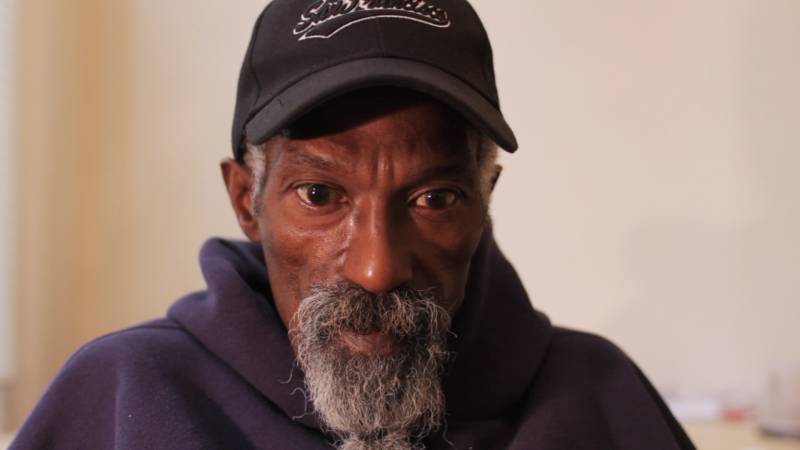
Francisco is pictured a the top if this interview. The other image is a still from Moses.

