






French producer Jacques Bidou, in collaboration with Marianne Dumoulin, has helped to catapult a vast array of dazzling filmmakers onto the spotlight: Raoul Peck, Patricio Guzman, Annemarie Jacir, Tsai Ming-Liang, Alice Rohrwacher, Rithy Panh, amongst others. In total, he has worked on 42 fiction features and 72 documentaries from 25 directors, including 21 Cannes selections.
In the brand new book Once Upon A Time In Production, he shares years of experiences, anecdotes, with useful tips and recommendations. He structures the book around the production of Massoud’s Bakhshi’s Yalda, a Night for Forgiveness, which won the Sundance Grand Prix Award three years ago. It included negotiating with 19 funding sources, grappl;ing with both Iran’s censorship and Trump’s sanctions.
Below is an excerpt of the book carefully and exclusively selected for our readers!
UK readers can purchase the book by clicking here, while US readers should use this link.
…
.
1987: South African Chronicles
We have to make clear choices that deeply reflect our aims and convictions. Building an identity takes time. A film takes between four and five years, and it takes a few films to get established. Ours materialised quite quickly. JBA Production’s very first film, in 1987, South African Chronicles, summed up the essence of our quest. Young South African filmmakers immersed in the different communities, translating the cruelty and violence of a system, an insider’s eye, a documentary. We intervened in a situation of urgency, producing the country’s young filmmakers (almost half of our productions have been first films), allowing time to research, to learn, time to shoot, to edit. It was around these choices that the team comes together, prepared to stand up for this kind of approach. At the time we were privileged to meet magnificent creative commissioning editors from the channels: Arte (then called “La Sept”), ZDF in Germany, Channel 4 in the United Kingdom, and a few others in Italy, Spain, Finland and the Netherlands.
To be clear: political and social agendas, urgent contexts, always told from the inside, with a fundamental principle, content, high stakes, inevitably, but also strong authored screenplays. We were definitively turning the page on “militant” cinema as we had known it, which had taught us the limitations of achieving what we wished to say at the expense of distinctive, cinematographic writing and without total engagement from the filmmaker, without addressing the essential question of the relationship between the filmmaker and the history he or she is addressing. The environment I’ve described above had shifted by the end of the century. What revolutionised the field of documentary in the days of the “Arte-ZDF-Channel 4” gang (the Garrel, Stein and Fountain era, to name but a few) was very specifically the decision to bring films to the viewer, to feed the desire for films and to provide the means for them to exist, to privilege the authors, to drive creativity within economic constraints, and to do so by entrusting this role to independents who clearly shared this goal. We were part of it and had the chance to accompany the directors: a golden age.
And our reward is within reach, a new generation of creators, strong works and the success of the genre on air. Ambitious documentaries, non-standard lengths and formats that are up against the grid of the mainstream.A group of inventors who influence the entire landscape of cinematographic and audio-visual creation: Channel 4 shakes up the BBC, Arte shifts the boundaries of France 3, France 5 emerges, ZDF reinvents young German cinema. Foreign channels support the movement: Rai 3, TSR, which has a more journalistic tradition diversifies its commitments, Yle in Finland takes part in almost all ventures, and many others. The influence of what is in part the appearance of a second-generation in television shakes a whole landscape that has become increasingly formulaic, caught up in large integrated companies. Since it does not favour creativity, it is destroying the areas of inventiveness and freedom that used to exist, such as the great BBC and ORTF (no nostalgia), where creators performed miracles. Another era.
And this movement stealthily changes the game. The success of these works run up against schedules which progressively stifle the exceptional. The same question rears its head again: how to safeguard the audience that has been won? The guardians of these schedules, their ratings in hand, become those who know what the public wants, what they need to see and hear, and everything is reversed. A documentary commissioning editor decides that it is vital to make a series about love at the age of twenty. He contacts a producer who is only too happy to receive this great suggestion, and the producer calls an author, who is totally involved in other things but is not going to object given the chance of getting paid work. We are no longer anchored to an author’s deep-rooted desire to bring his/her work to an audience. Instead, he/she is asked to reappropriate a story that is not his/her own and respond to the thoughts of someone who has the means to produce and who ‘knows’ what the audience wants. The first years of this century were marked by this shift, admittedly more subtle and gradual than described here, and unsurprisingly the genre was impoverished to make way for accessible norms that were easy-to-read. Raymond Chandler wrote in a letter to Charles Morton.

in 1950, primarily referring to television, “There you are, watching the bubbles of the primeval ooze. You don’t have to concentrate…You don’t miss your brain because you don’t need it. Your heart and liver and lungs continue to function normally… You are in the poor man’s nirvana.”* An unanticipated exercise in amnesia. What caused the original success is simply forgotten: a strong renaissance of creativity, especially in documentary, foundational genre for the whole of cinema.
…
.
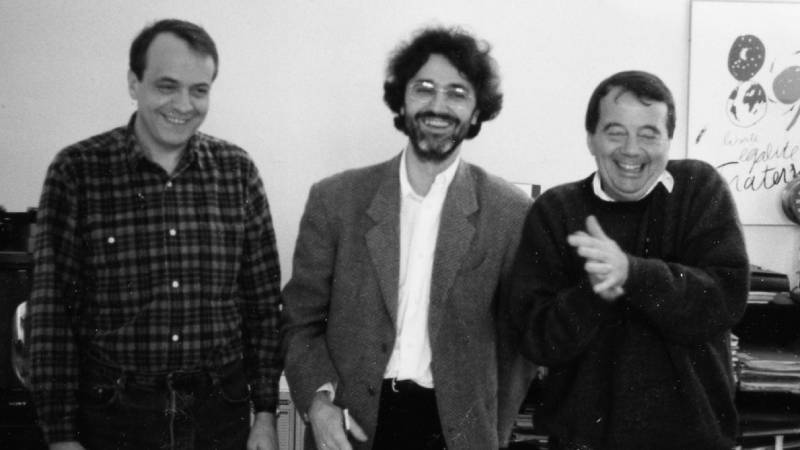
The brigade of militant cinema is pictured in its early years above, while Alan Fountain (Channel 4), Thierry Garrel (Arte), Eckhart Stein (ZDF) are picture in the middle. The last image is of Jacques Bidou (right) plotting with Pascal Bonitzer (left) and Raoul Peck, two masters of cinema, for a film which never finally gets made. English translation by Holly Aylett. Once Upon A Time In Production is published bu Sticking Place Books.
© Jacques Bidou, Translation © Holly Aylett


