






Xinhao “Violet” Lu is an Asian writer and director based in LA. Since 2020, he has directed 13 short films and miniseries for television. His dark comedy Red Man won Best Experimental film at the 2023 LA Shorts International Film Festival. His latest short film After That – in which an eponymous character living in the future memorialises his past and then disappears – premiered in the Slamdance Film Festival.
…
.
Paul Risker – What was it that compelled you to tell the story in After That and why now?
Xinhao Lu – The whole journey started from a talk between me and Mufeng, our cinematographer and the co-director of our film, we are both from China. There was one time we talked about our experiences during the pandemic. At that time, because the pandemic was extremely serious and unpredictable, we had a deep anxiety and fear that we might have no chance to go back our homeland for our whole lives.
And later, even the pandemic was over, but the geopolitical tensions gradually became unstable. Our anxiety and fear turned of the pandemic turned to war. So we had a discussion about WW3, which could happen in any time. During the discussion, I imagined what would be like everyone leaves the planet and I’m the only one left in the city? And How would I feel if that really happen? Following all the discussions and my imaginations, I wrote this film.
The time is now because we have never been so close to WW3. It’s coming nearer step by step, which is an undeniable fact. And we see a lot of signs that the order of old world is gradually collapsing. Our fear and anxiety about the present have also reached the highest peak.
PR – How did you seek to weave dreams and feelings into the film?
XL – I think I already knew the tone and what kind of emotion I should express through the film when I had this concept of the story. So when I was writing the script, the feelings came out naturally. According to the dream, that’s the end of the story. The inspiration was from one of my anxious dream. I think it was really suitable for the way the character’s leaving. But when I was filming, I intentionally make the scene really peaceful instead of anxious. Because I was imagining if the world would become like that, a total disappointment, the leaving for the character feels more like a relief.
PR – Are there any films or filmmakers that were an influence or you watched during the making of the film?
XL – One film is called When I Look at You, by Shuli Huang [2022], made to me the charms of Super 8mm film and indirectly influenced us to decide to use this format. Besides this film, there were really no other references. Because I actually tried to avoid to be influenced by other films. I really want to create something hard to be categorized, but at least is original.
PR – The film led me to think about how the possibility of WW3 has been a shared fear for more than half a century. On some level, After That appears to contemplate whether human kind can resist the “death drive” or foolish to propel ourselves towards our own self-destruction. Please comment?
XL – I think for the war for sure human-being are pushing it to happen, whether intentionally or not. Because the core of humanity is greedy. But resisting the “death drive” is also the distinct of humanity. So this is actually a conflict but a circle. In the history, it’s like that. And in the future, it will be the same. So to be honest, I think this process is meaningless and absurd. So in my film, the leaving for “the future me” is like a relief. Cause after seeing all of these, I think he will be completely disappointed. So nothing matters for the character anymore.
PR – Is After That a political film, and more broadly, is all art political? And is there a demand on art to become more politically minded or does our present day change the way art should define itself?
XL – I think honestly, if you live in a society, almost everything, including art for sure, is influenced by politics, on purpose or not. Because no matter how we try to keep the purity of art, us, as human living in this world, is always effected by politics. But for me there are two kinds of films, one is conveying the political opinions, the other one is effected by politics. I think After That is the second one.
I think the political demand on art hasn’t changed at all. Cause “art” is just a word to define the work of human-being’s thoughts. There is always political artwork and non-political one. So for me, how art should be existed is not matter. Just express whatever you want to express.
PR – Tchaikovsky’s Symphony number 6 is an emotionally stirring piece, and would I be correct to say this was deliberately chosen for specific reasons that connect film and symphony, you and Tchaikovsky?
XL – I heard about his work long time ago. But our editor is actually the one who brought up this much. I simply just feel this melody is so nostalgic and full with hope. But it also contains a sense of sadness and relief. So when I was imagining the dancing sequence, I just naturally put it in that scene.
PR – Does the way we can splice through time in your film and cinema more broadly, exploring past and present, make cinema a time travelling machine?
XL – This is exactly what I want to do. But the time travel in my film is a bit beyond the living experience. Because even though it’s the future story, all the constructions are modern. I want to use this surreal way to reconstruct the reality. To make people feel familiar but strange, to hopefully make the audience think of presence again.
PR – The use of Super 8mm film makes After That visually distinctive. What was your thought process behind using this old video format?
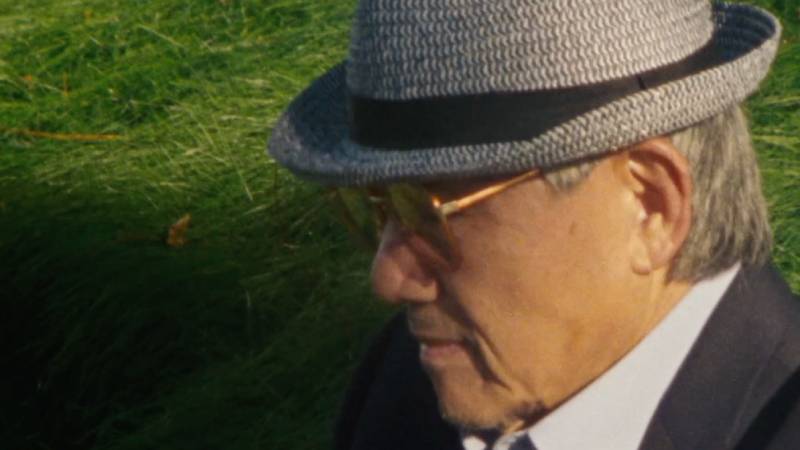
XL – I want to make a film like a “video diary” instead of a traditional narrative. For me, the best format for presenting a “video diary” is Super 8mm film. The reason is that it can present a feeling of intimacy and a non-cinematic texture. It’s more rough, which is without the precision of polished “movie”. And another reason is, I think this texture is timeless. Though it was from the past, but for me the feeling it can present doesn’t belong past, instead a sense of surreal. It blurs the sense of time and makes the audience hard to recognise the story is about past, presence or future? That’s exactly what I want. I also want to convey a feeling that the story is about now, past and future. So Super 8mm is the perfect format for this story.
PR – One of the other striking aspects is we never hear the character speak; we only hear the narrator. This creates a contradictory intimacy and distance with the character. How does this influence the audience’s experience of the film?
XL – This is a great question, thank you for asking it! I think using only voice over is a way to build a sense of extremely loneliness. It feels everything he said happens in his mind. I think this could build up the loneliness and alienation in that world. In this film, I used the second-person perspective as the voice over lines. For me, it’s a talk with the character himself, but also with the audience. I feel this perspective could make the audience imagine what if they were this character subconsciously. It’s pretty common in the literature but not in film, so I want to give a try. I’m trying to break the subconscious wall of the big screen, to have a talk with the audience. So I want to use this way to create some distances from the character and the audience, also hopefully make the audience think themselves, how they will feel. It;s a risk and a small experiment I wanna try.
PR – If we are aware that we’re living our own story, could the narrator and the character be one and the same?
XL – Exactly. This is one of the reasons that I wanna use the second-person perspective way to narrate the story.
PR – What were the main learning lessons from After That?
XL – I learned the process of making film in films. This is a beautiful process, and it taught me the beauty of being patient. If I have another chance, I would definitely choose to make films by films.
…
.
Xinhao Lu is pictured at the top of this interview. The other image is a still from After That.
