






Artima Sakulkoo is a queer Thai filmmaker based in New York. She earned a BFA in Digital Cinema Arts in 2016. She has since worked both in the United States and Thailand as a director, producer and assistant director.
Her third creation It Happened in August premiered at Reeling: the Chicago LGBTQ+ Film Festival in 2024. It has since earned a Best Director nomination in the LGBTQ+ category at the Bafta Student Awards. This dirty gem of a queer tale tells the story of immigrant in New York grappling with grief, and an inconvenient ex.
…
.
Eoghan Lyng –What is the genesis of Happened in August? When did that happen?
Artima Sakulkoo – It Happened in August came from a pause in my life when I was confronting the loss of my mother and a deep creative burnout. In late 2020, I moved back to Thailand, holding onto the belief that once my mother recovered, I would return to New York and continue pursuing my dreams. When that future never came, I felt completely untethered. During that same period, I was discovering my queerness while actively grieving, and many of those memories unfolded over that year. Including moments in August that stayed with me. The emotions accumulated quietly: love, loss, and longing layered on top of one another. Eventually, it became clear that the only way to move forward was to give those unresolved feelings a form, and that impulse became the foundation of the film.
EL – What Happened in August deals with suppressed love and memory. Please comment.
AS – I’m a hopeless romantic at my core, which is why memory became such a central theme in the film. Memories are something we all share as humans. They hold the love we couldn’t express and the moments we didn’t know how to name at the time. Growing up, I rarely saw what real queerness looked like, either on screen or in my own life, and that absence made love feel distant or quietly buried. In It Happened in August, memory becomes the place where those suppressed feelings live. Love doesn’t disappear when it isn’t acted on, it stays with us, reshaped by time and longing. The film explores how memory allows love to exist even when it was never fully lived or spoken out loud.
EL – Much of the tale centres around Thai-American relations. What are the main challenges in understanding each other’s culture?
AS – As a Thai person growing up alongside American and Western culture, I’ve experienced clear differences in how emotions are expressed. In Thai culture, care is often shown through responsibility and sacrifice rather than direct language. In American culture, emotions are encouraged to be named and spoken out loud. Neither approach is wrong, and I believe the common ground lies somewhere in between. In the film, these differences appear in quiet moments. When Arrow says, “I miss her,” Aim pauses, avoids eye contact, and responds, “I miss her too.” In Thai culture, that exchange is a significant emotional expression. A sister and brother sharing grief and connection in a restrained, grounded way. The film isn’t about choosing one culture over another, but about understanding that love can be felt deeply even when it’s expressed quietly.
EL – Colour fleshes out the world of the film. Did you set out to make this a deeply immersive, kaleidoscopic experience for the audience?
AS – I also coloured the film myself, because I believe colour and tone are essential parts of filmmaking and speak directly to a director’s voice. Each character was built around a specific colour palette that reflects their inner world. Aim carries yellow, warm and joyful, but layered with grief. Sandra is holds blue, calm on the surface, yet quietly mysterious. Arrow holds green and red, symbolising grounding and love, as he carries the family’s memories and keeps Aim connected to her roots. When these elements come together, the film becomes immersive without feeling overwhelming. My intention was never to make the color feel loud or distracting, but to let it guide the audience gently and allow emotion and memory to surface naturally.
EL – You play one of the erstwhile lovers. Why did you make that decision?
AS – Playing Aim wasn’t my first choice. I began acting in high school and was never professionally trained, so returning to acting felt intimidating. When I started casting It Happened in August, I posted on Backstage for the role of Aim, a Thai queer lead, and quickly realised how difficult it was to find authentic representation. Because the story came from such a personal place, I eventually decided to take the risk and play her myself. I was nervous stepping back in front of the camera, but my producers and colleagues encouraged me and supported the decision. Pinch myself by saying this, but it became one of the most meaningful choices I made for the film and unexpectedly opened new doors in my creative journey.
EL – Did you utilise an intimacy coordinator?
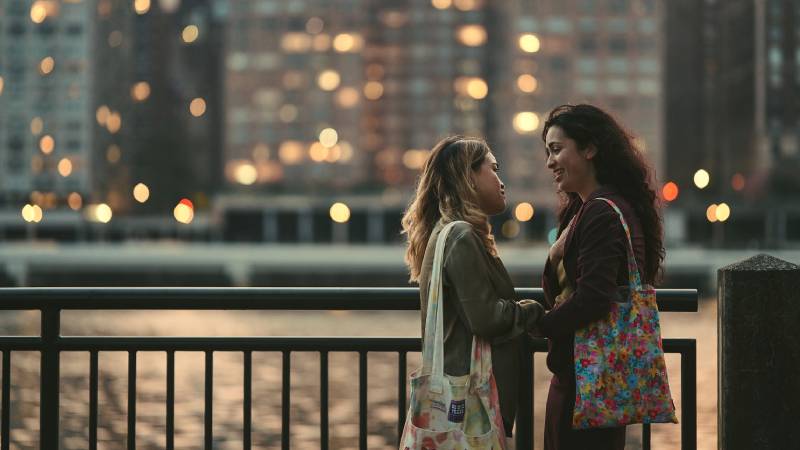
AS – We did not use an intimacy coordinator, as the film does not include explicit or physically intense intimacy. The relationship between Aim and Sandra is expressed through subtle gestures, emotional proximity, and quiet moments rather than overt physicality. Before filming, Linsy and I spent time building trust and establishing clear communication as collaborators, which helped create a comfortable and respectful environment on set. Our focus was on emotional honesty and allowing intimacy to emerge naturally through performance.
EL – The tenderness of your film recalls Blue is the Warmest Colour (Abdellatif Kechiche, 2013). Did that movie leave an imprint on this work, and if not, what were the aesthetic inspirations?
AS – Although Blue Is the Warmest Colour is often referenced when discussing tenderness between women, it was not a direct influence on It Happened in August. For themes of memory and the feeling of missing home, I was inspired by Girlhattan (2017), directed by Baz Poonpiriya. The intimacy between Aim and Sandra draws more from performances than spectacle, influenced by my longtime inspirations Sarah Paulson and Cynthia Nixon in Ratched, whose work reflects a form of queer representation that feels grounded and truthful. Films such as Saving Face (2004), Frances Ha (2012), and Past Lives (2023) also shaped the emotional tone of the film. Ultimately, my strongest inspiration came from personal history, allowing tenderness to emerge in its own time.
EL – One of the characters is an acting coach. As an actor yourself, should performances be guided by classes or by intuition?
AS – Both. Training and intuition work best when they support each other. Classes are essential, especially for actors in the early stages of their careers or for those who may not have direct access to the industry. Technique gives actors a foundation, discipline, and a shared language on set. I also believe we are all students of the world, and taking acting seriously means continuing to learn, not just actors, but directors and crew as well. To direct actors well, you need to understand what it feels like to be in their position. At the same time, the most honest performances come from intuition. When an actor stops trying to “perform” and allows themselves to simply be present, the work becomes believable.
EL – Was it important for this to be an LGBT+ tale of mixed race love?
AS – I’m a queer Thai filmmaker, and it’s important to me to make films for people like me, for communities that have rarely seen themselves reflected with care and complexity. I come from a minority background that has often been overlooked, and I believe visibility should feel as natural and human as any other love story. At the same time, I resist being boxed into labels, because many queer people have spent their lives being defined by them rather than understood. Love between two women should be allowed the same tenderness, openness, and emotional range that exists so freely within a heteronormative world. At its core, the film is about connection, something we all long for, regardless of identity.
EL – Do you think that Thai audiences will relate to the film differently to Europeans?
AS – Yes, I believe different audiences may connect with the film in different ways. Thai immigrants, in particular, may find the story especially relatable, as the film was created with immigrant experiences in mind. Many immigrants share a deep understanding of responsibility, sacrifice, and emotional restraint, regardless of where they come from. Thai audiences may connect to the indirect expressions of love and grief, as those emotional languages are familiar. European audiences may engage more through observation, meeting the film from a different cultural distance. What matters most to me is that the film leaves room for audiences to connect in their own way.
EL – What’s next for you?
AS – I’m currently writing and developing a TV pilot series titled Queer Talk. The show follows three struggling artists as they navigate ambition, heartbreak, and the realities of New York City life, all while desperately searching for the perfect sublet in their four-bedroom Brooklyn apartment. Alongside developing the series, I continue to direct and work as an assistant director on projects that challenge me and allow me to grow creatively.
…
.
Artima Sakulkoo is pictured at the top of this interview. The other image is a still from It Happened in August.


