






Austėja Urbaitė is a Lithuanian film director. Born in 1991, she grew up near the Baltic nation’s Vilnius. She studied Film Direction at the Lithuanian Academy of Music and Theatre. Austeja’s debut feature Remember to Blink is “a multilayered and clever psychodrama packed with an explosion of emotions”. It premiered at the 26th Tallinn Black Nights Film Festival (click here in order to read our review of the film, written back then).
Remember to Blink has been selected to the 10th edition of the ArteKino online film festival, and it is available to stream for free during the entire month of December 2025.
Click here in order to watch Remember to Blink now.
…
.
Joshua Polanski – Please tell us about the genesis of Remember to Blink?
Austeja Urbaitė – This movie is a hybrid of stories experienced by me, told by others and imagined. I have worked with kids my whole life and my first encounters with kids in the orphanages as well witnessing of adoption stories woke me up to a wider view of life, meaning of family and child identity.
JP – Language and renaming play a key part in the power dynamics of adoption as depicted in Remember to Blink - a system that is far from the rosy-lensed narrative of salvation that is often depicted in more happy and simple studio films like The Blind Side [John Lee Hancock, 2010]. Is adoption a subject matter close to home? How did it end up inside your circle of compassion?
AU – Sometimes the right thing to do (the salvation) can feel really wrong to us (our personal experience/view of life). In reality we indulge so easily every situation, often without stopping to question our personal perspectives. I call this emotional blindness (hence the title). I have spend few ears working as a theatre facilitator in an orphanage and I have been much influenced by these children. Some of them had adoptive families in Italy, that they would visit during summers. They also had friends already adopted there sending them letters about their lives, joy and sadness.
In my group, I had a girl who had a family waiting for her there, but her drunken father didn’t sign off the permission to let her go to that new life. The difficulty that arrives with the international adoption, the question of identity kept me thinking. I have witnessed international adoption in first months and saw that language and words are not the most important thing. I had witnessed mothers uncomfortable to touch, and I had hard time understanding how can this be love or how can a child survive this kind of love. Most of all I started feeling the difference between a child that is being seen and a child that is objectified as a means to complete something lacking in the grown up person. The main question that kept me going and digging deeper was: why do people adopt at all? Why do we give birth to the children? And are we aware when our own needs are bigger than theirs.
JP – Why are the couple French? How did you decide this?
AU – I chose France as I believed I would be capable of creating an authentic enough view of it and portray both countries in as much equality as possible. As I have traveled and lived in France for a bit with various different local people, I have worked for French people in Lithuania running a film festival, I speak the language well enough to be able to allow the actors to improvise and to keep track of the underlying shifts. I have a deep love for French culture, language and art. I met wonderfully warm people as well as I know what it feels to be looked down on. So being able to do as much justice as possible and to show the home and the couple from authentic perspective rather than imagined one from books or other movies was very important. This made the story feel real.
JP – How was the film received in Lithuania? Was it any different in France?
AU – The movie was awarded with Silver Cranes for Best Film, Best Director and Best Sound in 2023 national awards in Lithuania. We have received much warmth and people really seemed to feel it and admire the open view and ambiguity it breathes.
ArteKino will be the first broad distribution for the movie in France. So I can’t wait to hear the reactions from a wider audience. We had couple screenings in Paris and French guests watching the film in Lithuania – and I would say that no matter the nation people can feel the underlying unifieng questions of parenthood, egotism and identity.
JP – The Gorgon/Medusa is mentioned a few times. Was this analogy part of the original concept?
AU – The Gorgon came to me from a book by François Mauriac. Le Sagouin, which I read many many years ago. It’s written in such a great way that reading about a “horrible woman” you can understand her and feel for her even if you can’t justify her actions. The woman was called a Gorgon on one page. I read the myth again and felt a sense of connection between the character, how we see it and my script. The monstrosity from the outer perspective that is hiding a deep pain inside. And that’s also why Leon (the father character) is portraying the Gorgon from a completely different angle, to sort us make us question. The movie for me is much about the perspective and how we judge good and evil within ourselves and others.
JP – The children are great. Can you tell me about the process of casting these actors?
AU – These kids were a miracle gift to us. The casting took many months, I had the young and great actress Greta Petrovskytė look for them and then improvise with them during the casting sessions. I didn’t trust casting agencies. She met about 400 kids and I chose to meet 30 that I saw potential in the tapes. Inesa and Ajus appeared almost at the same time in the end, just when we were thinking we will never find them. And so it happened. We sort of knew instantly and there were no questions. We spend around three months meeting once a week learning to be here and now, to improvise, to listen, slowly telling the story, creating our words and playing out scenes. I never gave them the script. There are many wonderful details in the movie that are created completely by them being their characters.
JP – What was the hardest aspect of production? And what was it that made it challenging?
AU – I really wished to shoot this movie in France in real environments, nature, mountains and the ocean. To have these kids for the first time see a completely new magical world different from Lithuania and to have these little people (the grown ups) with their drama and big egos in contrast with this vast powerful nature. But the most difficult thing was trying to get the funding in France – and we never did. It took many years and we ended up having to creat France in Lithuania.
Now that we managed to do it and to make it believable I am really proud of our team and myself. So many people think we actually went to France to make it, where in reality the house is surrounded by other houses, a school, a village and a street on one side. I guess the difficulty in getting funding was being a debut director, unable to prove that I know what I am doing, I had no other feature films to show that what I will do with the actors between the lines is not near to what you see on the pages filled with letters. I crossed my paths with Leos Carax once on my way out from the fund hearing, so you know, tough competition. (P.S. I love him anyway!).
JP – I recently saw Gabrielė Urbonaitė’s Renovation and was pleasantly surprised to see her name as the editor of Remember to Blink. What was it like working with Urbonaitė? I don’t believe you two had worked together before?
AU – This was my first feature film and Gabriele’s first editing of a feature film. So we worked together, sometimes even editing different sequences at the same time and then exchanging them and polishing each other’s sequences. She is extremely open, versatile, sensitive, great sense of rhythm and as she is a director herself. So she has a great sense of acting and picking takes. She was very patient to my way of “rewriting in the editing”, as the improvisation on set changed the accents that were made in the script. I would do it again and I really hope she would, too. I can’t wait to see her film Renovation, feels like family in a way.
JP – What’s one thing you learned on this project that you hope to bring into your next project?
AU – To pick my battles and to let go more. Touché!
JP – Speaking of upcoming projects, do you have anything in the works?
AU – I am slowly writing and re-writing. As I picked up a masters degree studies in Drama Therapy my creative life slowed down a lot. On the other hand – it’s all connected as I feel most driven creatively by emotion and the relativity of people’s minds. So let’s say I am on a journey of research.
…
.
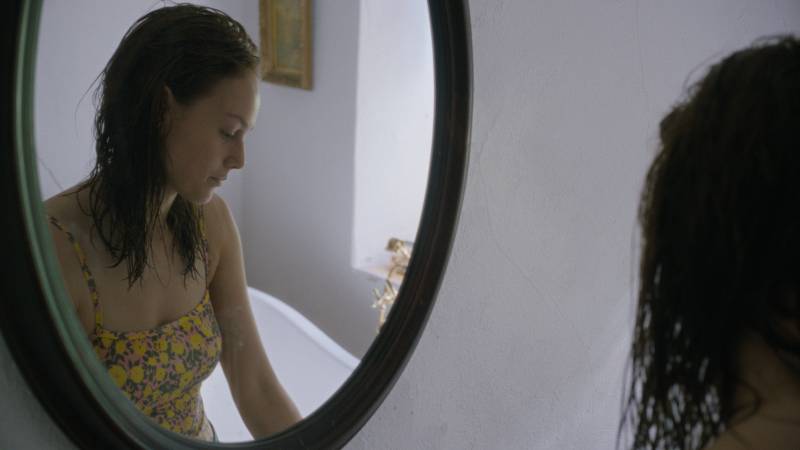
Austeja Urbaitė is pictured at the top of this interview. The other image is a still from Remember to Blink.


