






Irvine Welsh has an impressive library of books that he’s written himself. Two of them, Trainspotting and Filth, were adapted into motion picture stories, so it seems fitting that Welsh is now starring in his own documentary: Irvine Welsh: Reality Is Not Enough. DMovies journalist Eoghan Lyng caught up with Welsh and director Paul Sng in order to discuss the film, which premiered on August 20th at the Edinburgh International Film Festival, and is out in cinemas on Friday, September 26th.
…
.
Eoghan Lyng – So are you promoting this film at the Edinburgh Film Festival?
Paul Sng – Yeah, yeah, we’re closing, aren’t we? Closing Gala film tomorrow night, and then the theatrical release is at the end of September.
EL – What drew you both to this project?
PS – Well, I mean, I’ve been pals with Irvine for a while and I asked him one night if he’d ever thought about doing a documentary, obviously fishing, to direct it, and then he was interested and we had a few chats about it. And I think we both wanted to make something that wasn’t your standard talking head film, something that would be cinematic, something that would explore whoever it is through his work. The film is thematic: we’re looking to these questions about mortality and love and creativity, the place where you come from, how it influences you. But also, not wanting to make something that was about the past, about how these things also, they are in Irving’s life in the present day. So that was 2022, and yeah, three years later, here we are.
EL – Irvine, did you enjoy the format?
Irvine Welsh – Yeah, very much. It wasn great.
It was a strange thing because you kind of pause around for about 18 months, didn’t you? And it was, but it didn’t, because we’re pals, it didn’t really feel intrusive. It just felt like, so I got out and chat and then you got, you soon got used to the idea that the camera guys, they were really good as well. And, you forgot that it was a kind of sort of boom mike in your head and there’s a camera following you and all that.
EL – How do you think the format of documentary has evolved; has Peter Jackson modernised it with his Beatle and army projects?
PS – Peter Jackson made a great documentary with the, it’s called Get Back, isn’t it? Or is it called Let It Be? I always get confused
IW – Get Back [The Beatles: Get Back, 2021].
PS – Yeah, I mean, I think, I don’t think he’s necessarily advanced the form compared to what other people were making documentaries were doing.I mean, I think when you look at the films that have been coming out over the last 10 years or so, there’s a lot of the influence of Asif Kapadia that I see a lot of times. And it’s this idea of getting away from talking heads and using archive. I obviously love documentary, but while I’m making a documentary, I tend not to watch other documentaries. I’m more interested in fiction films. And I think in terms of how we structured this, it has a similar structure to a fiction film. So you have an inciting incident at the beginning of the film when Irving takes DMT. You have a midpoint in the film where Irving has been interviewed by an Irish podcaster who is particularly confrontational, that can cause up to look inside himself a bit.
And then you have things throughout, you have story beats. And now story beats, rather than being linear, are thematic. So the novel readings that are in the film were chosen to represent the themes, so they’re about mortality, they’re about addiction, they’re about love. They’re about any of these kind of things that we’re looking at in the film. And it has that sort of structure that theme and Irvine move us forward rather than events, as it were.
EL – Who was that podcaster, and how did he confront you?
IW – He was just very rapid-fire with the questions. And we didn’t do ourselves any favours because we were all pretty pissed. We were going to concerts, we turned up pretty drunk. So he kind of capitalised on that a bit.But it was good because it made for good, made for quite dynamic.
PS – It was Michael Anthony. And there’s a bit of stuff in the film where you say something to him like: “Do you think you’re Jim Morrison or something?” Because he kind of has this appearance of the long hair and this kind of jagginess. I’ve watched some of his podcasts since and he’s not nearly as part of a presentation of everyone else. But as Irvine says, we were very late.
IW – We were very late, very drunk. So I think he kind of saw the opportunity and went for it. But he’s very good.
PS – He’s a good dude.
EL – Irvine, you publicly praised Sunlight, a movie we reviewed about one man’s recovery. What did you enjoy about it?
IW – Oh, right! No, I thought it was good. It was just very kind-of-sort-of naturalistic and real, basically. And yeah, I enjoyed that movie.
EL – As artists, do the two of you crave authenticity in films?
PS – Yeah, or the opposite. I think, when I look at a film, you want to feel something from it.And,, you want to not necessarily like the characters, but at least believe what you’re watching, to suspend your disbelief and feel that you’re watching something that happened to somebody. So I like films that are realistic; I like films that are completely off the scale. And that it’s a complete fantasy, but it’s just about whether it feels real and makes you feel something.
IW – I think the authenticity is in the world that they create. The film they create, you buy into that.Yeah. So it’s kind of like a fantasy or a sci-fi thing that can be authentic to that world that they’ve created. As long as it’s consistent, there’s a consistent vibe.
EL – How long did this project take from beginning to end; two years?
PS – Probably three. It wasn’t that the craft of making it took three years, but making an independent feature documentary, we do crazy things in documentaries like the Wild West. And most people that are sensible wait till they’ve got a budget and then go off and make a film.
Whereas we go, we’ve got a little bit of money here. We’ll start making something and then we’ll bring a bit more in and we’ll do this. And we got to the end credits and we still hadn’t closed finance, but we have now done that. And I’m glad that we did things that way. Because if we just waited for the money, it wouldn’t have happened. And I’ve very much of the school of thought that you don’t wait for permission to create, do what you can with what you’ve got. I mean, if it had come down to it, I’m glad it didn’t, but we would have paid this on a phone and it wouldn’t have been as good. But once I commit to something, I have to finish it. There’s no giving up on these things.
EL – I saw a documentary about Spike Lee discussing the hurdles he jumped to finance Malcolm X.
PS – I mean, when you’re in the middle of these things, you’re just determined. And my gauge to make anything is if I don’t do this, will I be heartbroken? And with this film and with any of the other films I’ve made or I’m making, if they didn’t come into the world, I would be heartbroken. Well, of course, you can get over a broken heart, but if in the process of making something, you think I wouldn’t be heartbroken, I would walk away.I mean, unless, of course, you’re doing it for money and that’s a completely valid thing if you were doing something for money if needed. But you go through tough times and you go through long, dark nights of the soul where what keeps you going is just your belief and your commitment to it and that it touches something in you and your team, you all connect to it. So, yeah, I knew we’d finish it.
EL – What was it like for you Irvine, considering your métier is that of an author?
IW – Yeah, I’ve been a bit shy about anything to do with biography because I think really the great thing about the image that people have had of me has been this kind of, this kind of ex-junkie guy for the housing schemes who’s kind of stumbled upon this ability to write like this kind of idiot-savant type thing. And I’ve kind of played up to that to an extent because it sticks a scarecrow in the field, where they can get around and then you can jump on with your other stuff. Whereas I think that it’s more exposing when you’re sort of showing your friends and family, close to friends and family in the relationships that you have with them because that’s really, that’s who you are to an extent in the grounded reality of your life.
So that was quite exposing and was also much more exposing to where the creativity comes from, that kind of, it’s very hard to do it dramatically but you’ve actually got to do it dramatically just through filming it in a clever way and through the cutaways and uses of the narratives and all that. But how you actually make a book, I think I’ve never really seen that in a writer’s documentary before, how you actually, so I mean, that’s one of the novel things about the documentary. It actually shows how writers write books, which sounds like a simple thing but it’s never been shown really.
PS – I mean, I think because you do so much outside of writing novels, whether it’s DJing, boxing, you were an easy person to form a story around, whereas there are some writers who would just write and that’s perfectly fine, that sort of thing but because you lead such a rich life of so many interests and things, it would be very difficult to make boring film.
EL – And you’ve done some acting, like your cameo in Trainspotting (Danny Boyle, 1996).
IW – Yeah, I mean, I was acting on Saturday in a film called Supply and Demand [Garry Fraser, 2023], it’s a three-part thing that a friend of mine, Gary Fraser, has done. Again, it’s like he’s done it on zero budget with rolling in favours and it’s quite an achievement for him, basically.
EL – Will your documentary do the festival circuit prior to a more mainstream release?
PS – The general release is from September 26th and so we’ll do festivals overseas, but we wanted to get it out quite quickly after the world premiere in Scotland and then it’ll be, I think, available on, later down the line for people to watch at home and that sort of thing, but looking forward to putting it in cinemas and taking it out to a wider audience and we were saying earlier that once you make something and you put out, it’s not yours anymore. And you let it go up into the world and that’s an enjoyable thing to do.
EL – Irvine, are you working on a book at the moment?
IW – Well, I’m kind of pulling together another book. I’m not quite sure whether it’s going to fly up, but I’ll see how it goes.
EL – Your writing style reminds me of Roddy Doyle’s; is that a fair comparison?
IW – Maybe a bit, I don’t know. I’m not sure. I’m not a big reader of these kinds of pressing features and stuff and all that,but I do know Roddy, he’s a great writer. I lived in Dublin for five years, so I got to know him there.
EL – Paul, are you working on another movie?
PS – Yeah, the next film that will probably come out is a film called Little Warrior, and that kind of came about because of Irvine, so Irvine introduced me to a guy called Gary Young, who’s a boxing trainer, ex-boxer, and Gary had formed this kind of online working relationship with a Venezuelan boxer called Joanna Gomez during Covid. So we made a short film about that, and it’s basically following Joanna’s story to escape poverty in Venezuela and qualify for the Olympics.
EL – How do you think Edinburgh has changed as a city over the years, culturally?
IW – Like everywhere else: tourists, students everywhere
PS – I’ve only been here for seven years. and what I’ve seen in it is just more and more gentrification because the world that Irvine writes about seems to be getting pushed out further and further from the city centre. But that, as Irvine says, happens everywhere all over the world.
EL – What do you hope audiences will learn from this documentary?
PS – That Irvine’s six foot two.
IW – Not a short arse! Yeah, I mean, it’s kind of being happily married in a stable relationship. It would be a good documentary for a single man.
PS – I think what you can hope, what the audience might take from it is to just do it, to just get out there. Whether it’s writing or playing music or painting, just go for it. Don’t wait for permission. That’s what you did. As a filmmaker, that’s what I did with my first film. I just went and did it.
I didn’t go to film school. I just went and did it. And I think it’s easy to say that, but I think certainly now in terms of mobile phones and cameras, you can make things much more cheaply. The democratisation of the internet as well means you can put things out. So, you don’t wait for permission. Do it.
EL – Tat’s quite a punk ethos!
PS – Well, I’m too young to be a punk. You were a punk, Irvine?
IW – Acid-house, but the same as punk really.
…
.
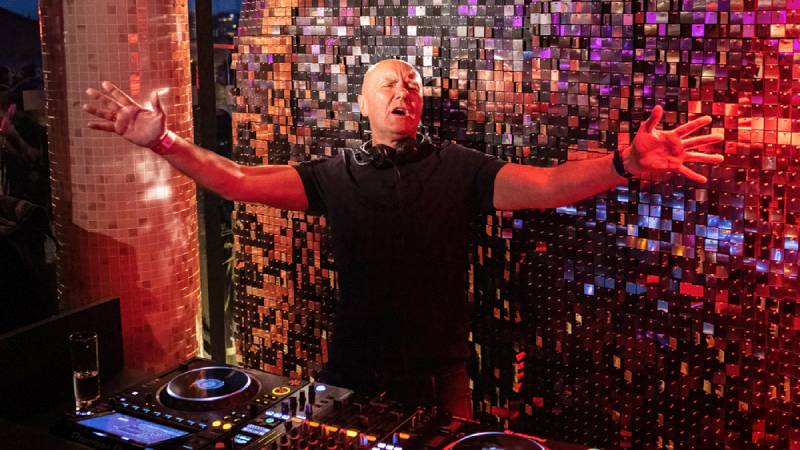
Irvine and Paul are pictured together at the top of this interviews. The second image is a still from Irvine Welsh: Reality Is Not Enough.


