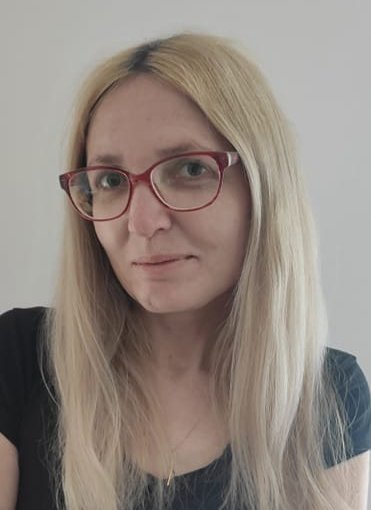







Carolyn and Andy are writers, directors, animators and co-founders of London Squared Productions. They’ve been creating films, music videos and animated content together for nearly three decades. Wife and husband shared the director’s chair for the first time in the short film 149th and Grand Concourse and then again in Our Crappy Town, both released in 2017. Their latest effort 1981 premiered at Sundance in January 2026. This deeply personal short film tells the story of “the birthday party from hell”, which left children “disturbed and traumatised”. Review to follow soon.
…
.
Nataliia Serebriakova – 1981 is based on a real teenage memory. What made you decide this story needed to be told now?
Andy London – It’s a coming-of-age story, but it’s also a conversation about our culture divide, the conflict between progressive and conservative values. And the year 1981, the beginning of the Reagan years ushers in these divisions.
Carolyn London – This story is time stamped in 1981, but it’s a way to examine timeless fears and anxieties around sex and lust and all the humiliations of growing up.
NS – How did revisiting that experience change your perspective on the adults involved?
AL – It was one of the first times I learned firsthand, some parents were checked out and clueless.
CL – They were coming off the ’60s and ’70s and some of them (like the adults in our film) felt like they had to be “groovy”. It wasn’t cool to have hang-ups about sex. You had to be free. Which of course, is not freedom at all.
NS – The film avoids clear moral judgment. Why was neutrality important to you?
AL – Being a parent is a shitshow. We’re all winging it, so I try not to pass judgement on other parents. Sixteen years ago, just before we had our son, I remember watching a mother scream at her child in a crowded train station. I was so horrified, I almost called 911. One year later, I saw another mother screaming at her child in the same train station in the same way and I completely got it. I was even tempted to join her.
CL – i think you have to be generous with your characters. They think they’re doing the right thing! And in their framework, they are. They’re just loving, flawed humans. You have to love all the people in your films, even the ones that are nuts.
NL – Music plays a key emotional role in the film. How did you use sound to shape memory and mood?
AL – For me, music is a time portal. When I play Judas Priest’s Hot Rockin’, it sends me to the early ’80s to the suburbs of Long Island. Specific music tracks not only inspire our films, they inform the stories like artifacts.
CL – We often start with music first before we even have a script. Something about finding the right track drops us right in and we know exactly the kind of film we’re making.
NS – Why was it important for the central music cue to repeat in different versions?
CL – To change the tone, to mark Douglas’s loss of innocence. The first time, it’s sensual and alluring. The second time, with Tommy James and the Shondells mono version, it feels poignant and haunting. Like waking up from a dream.
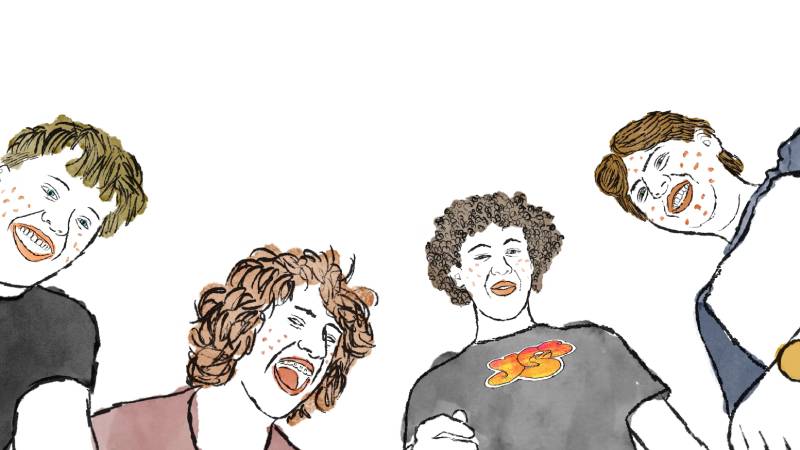
NS – Rotoscoping is often linked to realism. How did you adapt it to create a dreamlike tone?
AL – We did a lot of animation tests and experimented with an assortment of mediums. This included watercolour, brush and ink, markers, fountain pens, pastels, etc until we landed on that dream-like look.
NS – The animation feels deliberately rough and tactile. What does that texture add emotionally?
AL – We were going for something handmade and rough around the edges. We took a lot of inspiration from ’70s’ animation, film and television.
CL – We needed it to feel raw and vulnerable but also a bit punk.
NS – How did you balance dark humor with the film’s traumatic subject matter?
AL – I think that balancing dark humour and family trauma is our calling card. We’ve been poking fun at our demons in films for twenty five years. And with our son’s debut, it’s now a family tradition.
CL – You have to laugh. The things that come into our lives are so insane, that the only way to make sense of the absurdity is to laugh and hope we can make some connection through the laughter.
NS – Did casting your own son as Douglas affect how you approached the material?
AL – Absolutely. It felt like making a documentary. It started out superficial. We were making a film loosely based off my childhood experience and we needed to shoot some tests of a teenage boy and since we were living with one, we did those tests with him. But as the film progressed, we had to go a lot deeper and admittedly I did worry we would traumatise him. Regardless, I think he benefitted from the experience. He learned how to act and take direction.
CL – He ended up getting very invested in the character and very meticulous with his performance. I think he went from “stop it, mom and dad!” to “i want to do this right.”
NS – Which details of the early 1980s were essential for grounding the story?
AL – The outfits and the the music. I was part of a tribe. We all wore Levi’s jeans, sported mullets and most importantly, listened exclusively to heavy metal. If we were caught listening to anything else, we were shunned.
NS – The film reflects how memory loops and distorts over time. How did that idea shape the structure?
AL – We tried not to spell anything out. We wanted the scenes to wash over you and leave a ghostlike impression. A lot of the backgrounds are left empty, allowing conjured memories to breathe freely.
NS – After working together for over 20 years, how has your collaboration evolved on a film this personal?
AL – We’ve learned to put our egos aside in order to make something bigger than ourselves. Our collaboration is a lot about trust. Though sometimes we’ll have our disputes, we trust each other’s vision and we share each other’s taste.
CL – It’s weirdly never personal between us. As parents and married people – that’s personal. But as filmmakers it’s very not-personal for us. It’s impossible for us to have hurt feelings when we’re working together. We just say what we need to say and do what needs to be done in service of the film.
…
.
Carolyn and Andy are pictured at the top of this interview. The other image is a still from 1981.