







Eight years after her debut feature, Dark Blue Girl (2017), German director Mascha Schilinski announces herself as a distinct and powerful voice in world cinema with her sophomore feature Sound of Falling (which premiered in Cannes last May). DMovies editor Victor Fraga described the film as an “astounding” work that offers “an extremely complex and multilayered exploration of our humanity, never afraid to tread the darkest corners of our existence”.
The story spans three different eras, following the lives of three different families who leave their imprint on a German farmhouse. The first story is set in the 19th century, the second during the German Democratic Republic in post-WW2, and the third story is set in present-day Germany.
Before Dark Blue Girl, Schilinski directed the short film Die Katz (2015), about a complicated mother and daughter relationship. All of her films have revolved around the subject of interpersonal family dynamics, exploring dependency in Die Katz, a daughter’s mischievous games to keep her parents apart in her feature debut, and the ambitious Sound of Falling, that leaves us with more questions than answers.
Sound of Falling is out in cinemas on Friday, March 6th.
…
.
Paul Risker – Sound of Falling is a film that’s never complete in your mind. Instead, it’s a film that requires you to think about what you have seen or experienced.
Mascha Schilinski – The film is about memory itself and how memory and imagination flow into each other. And this is a film where you can have your own in mind, parallel to the one you are watching.
The images that you see in the film are meaningful, but the images that you don’t see are even more important. There are so many black boxes where you can just feel something happening, and you have to build this in your own mind, in your own imagination. What could be in these black boxes or in these in-between ellipses?
I think this is why it could take a while to take this film in, because it’s confronting people with uncomfortable feelings of their own identity or their own past. And it’s also about things that we are repressing in order to survive.
PR – This speaks to the power of art to transform and communicate on a deep level. Is it important to consider your audience?
MS – When I start a project I never ask myself who it is for. I have such a longing to see something from other directors’ films that are really coming from their gut, where they have something to tell me about some experience and inner perspective that’s so specific that I can rely on. This is because I am going to enter a new world that I didn’t know before.
But what I love about art, and cinema especially, is when you don’t expect anything and when you come out, you find you feel a little bit less alone – you see yourself represented onscreen.
PR – Cinema is a narrative medium, but narrative is not its only consideration. The cinematic medium can effectively appropriate aspects of the other art forms to interrogate what cinema is and what it can be. However, it can feel as though the medium has been streamlined to its detriment.
MS – I love that there are so many ways to make a film, but every story has to find its own form. And yes, sometimes it feels like we are stuck in a dead end, where there’s a specific way we should make a film or tell a story. I had so many people during the making of Sound of Falling telling me, “Oh, no, this is not how you should do this. There’s no main character at all. Where’s your plot? Where’s the structure?”
I graduated from film school with a screenplay and I almost failed. I got the worst grade because they didn’t think this was what a screenplay should be.
We are such a young art form in comparison to the other arts. And at the beginning we adjusted to find out how we can tell stories and how narratives work in different ways. So, I love the type of cinema where you’ll see something that you’ve never seen before, but at the same time, it is very familiar because it’s almost like a collective language of imagery that you’re confronted with.
PR – The opening shot of Erika on the crutches followed by how the first scene plays out, strikes me as being important in that they introduce certain ideas. It tells the audience to not take anything at face value, and Erika’s curiosity is a cue for the audience to engage their own curiosity.
MS – This was the first scene that I had in mind, and I wrote when working on the screenplay, but it was not originally the first scene in the film. And so, it’s very special that, during the editing process, it once again became the first scene, because it was the first one that I had in mind and from there I developed the rest of the screenplay. It was the breakthrough moment because before, it was like I couldn’t plot. Then every image bubbled up and we just wrote them down.
This wasn’t an active cognitive process or an active discussion. It was literally that imagery came almost like in a dream where I just saw it happening and then wrote it down. And that’s how it came together. Then it became this important metaphor for the whole film – this phantom pain, which is something that you don’t know about or where it’s coming from, but it’s still present.
The theme of imitation is so strong in Sound of Falling. When I spend time with people, I immediately adopt their accent. It’s nothing that I’m doing actively, it just happens, and it can be so hard to get out of it. I remember when I was a kid, I’d come back from school and my parents would say, “Oh, you spent the whole time with Laura… Please now be Mascha again“. And I was like, “But how? I don’t know”.
What I wanted to explore in this film was that all these characters have this longing to be here in this world, where, for once, nothing came before them, nothing was preconceived, it was just them. It’s about this longing to experience yourself and the world without any concepts. Instead, you can just feel who you are, and nobody asks, “Are you a human being?” Or says, “This is a river… this is a chair” and so on.
PR – Sound of Falling respects memory and time, not in the way that human beings perceive them as linear and complete, but for the fluidity, imperfections and incompleteness.
MS – I’m fascinated by how human beings are constructed, especially our capacity for imagination. There is a key sentence in the film when Angelica tells us that the villagers always say that a person is what they do. She strongly believes that a person is not what they do, but where they are in their mind when they’re doing something. To her, that’s more accurately who a person is, and so, the internal thoughts or feelings and the external actions are not necessarily always in exact alignment. Sometimes they are the opposite, because our survival instincts can hide what is actually inside us, when it is best that they’re hidden. And so, we can be the complete opposite of who we are in our outer persona.
I wanted to explore that idea in this film, where we are all prisoners in our bodies, looking through our subjective gaze. So, everything that we are looking at is filtered through our own story, and I sometimes find this is unfair because someone will be looking at you and projecting onto you from their own biography. But you have nothing to do with this, and so you will never be truly seen for who you are from someone else’s perspective. Basically, there’s a certain way we want to be seen or there’s a way we think we should be seen. And then, there’s the way we are seen. These don’t always line up, and so, sometimes we want to be invisible and not to be seen like that. But we have to be seen to exist, because we exist with other people.
I also know that when, for example, we are speaking, and I look at you, I’m a prisoner in my own body. I look through my eyes at you, but later, when I remember this moment, then suddenly I can see myself from an outer perspective. Maybe I can see myself sitting in this hotel room on the sofa. And then there is a picture in my mind that actually never happened, but that shapes my identity as well.
PR – Please describe this picture in your mind?
I wanted to create a stream of images for all these people who lived in this place in the film, who should feel like they’re remembering, or they’re dreaming at the same time. You can never be sure if this really happened, but the only thing that you know is the feeling that is left is real. It’s the same thing with trauma, and this is what the film is dealing with. When you experience a trauma, you will dissociate your mind from your body. You have to repress things in order to survive. But then, there will be those things you will need to remember later. I find it so interesting that we are equipped with the ability to actually push things away and compartmentalise.
I did so much research for this film and there was so much violence, I found. And sometimes I ask myself, why did these people not just die in these moments because it’s so hard to take. Why are we equipped with this survival instinct? Why are we driven to survive when we have to die in the end? This was something that I was interested in, and I realised, okay. It seems that even trauma is part of our lives, and there is beauty in it. And it’s not about pushing it away from us, it’s about embracing this as well, because we are humans gifted with sight.
So, this film is about how women looked at one century. Some people have said to me that it’s a feminist film, but I’m like, “No, I don’t judge it,” because we are equipped with eyes to see and this is how we see things. There’s no value in judgment being attached to that.
PR – When you talk about the collective history of a place, it has a Jungian dynamic to it, especially the ideas of the collective unconscious. You’re almost pitching the film’s setting as having its own collective unconscious. Could we view Sound of Falling through a Jungian lens?
MS – That was basically already there in that place, but my co-writer [Louise Peter] and I realised that we’d tapped into our own memories and thoughts, and how much these aligned with each other, as well as what we had researched about the place and the stories attached to it. So, there is a universality to these feelings.
…
.
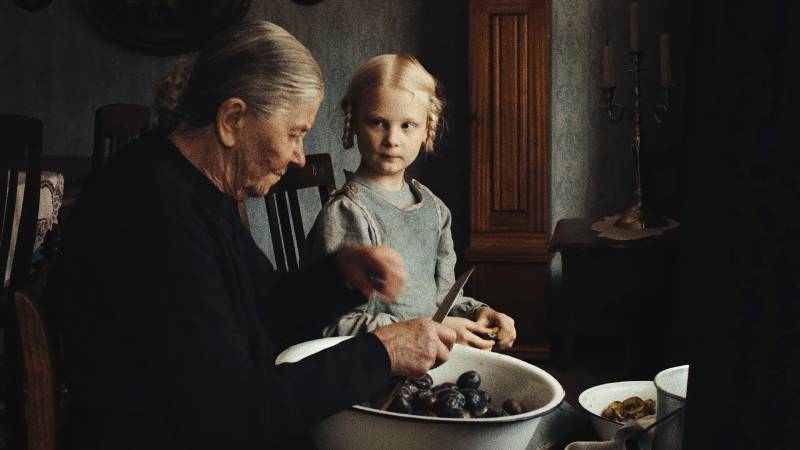
Mascha Schilinski is pictured at the top of this interview. The other image is a still from Sound of Falling.

