








Actor and director Nick Craven has a keen interest in film history and theory. During the past decade, he has directed four short films ands acted in many more.His latest work Crying on Command, “an engaging drama about how our dreams hang by a thread, and the emotional chaos that ensues as they fall apart”, premiered at the Flicker’s Rhode Island International Film Festival.
…
.
Paul Risker – Why filmmaking as a means of expression? Was there an inspirational or defining moment for you personally?
Nick Craven – Wow. It’s hard to keep that answer brief. I think audiences understand who a filmmaker is the most after watching a film, compared to either a writer or an actor (which I also pursue). It’s a director’s medium, after all. That’s maybe not an attractive idea to some, but I think being in that seat can be therapeutic. It’s all just fascinating. Visual literacy. The idea that a series of images, no matter how big or small, can be so impactful and effecting. For me growing up, film was therapy, it was escapism; joyful, confusing, but regardless, always felt incredibly real, more real than life sometimes did. I had one class in college where we watched a scene from Coppola’s ‘The Conversation’ on a loop, and had to write what we saw as far as the composition, the light, the way the camera moved, etc., and write down what it meant to us in regards to what was happening in the film. We had to include film vocabulary we had learned in the class, but the dissection and the meaning of the moments could be subjective, and as free as you wanted it to be. Stream of consciousness. I learned early on that this was a basic definition of the job of being a director. That was a wild feeling.
PR – What compelled you to want to tell this story, and at this particular point in time?
NC – I don’t know if we necessarily looked at what was happening in the world and then responded to it with this film, but for Jake and I, this story made sense for us now as opposed to five years ago, because of how we’ve contextualised our struggle when it comes to pursuing the arts. It’s less intimidating, we understand the job, and most importantly, we have a much better sense of self, which is where we wanted Jordyn, our protagonist, to come from. She didn’t just get off the bus Judy Garland style, she was already an experienced, knowledgeable actress, who had seen and gained closure with the idea of rejection. Why it’s compelling to me, specifically, is because…it’s all I’ve known. My family are all artists. My dad is an actor. He romanticized the hardships, telling us stories of when he was a young actor in New York. Growing up, I also saw him face the harsh realities of when he wasn’t able to work for long periods of time. It’s confusing and compelling to be so in love with something and have it treat you so badly, regardless of status. What’s ironic is that if you were in this kind of relationship with a person, a good friend would tell you to get out of it, but in this career, a good friend would tell you to keep going.
PR – From the beginning one of the things that struck me about the film was how it captured a certain sensibility of disingenuous politeness that exists in this industry, that even film journalists experience. I’d be interested to hear your thoughts on this reading of the film.
NC – I feel like we’re living in a time of disingenuous politeness haha. It’s in this industry, every industry and life in general. That’s a different topic.
You are right, Jake’s character and Dan’s character both have that in common.
I will say this about the film though. In general, our industry is filled with people who claim they want you to succeed but quickly show that they do not care about you. The calvary is not coming as our friend Mark Duplass has said. He’s not actually a friend, but I think he’s a great friend to all up and coming artists. But yes it is in there. And those characters, additionally, serve as metaphors for how the industry can treat you, not so much an accurate interpretation of what happens in an audition room.
PR – You’ve said that you believe Crying On Command shows a different side to the idea of struggle in the industry. How does compare and contrast to the other portrayals of struggle.
NC – Many things I guess. I think what immediately comes to mind is that most films that portray struggle also have a happy ending. That’s not a bad thing. But less than two percent of actors are working actors. Most films show glimpses of glamour, fortune, and success. They portray characters that have been successful and need a come back. Or, are successful and are in the middle of downward spiral. Jordyn is none of these. The one film I thought about that was slightly similar was ‘Inside Llewyn Davis.’ That film was a huge influence on the mood. There’s a lot of short films that show the process of auditioning, which share some of the cliches. Some of these films are great. Some of them not my cup of tea. But hopefully this film painted a bigger picture of the industry as a whole, as well as remind us of those “cringe” moments.
PR – And following on from above, do you perceive Crying On Command as being political, and do you agree that all art is political?
NC – I certainly don’t believe all art comes from a political place. But I’m sure in one way or another you can tie it to political ideologies. We’ve never approached Crying On Command as being representative of anything political within the industry, I think if we had it would have probably taken away the sincerity and the effort we put into thinking about these characters and our own experiences.
PR – Would you agree that Crying on Command is a challenging experience for audiences, because it challenges our ability to find an objective vantage point from which to view the interaction, and separate emotion from the way in which we understand the story and its characters?
NC – Oh, that’s interesting. I guess it’s impossible to answer because I don’t have the point-of-view of a regular audience member. What I will say is that- you mention the different points of view – it’s another aspect of this film that I hoped would be different compared to other “audition room” short films. Most I see have classic man-vs-society, so to speak, external conflicts, where the enemy is the room itself, without offering a clear point of view to each individual in that room. I think our goal was to make sure that all three of these characters watching Jordyn would have a different opinion of her, and what was happening in the present moment. They were all individuals, even if presented for only a second.
PR – Crying On Command builds the tension of the drama to explosive effect. Could you discuss the use of the cinematography and sound design to create this suspense and tension?
NC – I think my preference as a filmmaker tends to have minimalist features, which included what was in the audition room and our sound design. The room didn’t feel empty enough where you wouldn’t believe that an audition would take place there, but it felt empty enough where you could really hear the sound of your own voice. An audition is already so anxiety ridden, but hearing your own echo also forces you to suddenly be really aware of yourself. The self- consciousness and fear that exists in all of us really comes alive. The white walls are also, hopefully, off-putting. Is this heaven or hell? I wanted the actors to feel like rats in an experiment. The sound design truly comes from my own experience with anxiety. Either you can barely hear things, or things are really loud. The room tone was an aspect of that we played with. It would barely be heard but by the end it’s all she could hear. The desolation crescendoed.
PR – If cinema is a conversation, what do you hope that Crying On Command contributes to its thematic concerns.
NC – I’m not sure if the film is meant to have much of a comment on the current state of cinema. But I hope when people see it, they are inspired to make more shorts. It’s a much harder art form than we give it credit for. I met someone the other night that reminded me of the Oscar Wilde quote, “I would have written a shorter letter, but I didn’t have the time”. I subscribe to that thinking.
PR – Crying On Command is your fourth short film. What’s next for Nick?
NC – Like most people in my position, I’m waiting on a lot of phone calls and then following up when I think enough time has passed haha. Jake and I would love to make a feature. WE NEED MONEY!! Lots of things are being written and we’re always collaborating. But my hope is that we get back to work by the end of this year.
…
.
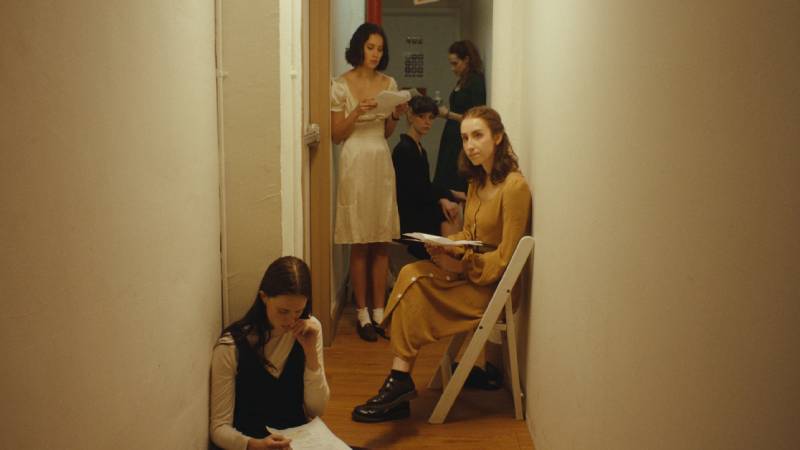
Nick Craven is pictured at the top of this interview. The other image is a still from Cry on Command.


