








Director and writer Jack Serra was born in Alabama, in the United States, in the year of 1999. He has lived in New York, California and Texas. He started making narrative shorts, music videos and commercial work in his adolescence. He began the production of his debut feature in 2021, when he set up the production company ARZ Pictures. He has since directed nine short films. His latest work Generation Well premiered at the LA Shorts International Film Festival.
…
.
Joshua Polanski – I read that this film comes from a place of personal loss. Can you say more about that? What about your experience with those emotions did you aspire to capture?
Jack Serra – I lost my father when I was 23, and that experience fundamentally changed me. With Generation Well, I wanted to explore the quiet, lingering weight of grief – how it can isolate you, but also force you to confront who you are. The film isn’t autobiographical, but it’s rooted in the atmosphere of loss I carried during that time.
JP – You seem to shoot in many locations. Can you tell me more about what you valued most in scouting each location? What did that process look like for you?
JS – In all honesty, we didn’t have the pick of the litter when it came to locations. But that limitation pushed me to focus on finding consistency in tone and style, even if the spaces themselves weren’t ideal on paper. I was always looking for textures and moods that would visually tie the story together. In the end, that constraint helped create a more unified world for the film.
JP – The film uses a structure and editing style that favors, in a good way, estrangement. One feels like the world isn’t quite right through the structure alone. Can you walk me through your approach to editing in Generation Well?
JS – I knew from the start that I didn’t want the edit to feel seamless or conventional. Grief, to me, is jagged and uneven, so I embraced an editing style that let the film reflect that—moments cut off too soon, or lingered on just a beat too long. The goal was to create a rhythm where the audience feels unsettled but still compelled to keep watching.
JP – I couldn’t help notice how much hockey there is in this 18-minute short. There is this tendency among American hockey fans to almost feel like we need to evangelise the sport. And whenever I see a hockey reference in a film, I think, “Oh, you’re just like me.” Can you tell me about the jersey choice and how that made it into the film?
JS – I’m not even a big hockey fan, so it’s kind of funny that it ended up in the film. But when I thought about what sport Gale might be into, I immediately pictured my hometown’s minor league team, the Birmingham Bulls. It was such a vivid image from growing up that it felt right to use.
JP – Everyone always asks about the hardest scene to shoot. Instead, can you tell me about the easiest scene to shoot? What came the most naturally and why do you think that was?
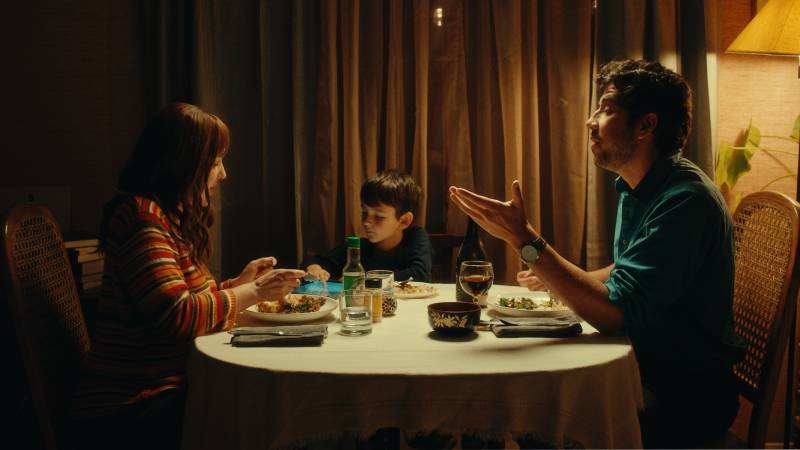
JS – The easiest scene to shoot was actually one of the quietest ones – just a conversation at the kitchen table. There was no trickery involved, just two actors who clicked and a space that already had the right mood. We barely had to adjust anything, which almost never happens. I think it came naturally because it was stripped down to performance.
JP – Reading the press notes, I couldn’t help but notice how multicultural the crew was. In today’s political climate, where multiculturalism and pluralism are under attack, it’s inspiring to see a crew like this one come together. How do you think the diverse backgrounds and experiences of the cast and crew helped you to shape the best version of this short?
JS – What I loved most about the crew was that everyone came in with totally different perspectives and ways of working. That variety made the film feel bigger than just my ideas—it pushed me to see things in new ways. It wasn’t some grand plan, just the best people coming together. And I think you feel that mix of energy in the final film.
JP – Was Generation Well always the title? How did you end up selecting the name for the film?
JS – I knew early on that I wanted a title that felt a little unusual – two words that don’t typically go together. Generation Well came a few drafts in. It’s partly a reference to a literal well, something you return to and draw from, and partly a nod to how deep generational patterns can run. I also liked how we often group people into generations, even though identity isn’t always that clear-cut. The title holds both ideas.
JP – What’s one thing you learned on this project that you hope to bring into your next project?
JS – I learned how important it is to trust simplicity. There were moments where I thought I needed to add more—more coverage, more movement, more dialogue—but the strongest scenes came from restraint. That’s something I want to carry into the next project: letting the story breathe.
JP – What’s next for you?
JS – What’s next is Luxor, my upcoming short film. Where Generation Well was about grief and estrangement, Luxor is a tighter, more ironic story that plays with tension and morality. I see it as a chance to stretch myself in a new direction while continuing to build a body of work. My hope is that together these shorts show range and point the way toward feature filmmaking.
…
.
Jack Serra is pictured at the top of this article the other image is a still from Generation Well.


