







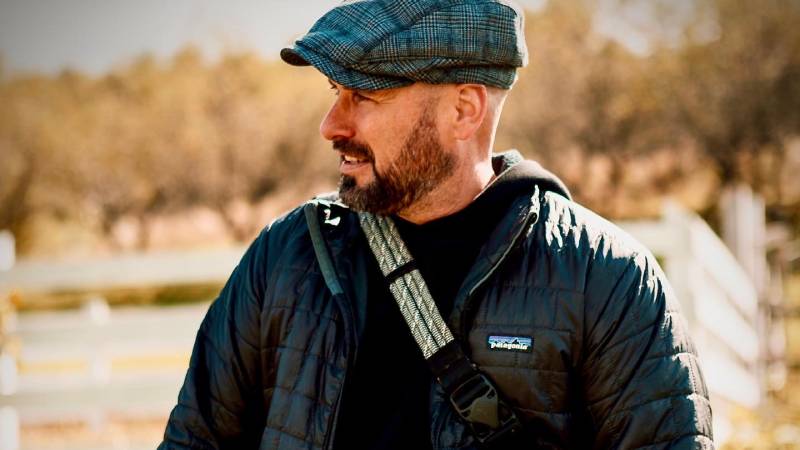
David Kabbe was born in Kabul in the 1970s, briefly before the Soviet invasion. He moved to the US as an adolescent. He has worked in production for more than 20 years, with a broad portfolio including independent films, television, live events, tentpole premieres, talk shows, and multimedia events, and clients such as Paramount, Universal, DreamWorks, and Warner Brothers.
His directorial debut Izidor, a short film that invites viewers to feel “the wonder, magic and glory of the world around us” as they “witness Romania through the eye of an orphaned child” premiered at the Cleveland International Film Festival. Click here in order to accede to our exclusive review.
…
.
Eoghan Lyng – You are an Afghan-born American director who has lived in many parts of the world. Why did you opt for a Romanian story in your first film?
David Kabbe – Thank you for that question. I wouldn’t say I set out to make a specifically Romanian story; it’s more a story about hope. Growing up moving around the world, I came to see that the orphan experience is something deeply human and universal. Every society, across time and culture, has faced the same essential question: How do we care for children when their parents can’t, or are no longer here?
While the film is set in Romania during the communist era, we chose to focus not on the politics, but on what truly defines Romanian culture: family and faith. Rather than framing Romania through the lens of ideology, we expressed it through the character of the nanny—someone who embodies those core values with quiet strength and love.
EL – The movie opens with an animated segment. Was this designed to attract child viewers, or maybe to convey their mindset?
DK – Not at all. The animation was never intended to attract a child audience. On the contrary, it was very much designed with adults in mind. We chose animation primarily because the asylum scenes couldn’t be realistically – or ethically – captured in live action. Animation allowed us to approach those moments with a layer of abstraction, creating a visual buffer that makes the difficult subject matter more emotionally accessible for the viewer. Yet, the colour palette and animation style were also deliberately designed to make the viewer feel uneasy – like they don’t want to be there – mirroring Izidor’s own experience.
EL – You have a very powerful child protagonist. Please tell us about casting. Was it difficult for such a young cast to take part in such a grim story? Were there any challenges?
DK – One of the many mini-miracles was meeting Iosua Barbu (Joshua). I was first introduced to his mom, Anca Barbu – a trained actress who set her career aside to raise a family – through our amazing Romanian co-producer, Elena Beuca-Rogers. Anca taught her kids English and understood the performing arts. We auditioned other children, but Joshua just got it. His audition was strong, and unlike the others, he stayed focused and in character through every scene. What you see in the film isn’t Joshua, it’s Izidor. Every time the camera is on him, you can see it in his eyes: wonder, pain, joy, trust, and even wisdom. My first film professor warned me not to make my first film with a kid as the lead, but I’m so glad I did.
EL – Sound Designer Benjamin Jacquier recorded snippets from an elementary school. Please tell us about this creative choice.
DK – Ben lives in the French Alps and is a sound designer, musician, and snowboarder. He records his own sounds in the wild, creating rich, textured soundscapes. I DM’d him, we got on a call, and instantly clicked, especially after he told me how he once recreated his grandfather’s WWII story through sound. We spoke the same creative language.
Ben had the tough task of designing what hell might sound like. It was Ben’s idea to record the 5th grade class at his local elementary school to capture the eerie atmosphere of the asylum. As heavy as the task was, the result was chillingly effective.
This film wasn’t easy to make as sitting with these heavy stories and themes day after day was emotionally intense. But Ben brought incredible passion, creativity, and professionalism to the process, and was a joy to work with.
EL – Please tell us about funding. Your film is listed as American. Did you receive any support from Romania?
DK – Izidor is based on the true story of Izidor Ruckel’s childhood. The live-action sequences were filmed on location in Sighetu Marmației, Romania, where the real events took place nearly 37 years ago. The current mayor of Sighet was incredibly supportive, giving us full creative freedom to film throughout the city – including inside the very institution where Izidor spent his early years. It was called a “home hospital,” but in reality, it functioned more like an asylum.
We also had an amazing network of local supporters – friends, artists, and families – who generously shared their time, talents, and even personal heirlooms to help us recreate 1988 with authenticity. That kind of support was invaluable.
While most of the financial backing came from the US, the heart of the film was absolutely shaped by the generosity and spirit of the Maramures community.
EL – This is a tale about orphans and resilience. What lessons have you learnt from these young survivors?
DK – You said it: resilience. But here’s the thing – no one wants to be remembered only for their resilience. It’s like a boxer who keeps getting knocked down but refuses to quit. We admire the fight, but we also feel a kind of sorrow for the struggle.
I thought I understood this world going in, but the deeper I went, the more I realized I was still in the shallow end. And honestly, I’m still learning. The darkness these kids lived through is overwhelming – but what keeps pulling me in is the way hope still shows up in those dark corners. That paradox is what fascinates me.
We all know what it feels like to believe there’s no way out – and then somehow, there is. Sometimes it comes from within, but more often, I think, it comes from each other. A small act, a kind word, someone showing up when it matters. Izidor didn’t recognise hope when he first felt it; it wasn’t familiar to him. I think that’s true for a lot of us. We often only understand the hope we’ve received long after the fact—when we look back and realise how much that gesture, that moment, meant. A coffee on the worst day. Someone fixing a flat tire. A stranger saying: “you’re not alone!”.
Those are the lessons I’m still learning.
EL – How many production days did your film take?
DK – Seven days for live action, a year-and-a-half for the animation production.
EL – Are you expecting to show your film to Romanian audiences? How do you think they might react?
DK – I’m in Greece now and heading to Romania in the second week of June. We’ve scheduled private screenings in four cities: Bucharest, Cluj, Timisoara, and Sighetu Marmatiei.
In Bucharest, our June 25th event will be held at the National Museum of the Romanian Peasant. We’re partnering with IICCMER (the Institute for the Investigation of Communist Crimes and the Memory of the Romanian Exile) and the Museum of Abandonment. IICCMER has spent over 20 years researching the crimes of communism, and the Museum of Abandonment honors the hundreds of thousands of children who suffered under the regime. Both organizations have studied Izidor’s institution in depth, and we’re grateful that Izidor can add a new emotional layer to their work. Reading about it is one thing—but film has the power to make people feel it, remember it, and be moved to act.
EL – Would you consider re-structuring Izidor as a feature length project? Are there any other projects you would like to tell us about?
DK – Izidor‘s follow-on project is currently structured as a four-part limited series. It expands on everything the short film hints at and answers the questions that naturally arise after watching it. The short is a teaser for a much bigger story – one that begins with the creation of these asylums under Ceaușescu’s regime, follows Izidor’s journey through that nightmare, the discovery by Western journalists, his adoption to the US, the shock of a new culture, and his long fight for advocacy and mental stability. It’s a redemption story, but not the typical Annie-style orphan tale.
The orphan experience is far more complex than it’s usually portrayed. In cinema and literature, it’s often reduced to a trope—just watch Disney, Marvel, or DC films, or count the orphan heroes in classic literature. The orphan is used as narrative shorthand for the “call to adventure,” because it builds instant empathy and frees the hero from family obligations. But real life isn’t that clean. The limited series aims to explore what happens after the “call”—how someone survives and heals when the world has already discarded them.
I do have other projects in development, across a range of genres. Each one deals with transformation in some way, whether personal, cultural, or systemic.
…
.
David Kabbe is pictured on both images illustrating this interview.


