








Filmmaker and writer Angeline Gragasin lives in rural upstate New York, and teaches at the Parsons School of Design in New York City. She directed six short films, and produced many more. Her creations have screened at BAM, Clermont-Ferrand, ZINEBI, Palais de Tokyo, Jumping Frames, and other. She received fellowships at Yaddo, The Wexner Center for the Arts, The Flaherty Film Seminar, and UnionDocs, among others. Her texts have been published by The Creative Independent, Screen Slate, LR Magazine, Arbelos Films, and Cinema Reborn.
Her latest film Myself When I Am Real was selected for the Los Angeles Asia Pacific Film Festival. This writer describes it “a sensitive short with an eye for detail”. and which sympathises with “a teenager’s struggles to escape her mother’s shadow”.
…
.
Paul Risker – How would you describe your relationship to cinema?
Angeline Gragasin – Cinema is like the earth, the soil. It’s a place where ideas germinate and grow and flower and fruit and seed – as films. It is a place of fertility, of synthesis, and of reproduction. It’s also a place where emotions and ideas can be fully explored and finally put to rest (in a kind of death), and perhaps many years later resurrected or reborn in unexpected ways… New ideas, new images, new sounds, new films. New seeds, new leaves, new species, new fruit. Many different, magical, unfathomable things can grow in earth, just as cinema can give us many different, magical, unfathomable kinds of films. My relationship to cinema is like my relationship to the earth. I feel the same curiosity, wonder, love, and respect for the mysteries of cinema as I do for the mysteries of the earth!
PR – “What we are” versus “who we feel we are” can often be out of synch. I’ve spoken with directors who say that it took a number of films before they felt they could call themselves a filmmaker. Do you feel that you can call yourself a filmmaker?
AG – I do identify as a filmmaker, but it took me many years to develop this identity.
I’ve always known that I was an artist (even as a young child, I knew this), but it took me some time to discover the craft of filmmaking, to develop my own perspective and practice.
As a student, I trained in many different art forms – painting, music, literature, theatre – before arriving at cinema, which seemed the perfect culmination of all my artistic interests. I first began experimenting with video in my early 20s, collaborating with other young independent filmmakers who had themselves gone to film school and were willing to collaborate with and share their skills with me. I made dozens of short films within those first few years – all of which were quite amateur and unsophisticated – but I was learning by doing, learning to develop my own taste and values and obsessions as a filmmaker.
Now that I have over a decade of experience under my belt, I feel secure in my identity as a filmmaker. But there is still a part of me that feels I cannot fully claim this identity until I’ve made the leap to feature filmmaking. This feels like an important rite of passage, at least for me.
PR – What was the genesis of the idea for Myself When I am Real and what compelled you to believe in this story?
AG – Myself When I Am Real the short film is actually a sequence extracted from a feature screenplay of the same name, modified slightly to function as a standalone short film. Starting with the short allowed me to develop the storyworld and visual language of the feature film, on a much smaller scale.
I initially wanted to write a feature film that was set in my hometown of Racine, Wisconsin, in the year 2000. I was inspired by this specific time and place. Naturally, because I’d grown up there, I drew from my own memory, my own observations, when developing the script. All of the characters and events were informed by real people I knew in real life, and as the narrative began to emerge, it became increasingly clear to me that the film was, at its core, a story about my childhood, and an exploration of authenticity and realness. This is when I renamed the film (which originally had a different title) to Myself When I Am Real, after the Charles Mingus song, as a reminder to myself that this is what the film was really about.
PR – In what ways do you draw on your Filipino American heritage to bring a specific perspective to your storytelling, and do you feel empowered through cinema?
AG – I’ve tried to make a film that’s universally relatable, but also culturally specific and authentic to my own lived experience. If I succeeded, I hope this might be attributed, not to my identity as a Filipino American, but to my perspective as an artist whose cultural heritage also includes every person I’ve ever met, every movie I’ve ever seen, every thing I’ve ever done, every memory I’ve ever made.
I’m frustrated with the current political climate in the arts and academia in the US, which has also contaminated American cinema; I am talking specifically about the zeitgeist of evaluating art and artists through the lens of identity politics. While I’m happy to explore and celebrate my heritage as a Filipino American, I’ve felt pressured to perform my ethno-racial and gender identity for my work and perspective to be relevant in the American context. I find it an oversimplification to reduce an artist’s work to their identity. Let the work speak for itself!
PR – For a film that has a strong visual identity, the absence of any visuals in the opening scene is jarring. Could you discuss the thought process behind this creative choice?
AG – I had initially written the opening scene as a moving image sequence, but due to unexpected budget constraints we were forced to cut back on the number of shoot days to save money. One of my solutions for cost-cutting was to cut the visuals, but keep the audio, which was absolutely necessary for the story to make sense. I decided that the dialogue was compelling enough that I could afford to cut the image and it would still be engaging. Once I cut these visuals, I adjusted the shotlist so that the entirety of the film would be shot exclusively from inside the house, for consistency. I thought it posed an interesting storytelling challenge to limit the perspective of the camera in this way. It seemed logical that the home movie cameraperson would stay inside the house for the entirety of the film. And I’m glad I did, because audiences often remark that the opening is especially suspenseful as a result of being asked to listen and imagine what they cannot see.
PR – Following on from the above, was it always your intention to adopt the home video style for Myself When I am Real, and how does this empower you to tell the kind of story you set out to make?
AG – It took a while for me to discover this, and similarly to the opening, the home movie idea occurred to me as I was trying to solve the problem of what camera to choose. I thought this approach fit perfectly with the core themes of the film, though some people tried to talk me out of it. Thankfully, my DP Yujin Yohe was 100% onboard with this idea. He thought it was very daring, very punk. We fully committed to shooting on tape, using a single camera and lens, with no post-production color nor visual effects. This visual language felt more authentic to the story I wanted to tell.
PR – It strikes me that Myself When I am Real is about watching and listening. This is not only because of the home video style that introduces voyeuristic connotations, but because of the way you penetrate the hive of human conversation, karaoke, and dance to pick out subtle observations. What are your thoughts on this reading?
AG – Thank you! Yes, absolutely, that is exactly my intention with the film. I wanted to invite the viewer to observe the nuances of these social interactions as closely as I remember doing as a child. As an artist in general – but especially in my practice as a writer – I feel like so much of my work is observation and documentation. I think children have a natural gift for observation, which atrophies with age. Perhaps once we become self-aware and self-conscious, our attention turns inward, and we become selfish, in a way. I’ve tried to maintain that childlike sense of wonder and attention to the subtleties of human behavior and language.
PR – It might appear that Annette or Mercedes are the dominant characters, but could we declare that Jasmine is the film’s driving force? Is a large part of the story’s focus on Jasmine’s experience of the struggle to escape her mother’s shadow?
AG – Although the screenplay was originally written with Annette as the protagonist, I later discovered, in the performance and especially in the edit, that Jasmine emerges as the film’s pivotal character. In many ways, the story is told from her perspective. I’m speaking figuratively, not literally. Although Jasmine is not physically operating the camera – the cameraperson is an unnamed, unseen guest at the party – I approached the edit as if it were Jasmine who had found this MiniDV tape 20 years later and edited it herself. I thought this editorial choice added an interesting dimension and emotionality to the film. I saw another opportunity for character development, and I took it.
PR – To what extent are you intentionally creating space for the audience to enter the film to understand the individual characters? Is it important to you that the audience are actively engaged?
AG – Yes, it is essential to me that the audience is actively engaged in the act of observation and discovery. This is my favorite part of movie watching! Using my imagination to explore and understand a story and its meaning. I like films that have depth and mystery, films that ask viewers to imagine and interpret and find new insights with each viewing. To me, an obvious film is a boring film. But you can also go too far in the other direction, and make something that is so obtuse and esoteric that nobody gets it. The challenge is to tell a story in a way that is both subtle and familiar. This is what I’ve tried to do with Myself When I Am Real.
PR – Is filmmaking a transformative experience?
AG – It depends on what you mean by filmmaking. If by filmmaking you mean shooting and editing, or perhaps even screenwriting, then my answer is: sometimes.
But if by filmmaking you mean the totality of the process, including the countless invisible hours spent imagining and obsessing from conception to completion, which in my practice takes literally years – then yes, this process is a transformative experience. If we count backwards from the moment the finished film plays for a live audience in a cinema, to the moment of inspiration that would eventually become the film, it is impossible to not be transformed by such a long and arduous process. Each film contains years of work and is a record of my own transformation that only I can see!
…
.
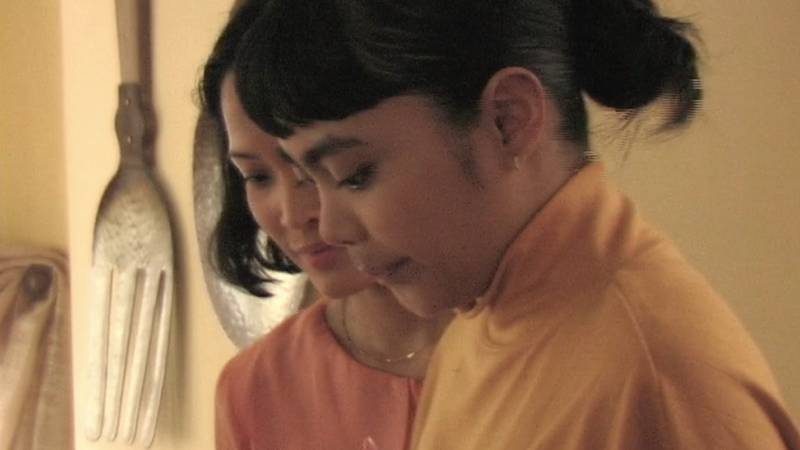
Angeline is pictured at the top of the interview, snapped by Michael Stephen Brown. The other image is a still from Myself When I Am Real.


