







Thomas Lorber in a French-born Canadian filmmaker with a background as a stuntman, and now running his own production company Underdog Pictures. He recently doubled Oscar Isaac in Guillermo del Toro’s Frankenstein (2025).
He has directed five short films since 2020. The latest one, Legend Has It, premiered at the Sapporo International Short Film Festival last year. This proof of concept for a feature tells the story a male stripper-turned-fighter, in an extravagant mockery of masculinity and queer stereotypes
…
.
Nataliia Serebriakova – Where did the idea come from to make a male stripper the central character of this story?
Thomas Lorber – I was looking to do my next short when one of the co-writers, Frank Tremblay, sparked the initial idea for this film. The premise excited me right away. It felt fresh, high concept, and I could see the potential for action and comedy. Ramesh Santanam, the other co-writer, joined us on this adventure, and the three of us were off to the races. We threw a lot at the wall and what you see in the film… whipped cream, dildo, and lube is what stuck.
NS – Why was it important for you to combine action and comedy in this film?
TL – It’s simply my favourite sandbox to play in by far! It’s where I think I thrive the most. Coming from a stunt background, action is undeniably in my bones. Equally, growing up in France, watching French comedy legends like Pierre Richard and Louis De Funes, I’m naturally inclined to infuse comedy into action.
NS – The film contains a lot of humour – for you, is comedy mainly entertainment, or is it also a way of expressing something more personal?
TL – That’s a great question. I don’t think there’s anything wrong with comedy purely wishing to entertain. Wanting to make people laugh is a very valid and positive reason for me to do it. But there are also many sub-genres to comedy and it can certainly carry social commentary or be about real issues without sounding preachy, which I think makes it a powerful tool. Ultimately, what I love about comedy is that it brings people together. Laughing is contagious. I like laughing and making people laugh in my everyday life, so of course my films are going to try and make you laugh.
NS – How did you balance the absurdity of the situation with a genuine sense of danger and survival?
TL – I think when a character treats what’s at stake seriously, then the audience gets on board too. They feel the reality and danger the character finds himself in. It’s also important for the actor to treat the events of the story like they’re in a drama, not like they’re in a comedy. In the case of Legend Has It, the humour comes exactly from the imbalance between absurdity and a dangerous misunderstanding.
NS – You describe the story as a “fish-out-of-water” tale that mirrors your own life. In what ways does Adam’s final night reflect your personal journey between cultures
TL – From my very first day when I immigrated from France, I always tried to fit in. When you do that, you have no choice but to adapt, and a new version of you develops. There is definitely a parallel with the character of Adam/The Legend in our proof-of-concept short. He finds himself in a situation where he’s out of his depth, he has to adapt. But it’s also a key part of our through-line for the feature version of this story.
NS – Can we see Adam as someone who turns vulnerability into strength especially in a hyper-masculine criminal environment?
TL – When you perform in front of a live audience, whether that audience is one person or a full theatre, there’s always a risk in baring your soul, in letting your guard down. It’s easier to sort of only show the best version of yourself and dissociate yourself. I think real magic happens when you can make the two co-exist. When you succeed in doing so, you can give the audience catharsis but also have a cathartic experience yourself. I made myself small while I worked my way up as an artist in the industry but today, I think vulnerability is now one of my biggest strengths.
NS – Where do you draw the line between parody and sincerity in your work?
TL – You have to first accept that comedy is highly subjective. Once you come to terms with that notion and that you have no control over it, you look at what you can control. During the development phase, the comedic tone of this script, the humour, the awkwardness, was a constant conversation. We wanted to push the envelope into something that felt like uncharted territory, for the audience and for us as storytellers, but you also don’t want to alienate your audience. So you need to dial things back when necessary.
NS – How much did the actors’ improvisation shape the comedic tone of the film?
TL – The co-writers and I were just talking about this yesterday. On one hand, we had a solid script going into principal photography, but we were very blessed that we had actors like Jon Cor and Tom Morton in the film, who were great at improvising in their own right. One of the funniest lines of the film came from improv. However, the actors and myself will be the first to tell you, it’s so much easier to pivot and improv and build upon something when you have a great foundation to work with.
NS – The physicality of the lead role is crucial. How did you approach casting, and what were you looking for in terms of the “ideal male body”? Was it purely about aesthetics, or about presence and confidence?
TL – I’ve known Jon for the past 10 years and he was the first guy I envisioned in the role. Jon has everything you just mentioned. He’s charismatic, embodies confidence and he can fight.
NS – I believe this is a story about survival, about dignity, and about reclaiming control over one’s own narrative (even in the most absurd circumstances). Please comment.
TL – You nailed it. Funnily enough, the only man who ends fully naked and vulnerable in front of all the others is Adam and he ends up taking over the room. I spoke about Jon’s quality above, but he also has that sensitive edge and vulnerability that the role required. Likewise for Tom Morton and the edge he brought to Henri-Georges. The movie could have been good without them, but they made it great.
NS – Are there any future projects you could discuss with us?
TL – Legend Has It is screening at the Beverly Hills Film Festival (April 12th-19th). I’m excited to see the film with a Los Angeles audience. One of our co-writers, Ramesh, lives there, so it will be fun to share that experience with him too. I’m trying to get Adam, aka The Legend, to give the LA audience a live-show and strip one last time, but I’m told he hung his g-string for good… unless it’s for the feature version, so we’re working on that!
…
.
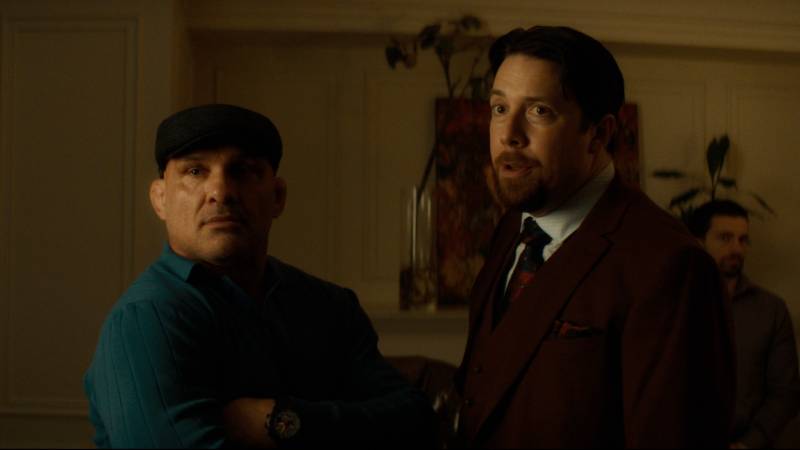
Thomas Lorber is pictured at the top of this interview. The other image is a still from Legend Has It.