







QUICK’N DIRTY: LIVE FROM BERLIN
Torn in 1991 in the Liaoning province of China, Xu Zao presents his impressive debut feature in the Perspectives section of the 76th Berlin International Film Festival. Light Pillar is a “supremely sad sci-fi” about rich people abandoning earth, and the less fortunate left to contend with shoddy VR at home.
…
.
Lida Bach – Your first feature film Light Pillar is a story about loneliness, disconnection, and a universal search for human closeness. What inspired you to deal with these topics?
Xu Zao – It’s based on my personal experience. I worked as an artistic director in the past. Near my home, there’s a film studio. I always passed by this place, so this setting is very familiar to me.
LB – Why did you decide to make this work a mix of live acting and animation?
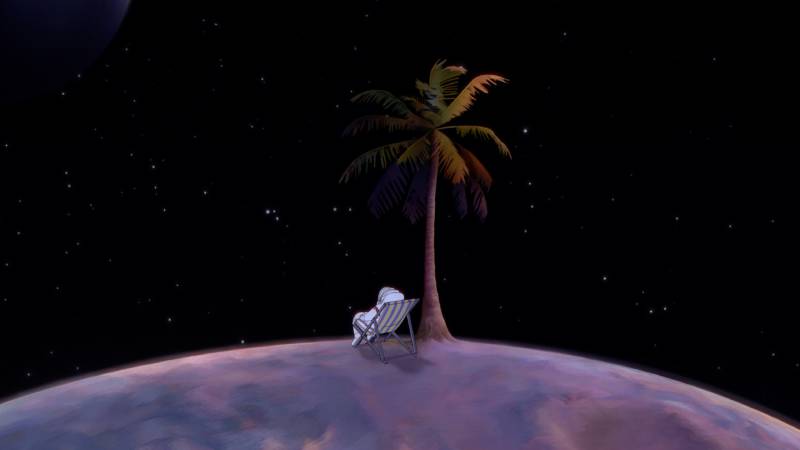
XZ – Actually, it is because I’m originally an animator. The first few short films I made were all animation. So I decided that the first feature I made was going to be animation as well. The reason I added live-action is because I wanted to make the virtual world a little different from the real world the character lives in. I experimented with many different methods; live-action seemed to be the most suitable. The animation is relatively drab and two-dimensional, and this corresponds to the protagonist’s life. On the other hand, the three-dimensional, rich, colourful part of live-action corresponds to the virtual world, which is like a beautiful illusion. Another more pragmatic reason is that live-action might save more time on production and compress the production cycle, which is equivalent to reducing production costs.
LB – The main character tries to escape his lonely life into a virtual space and never actually meets the woman with whom he connects in this digital space. Is this reflective of current Chinese society, that people seek connection online rather than in real life?
XZ – Yes, but it’s not just VR glasses; it’s also through games and the internet. Most people prefer to immerse themselves in the virtual world. They lack the yearning for connection in the real world. People get addicted to VR, or the internet, to games, to streaming…
LB – Another crucial element of this story is worker exploitation. Han and the other workers only get paid for a few months of the time they actually work. Are such practices already common, or is it a critical prognosis of how work conditions could deteriorate?
XZ – It does happen, but it’s not that common in Chinese society. The idea was more to have the audience feel pity for the main character.
LB – Did you research lower working-class life to accurately portray such conditions, or does it reflect some part of your own social background?
XZ – Some of it is my own work experience. And I’ve been in contact with these people a lot. As I used to work in film and art, I often engaged with the people working on film lots. And the film studio near my home is very similar to the one in the film. It doesn’t see a lot of movie shoots, but there are still a few staff members running it. The pay isn’t great, but the work is relaxed and they don’t seem to be as depressed as in this movie. They still find ways to be happy.
LB – Right now, the Chinese film industry seems to be booming. However, your film shows an individual film studio declining and shutting down. So film studios are popping up and then very quickly going bankrupt again, and just a few big ones can actually make it?
XZ – To be honest, I think that the entire global film industry is probably in a downward trend. Not only in China, but also in Europe and the United States. And this rapid cycle of opening and closing film production companies is indeed the case. China will quickly build a bunch of film and television bases, and then after one movie is finished, that base will be demolished and a new one will be built immediately.
LB – Within your story, there is a strong need for escape. Not only escaping into digital spheres but also literally escaping society, escaping everyday life, even in a symbolic way, escaping this planet. Would you like to expand on this theme?
XZ – To take up the previous subject, both the film industry and Lao Zha are in a process that requires transformation. Being a single person, he feels a strong need for a home. He wants to escape not just this film studio, but a certain lifestyle. He looks for ways to make his life better, to find a partner who loves him. This is probably what most young people or middle-aged people want. I would see it as people needing to pursue a new lifestyle, rather than escaping their past lifestyle.
LB – You’ve touched on the difficulties within the Chinese film business, and the international film industry as well. How difficult is it to produce an independent film these days?
XZ – To save money, I’ll do a lot myself. I’ll participate in every aspect of the work. The biggest cost factor is personnel, so the more I do myself, the more I can save.
LB – What does it mean to you personally to participate in the Berlin International Film Festival?
XZ – It means a lot to me. There are a lot of complicated elements in my film and I think a work like this might not be understood by everyone. As China is getting closer to the rest of the world, I hope that both the international and Chinese film festivals will open up to one another. There are things in films that are universal. Initially, I was worried some points in my film would not be well understood by the audience. But it turns out they can get it quite well. And that’s reaffirming to see.
LB – Are there artistic inspirations or films that influence you?
XZ – I’m more influenced by novels and literary works. And when writing this film, I often listened to music – kind of weird music, actually. All these elements together determine my writing style. In a way, it’s not that I choose an artistic style. It’s the style that chose me. If you were to ask me to make films in a different style, I couldn’t do it.
LB – Do you at this point already have a new project you’re working on and would like to share something about?
XZ – My next project is also a sci-fi comedy.
LB – Thank you so much for this interview!
…
.
Xu Zao is pictured at the top of this interview. The other image is a still from Light Pillar.


