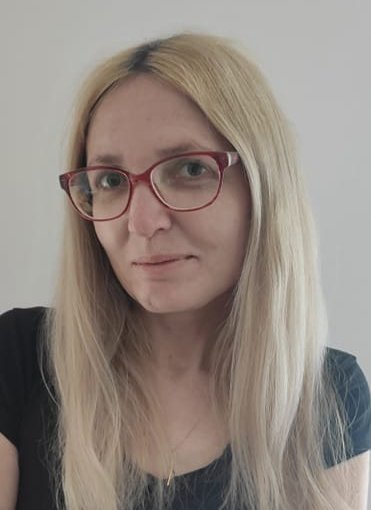

Born in 1984, Paul Negoescu studied film directing at the National Film School of Bucharest and first gained international recognition with short films selected at major festivals including Cannes, the Berlinale, Karlovy Vary, and Rotterdam, with two works nominated for the European Film Academy Awards. His debut feature, A Month in Thailand, premiered at Venice Critics’ Week in 2012 and went on to win the Fipresci Prize in Sofia and Best Debut at the Transilvania International Film Festival, while his second feature Two Lottery Tickets (2016) became one of the most successful Romanian films of all time at the box office. His third feature, The Story of a Summer Lover (2018) was distributed by Netflix in more than thirty territories and was warmly received by both festivals and critics. Another Lottery Ticket (2023) also received critical and commercial acclaim.
His new film Atlas of the Universe was shown in the Generation Plus programme of Berlinale.
…
.
Natalia Serebriakova – Why did you choose a pair of shoes as the starting point for Filip’s journey?
Paul Negoescu – It was not actually my decision. The idea came from my friend and co-writer Mihai Mincan, who is also a Romanian director and a very strong one. He directed his debut film To the North [2022] and his second feature Milk Teeth [2025], both of which premiered in the Horizons section in Venice. He wrote the first draft of the script. I honestly never asked him where the idea of the shoes originally came from. What I do know is that when I first read the script, I immediately connected with the character. I felt close to this little boy, and what happens to him resonated deeply with me. I was very touched by his loneliness and by his lack of courage, which he tries to overcome.
NS – So first you received the script, and only then decided to make the film?
PN – Yes, exactly. I read the script and then asked Mihai to introduce several changes that I felt were necessary. After we agreed on the final structure of the story, which he originally wrote, I rewrote the entire script based on my own experiences and my personal way of seeing the world, without changing the plot itself.
NS – Which of your own experiences did you draw from? Were you also born in a village?
PN – No, I was not born in a village. I lived most of my life in the city. However, when I was a child, I spent many summer holidays in the countryside. The place where we shot the film is actually the same place where I used to go on vacation as a child. When I talk about my own experiences, I am referring more to emotional experiences. I spent a lot of time alone as a child, and I often had to deal with problems by myself, without the help of adults. This is what interested me the most. I believe it is not the literal experience that matters, but the emotions you feel while going through it. I knew those emotions very well, so I filtered the script through them.
NS – The film has a very poetic title, Atlas of the Universe. What does it mean to you?
PN – The title was also chosen by Mihai. At first, we used it as a working title and planned to decide later whether to keep it. In the end, I realised that I could not find a better one. It perfectly reflects the way Filip, the main character, maps his world. For him, this small environment becomes an entire universe.
NS – How did you cast the actor for the role of Filip?
PN – I worked with an excellent casting director Florentina Băgatpanov, whom I also collaborated with on my earlier film Men of Deeds [2022]. She scouted children in schools in Bucharest, around Bucharest, and in other cities. She created a large shortlist, and I watched many auditions. In the end, I narrowed it down to about ten children, and finally chose Matei Donciu, who I felt was the best fit for the role.
NS – How did you work with Matei Donciu who played Filip in order to capture his emotions?
PN – I think that he understood the story very well from the beginning. The role suited him naturally. I explained to him why his character does certain things and what motivates him in each scene. He understood everything completely and is very talented. Working with him was extremely easy. He is probably the easiest actor I have ever worked with. Many scenes were done in one or two takes because he was already very precise. Most of the additional takes were actually needed because of the adult actors, not because of him.
NS – There is a moment that really stood out to me: when the boy returns home and falls asleep in the car. The scene feels layered, almost like a multiple exposure. How did you create that effect?
PN – We used several techniques in that scene. First, it was shot in live action. We filmed the boy sleeping in the car from outside, through the window. We also used a video projection that showed passing lights reflected on the car, which created a sense of movement and transition. On top of that, we superimposed other images from the film – scenes that did not appear earlier in the edit but were important in conveying his journey. Together, these elements helped express his inner experience rather than just the physical action.
NS – The film has a very distinctive soundtrack. It feels almost ambient, like the sound of a small universe. How did you work on the music?
PN – I collaborated with the same composer I worked with on my previous two or three films, Marius Leftărache. He is very talented and has a strong sense of how to connect moving images with music. He was also the sound designer and mixer for the film, so he paid close attention to the overall soundscape. Sound was a very important element for us.

NS – Why did you decide to make a film aimed at children and families, especially since there are fewer films like this today?
PN – The idea first came during conversations with my producer about the current state of Romanian cinema. We realised that there are very few Romanian films made for children, and those that exist are often quite weak. Some might entertain children, but not adults. We wanted to make a film that could work for both, so parents would not feel the need to check their phones during the screening. Most people of our generation now have children, so this felt important. That is how the idea started. My producer commissioned Mihai to write the script, and this is how the film eventually came to life.
NS – Last year I was in Cluj-Napoca at the Transilvania International Film Festival as a jury member, where I saw many Romanian films by young filmmakers. It seemed to me that contemporary Romanian cinema is moving in two different directions: on one side, established directors of the so-called New Romanian Wave, and on the other, younger filmmakers who try to imitate that style. Your film does not feel like part of the New Romanian Wave. It reminded me more of films by Agnieszka Holland. What filmmakers or films influenced you?
PN – I know that when Mihai was writing the script, he was strongly influenced by Abbas Kiarostami. In particular, by Where Is the Friend’s House? [1987] which is also about a child who goes on a journey to solve a simple problem. That film was very important to us. At the same time, it is not really a children’s film, but a film made for adults. We wanted to take a similar simple narrative structure – a child trying to solve something on his own – but approach it differently. Not in a conventional cinematic way.
NS – More mainstream?
PN – No, not mainstream. There is a word in Romanian that is difficult to translate directly. What I mean is something more accessible.
NS – Are you happy that the film was premiered at the Berlinale?
PN – Yes, very much. It is honestly the best outcome we could have hoped for. Films like this often circulate only within niche or specialised festivals, and they rarely have the chance to premiere at a major international festival and continue their life afterward. The Berlinale gives the film visibility and the opportunity to be noticed by distributors and other festivals. I believe this is a film that can work both at youth and children’s festivals, as well as at regular arthouse festivals.
NS – I have also a question about domestic distribution. Do you think the film can be successful in Romania as a family film, for children and parents?
PN – I think the film could succeed in Romania in two possible ways. First, if it featured a very famous or influential public figure. At the moment, most Romanian films that perform well at the box office rely on influencers from TikTok, Instagram, or television. People go to see those films because they recognize the faces involved. The second way is through a very large promotional budget. Unfortunately, we have neither of these advantages.
What we do have is the visibility that comes with being selected for the Berlinale. We hope to use the free press and attention around the festival to convince audiences that this is a film worth watching together as a family. Ideally, the film could spread through word of mouth. We also hope to reach schools and encourage organized class screenings, where teachers might recommend the film and take students to see it together. Realistically, this is the path we can follow.
NS – Is there a Romanian director whom you particularly admire?
PN – It depends on what we mean by admiration. I am a very good friend of Corneliu Porumboiu. We talk often and exchange ideas, and I appreciate him greatly both as a person and as a filmmaker. However, Radu Jude is without question the director who has helped me the most in my career. I learned about eighty percent of what I know simply by talking with him, especially when I was still in film school and shortly after graduating.
At that time, I was making short films and spending a lot of time around him, just observing how he thinks about cinema and what kinds of films he watches. That period was extremely important for me. We have not been in close contact in recent years, especially since the pandemic, but he remains a very significant figure for me.
NS – Do you have children?
PN – Yes, I have an 11-year-old daughter, and she is coming with me to Berlin.
NS – Did you show her the film?
PN – Yes, I showed her an early cut of the film. It was not finished yet: there was no final sound design, no music, a different ending, and some visual effects shots were still missing. Even so, she liked it. She was also personally involved in the film, since she appears in a small role as the girl Filip sees playing elastic jumping with two other girls.
…
.
Paul Negoescu is pictured at the top of this interview, snapped by Primoz Korosec. The other image is a still from Atlas of the Universe.