







In the satirical “castaway” Palmer d’Or winner Triangle of Sadness (Ruben Östlund, 2022), clothing could easily have been reduced to a matter of style. Unfortunately, such is not the case. Instead, the Swedish director treats garments, uniforms, and textiles as a currency. Set largely aboard a luxury yacht, the film proposes clothing as a social operating system: one that organises bodies, stabilises hierarchies, and sustains the illusion of order. When this system enters rough waters and uncharted territory, clothes do not go overboard. Rather, they are stripped of their symbolic authority and exposed as objects with independent functions.
…
.
Uniforms speak louder
Clothes are as fundamental to human life as air and water, and, at the same time, they become air and water. Microplastics, traces of dyes, and chemical residues circulate long after garments have fulfilled their social roles. Östlund gestures toward this reality early on. In the film, H&M appears as a “happy brand,” accompanied by the slogan #stopclimatechange. Responsibility is presented as something wearable, printable, and reassuring. Climate change is not treated as a material condition, but as a graphic – a promise that consumption may continue uninterrupted. Ethics become an accessory, stitched onto the garment rather than enacted through it.
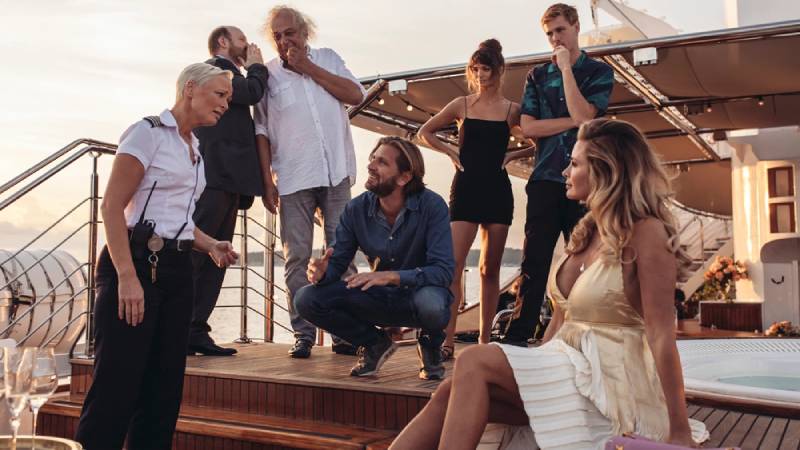
Literal uniforms set the course of the film. Shirtless male models in similar jeans form a disciplined visual choir. Service workers are categorised through clothing: waiters, cooks, yacht deck cleaners in boiler suits, mechanics, security guards in uniform, crew members in classic service attire, and the captain in formal dress. These garments do more than indicate profession. They erase individuality, regulate movement, and distribute authority. Clothing becomes infrastructure.
Even the VIP guests wear an identifier of their own. Their uniformity does not lie in identical garments, but in the shared privilege. They are the only group on board allowed to dress individually, and this controlled variation becomes a class marker in itself. Their unspoken role is to perform wealth. Like everyone else on the yacht, they have a function to fulfil, and they are expected to stay in character.
Even power must obey this system. The captain (Woody Harrelson) is discouraged from appearing before guests in a white sleeveless undershirt and bathrobe. His authority is not questioned because of incompetence, but because he is improperly dressed. Legitimacy mandates the a costume. This logic may seem exaggerated, yet it mirrors real-world reflexes. Recent controversies surrounding clothing and decorum in political spaces, such as the Oval Office, reveal how deeply authority remains tied to form. Power must come dressed to the nines in order to receive recognition.
The yacht’s interior extends this logic into space. It is within this floating environment that model Carl and influencer Yaya move, pose, and perform (Harris Dickinson and Charlbi Dean). The yacht is a textile world: upholstered furniture, curtains, drapes, carpets, rugs, cushions, throws, table linens, pool towels – a floating architecture of fabric designed to signal comfort, softness, and control. Luxury here is not only visual, but also tactile. Textiles absorb bodies, movement, sound, and excess, quietly sustaining the illusion of ease.
.
The winds of (climate) change
The weather replaces human management once things go terribly awry.
The storm destabilises the yacht, seasickness spreads, bodies lose discipline, and vomiting contaminates the textile environment. The forces of nature forces render the system ungovernable, revealing the fragility of our systems. They provide heat to the sunbathing elites. They erupt with the violence of a thunderstorm. Rain showers and bright daylight punctuate the story. The weather isn’t just the backdrop. It actively shapes labour, movement, and survival. Even sunshine – usually coded as pleasure – becomes a challenge. The characters must endure the heat.
The signs of climate change (extreme weather, rising temperatures) do not arrive as a single event. They slowly permeate the film.
As the textile environment becomes unstable, the labour required in order to maintain it grows increasingly visible. Soft surfaces must be scrubbed. Stains must be erased. Odours must vanish. This work is predominantly carried out by women, revealing luxury relies on gendered, repetitive, and largely invisible tasks. Significantly, demands related to textile purity also circulate through female characters. One woman repeatedly insists that the yacht sails should be washed because they appear “dirty grey” – despite the absence of any sails. Her request exposes a fetish for cleanliness detached from material reality. Dirt is intolerable not because it is dangerous, but because it disrupts an aesthetic code – a uniform of sailing, and arguably, of class.
.
Synthetic women
Clothes are subject to strict regulation. Authority and decorum are enforced through dress codes for men as well as women. The captain is reprimanded for attempting to appear before guests in a bathrobe and undershirt, while elsewhere a male passenger complains about a male crew member appearing shirtless on deck. Clothing is not a feminine concern, but a disciplinary mechanism that governs all bodies.
Material differences are also gendered. Non-uniformed male characters tend to wear more natural fabrics, while non-uniformed female characters are often associated with synthetic materials. This suggests femininity as constructed, performative, and replaceable.This is a broad production trend: women’s garments are disproportionately synthetic, while men’s clothing is more often associated with durable and “authentic” materials (such as cotton).
.
Clothes stripped of their authority
After the ship is attacked by pirates and sinks, clothing undergoes a decisive transformation. On the “desert” island, uniforms lose their institutional authority and become evidence. They mark origin, belonging, and trust. A previously unseen man is suspected of being a pirate not because of his actions, but because he does not possess a uniform. When documents and systems disappear, fabric becomes testimony. Clothing turns into a record.
As time passes on the island, garments accumulate dirt, wear, and damage. This is not merely visual decay, but a narrative device – and a quiet reminder that clothes require maintenance and care, actions so often invisible in the “happy” parts of films. At the same time, it becomes clear that clothes have stopped representing status and have begun recording experience. Fashion dissolves into material history.
The final beach-hawker scene crystallises this shift. Alongside fake luxury bags – remnants of the old symbolic economy – the vendor offers straw hats. The hat matters not because it signifies wealth or identity, but because it shields the body from the sun. Function replaces status. Vital needs overtake performative desire. The brand no longer protects the body.
Triangle of Sadness directs its criticism toward the homo consumericus – a subject trained to understand clothing as image rather than matter, as identity rather than responsibility. When systems collapse, this subject is left unprepared, unable to repair, care for, or meaningfully engage with the objects that remain.
The film leaves us with an unsettling takeaway. Systems fail, hierarchies collapse but textiles endure. Clothes do not vanish when meaning evaporates. Instead, they stay with us, demanding labour, care, and accountability. And when garments stop performing identity, they begin to reveal something far more difficult to confront: our responsibility toward the material world that we created. Are you ready to navigate the rough waters of the new world order?
…
.
The images on this article are stills from Triangle of Sadness.