







Punjabi-American Rippin Sindher is a director, writer and producer with focus on movies that trigger social transformation.
Her third short film Flight 182 premiered at the International South Asian Film Festival in 2024. This impressive little gem narrates a family story against the backdrop the terrorist events that killed more than 300 people in 1985. The work won the 2024 Julia S. Gouw Short Film Challenge with CAPE and Janet Yang Productions.
…
.
Eoghan Lyng – What inspired you to create such a probing film?
Rippin Sindher – My biggest motivation for Flight 182 came from a need to remember an erased history and to use cinema as a form of memory justice – for my own family and for the other 328 innocent lives lost on Air India Flight 182 in 1985. I grew up knowing fragments of this story, yet I never saw its human cost reflected on screen. I wanted to tell it through the lens of family, love and the impossible choices people face in moments of fear, while also honoring my uncle’s memory.
EL – Flight 182 was considered something of an attack comparable to 9/11 in 2001. How did the news impact people you knew on a personal level?
RS – I think it’s important not to draw direct comparisons to 9/11, but to understand that this was the largest act of aviation terrorism in the world before it – and yet it barely exists in the public narrative. In the United States, 9/11 has been embedded into the country’s DNA through memorials, museums, education, and an ongoing commitment to remembrance. After the Air India bombings in 1985, communities were terrified to travel, to gather, even to speak openly. There was immense grief, but also a haunting silence, made worse by the fact that victims’ families were largely left unsupported and unseen.
EL – The actors plunge into depths of despair. Was this difficult for them to summon?
RS – This was an emotionally demanding film, balancing suspense, despair, concern, and grief, but the actors I worked with are incredible professionals. Both leads, Sundeep Morrison and Gurinder Sindher, approached the material with tremendous care and trust. We grounded the performances in love rather than tragedy alone, which gave the emotions a deeper truth. Many moments came from focusing on what was truly at stake for their characters, allowing the despair to feel lived-in and honest rather than performative.
EL – For a film less than 20 minutes long, Flight 182 packs a lot in. Did you find it challenging to pad the script out so economically?
RS – Absolutely. Every line and every look had to earn its place. With a $25,000 budget, two and half days to shoot, and four locations, I approached the script with real conviction meaning everything had to be there for a reason. If it didn’t serve the story, it had to go. Restraint became the most powerful tool.
EL – Flight 182 is filmed in a style comparable to a documentary. Please comment.
RS – That was very intentional. I wanted to invite the audience into this household and let the visual language feel like everyday life unfolding, not something staged. Having made several documentaries, and because this story is rooted in real events, I was drawn to textures that felt honest and lived-in. That approach grounds the film in reality, keeps it from becoming melodramatic and ultimately honors the real lives affected.
EL – In your opinion, was the terrorist plot one based on religious idealism, or was it a protest?
RS – This is a deeply polarised issue, and as long as political violence exists, the arguments around motivation will remain tied to personal and ideological beliefs. What matters most to me is how those forces (however they’re defined) devastated real people and real families, including my own. When a 747 explodes midair and leaves nothing, but wreckage at the bottom of the Atlantic Ocean, we must hold up a mirror to what violence in any form truly does. It shatters families. That is why the real failure of this attack is to protect innocent lives. Flight 182 is a human film to me about family and the profound loss left behind after a terrorist attack.
EL – Ridley Scott is credited as one of the producers. What was it about the movie that caught his interest?
RS – I’ve always regarded Ridley Scott as a legendary filmmaker, so having him champion this work is an incredible honour. What matters most to me is that a story rooted in love, loss, and restraint resonated on that level. Flight 182 was made to focus on human stakes and quiet devastation, and to have someone of his stature stand with me is deeply meaningful. His support has meant the world to me.
EL – Please tell us about the airplane scenes. Were there any technical challenges?
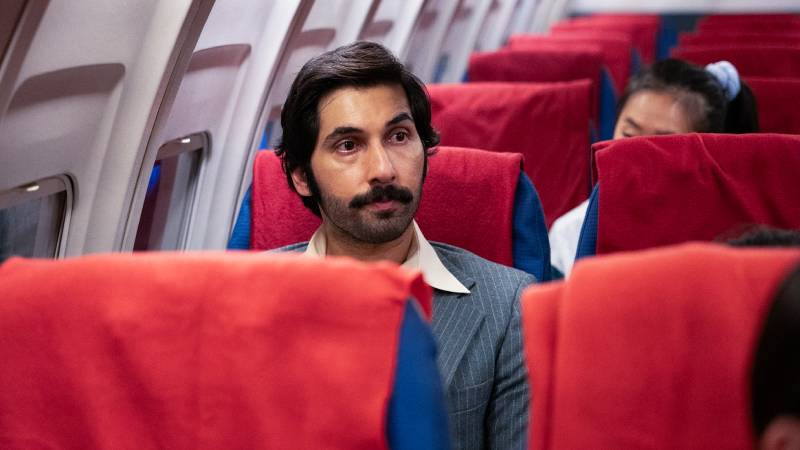
RS – Those scenes were some of the most challenging because we shot all of the airplane and airport sequences in half a day with a large number of extras. Budget-wise, we couldn’t afford real conveyor belts for the luggage, so we had to get creative. My production designer and art director built a clever, practical contraption that allowed the suitcases to move convincingly on camera. It was a great example of how collaboration can turn limitations into something cinematic.
EL – At one stage, a mass of clouds appears in the sky, suggesting a storm is to come this way. Please comment.
RS – The weather is very much a character in the film. As the story builds toward a point of no return, the brewing storm mirrors that emotional tension. To me, it reflects how little control we truly have on any given day and the quiet dread of choosing to move forward when everything feels unsafe; the sky darkening, the rain coming and an ill-fated flight still ahead.
EL – Forty years on from the attack, how do you think the world has changed and developed?
RS – So much has happened in the 40 years since, including other devastating attacks around the world. What feels most important to me is recognising patterns of systemic failure: how policies, practices and warnings were overlooked. If we don’t examine those failures honestly, we miss the opportunity to learn from tragedy. Accountability is the only path toward preventing future loss of innocent life, which is why I’m so committed to getting this film into the world. We have to remember and understand shortcomings in order to better protect human life.
EL – Would you consider building on this for a series or feature length movie?
RS – Yes, very much so. The short was always meant to be a doorway into a larger story. A feature allows the space to explore the investigation and the long aftermath in a deeper way, and it’s something I’m deeply committed to pursuing.
EL – What are you working on at present?
RS – I’m developing the feature version of Flight 182 while also building a slate of projects centred on untold histories and bold storytelling. I’m drawn to stories that sit at the intersection of cinema and social impact, and that’s what gets me up every day… knowing I have a distinct voice as a filmmaker that can spark conversation, curiosity and change.
…
.
Rippin Sindher is pictured at the top of this interview, as pictured by Evan Odinsoff. The other image is a still from Flight 182.


