








.
Michael Haneke’s Amour (2012) presents a narrative about ageing, care, and death through a lens that interrogates contemporary biopolitical apparatuses. Through the story of an elderly couple confronting bodily collapse and institutional abandonment, Haneke constructs a cold, silent, and ethical portrait of life management at the threshold of death. This article proposes a reading of the film through the theoretical frameworks of Michel Foucault on biopolitics, Giorgio Agamben on bare life, and Achille Mbembe on necropolitics, emphasising how Amour reveals exclusionary mechanisms and microgestures of resistance inscribed in the act of caregiving.
…
.
From love to the admin of death
Haneke opens Amour with the final scene: Anne’s decomposing body surrounded by flowers. The narrative, told in retrospect, guides us through a journey where affection is confronted by the limits of the body, time, and power. This is not merely the portrayal of physical degradation, but an inquiry into how cinema can function as a critical device in response to biopolitical rationality.
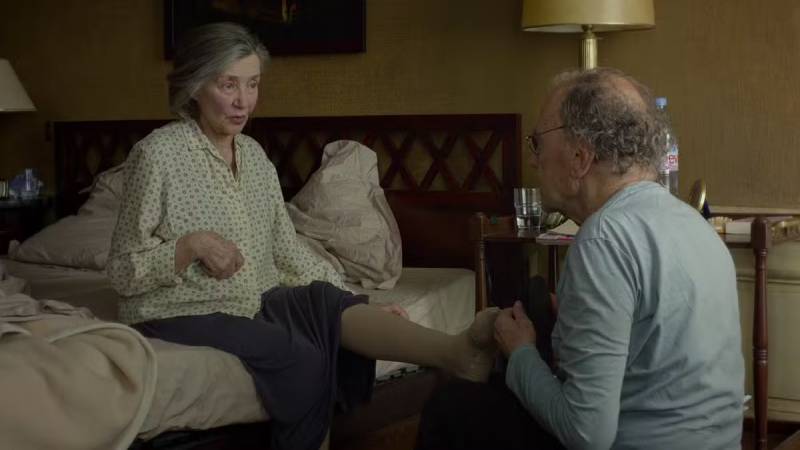
The home represents the bioterritory, and the regime of confinement. The Parisian apartment, filled with books and classical music,transforms into a microcosm of control. The house, once a space of autonomy, becomes a site of institutionalised aging. According to Foucault, biopolitics governs life through mechanisms that regulate bodies, habits, and expectations of productivity. When Anne falls ill, her body ceases to be the subject and instead becomes the object of management.
Georges’ refusal to hospitalise Anne becomes a gesture that resists biopower. By keeping care within the domestic sphere, he removes the beloved body from the medical circuit of diagnoses, treatments, and standardized death. Intimacy becomes a field of resistance.
.
Necropolitics: the decision to kill
At a certain moment, Georges ends Anne’s life. This act may be read as a compassionate end to suffering, but also as an ethical rupture with the necropolitical apparatus. For Agamben, “bare life” refers to existence stripped of political value. By denying Anne a technicised and impersonal death, Georges restores the dignity of her end. Death becomes an intimate choice, not a clinical protocol.
Achille Mbembe, in his concept of necropolitics, reveals how the state and its apparatuses decide who may live and who must die. Amour denounces institutional omission, where the elderly are socially discarded before biological death. The daughter, eager to “solve” the situation, embodies this logic: outsourcing care, rejecting the unproductive, and rushing to normalize loss.
.
Care and the micropolitics of affection
In Amour, to care is to resist. To resist haste, diagnosis, indifference. Through fixed, lingering shots, Haneke constructs a temporality that rejects spectacle. Care is not romanticised – it is exhausting, desperate, yet insurgent. It introduces a different tempo, one that defies acceleration and efficiency.
The pigeon that enters the apartment twice symbolises the otherness that escapes control. When Georges gently catches it, his gesture is not one of dominance, but of welcome. The bird, alive and free, inserts a poetic crack in the space of control.
Amour offers no comfort – only the silent ethics of presence. By exposing old age as a symbolic and material battleground, Haneke creates a film in which the politics of touch, silence, and persistence oppose the erasure enforced by biopower. The home becomes a battlefield. The body, a disputed territory. And love, though never named, emerges as the last form of insurgency.
