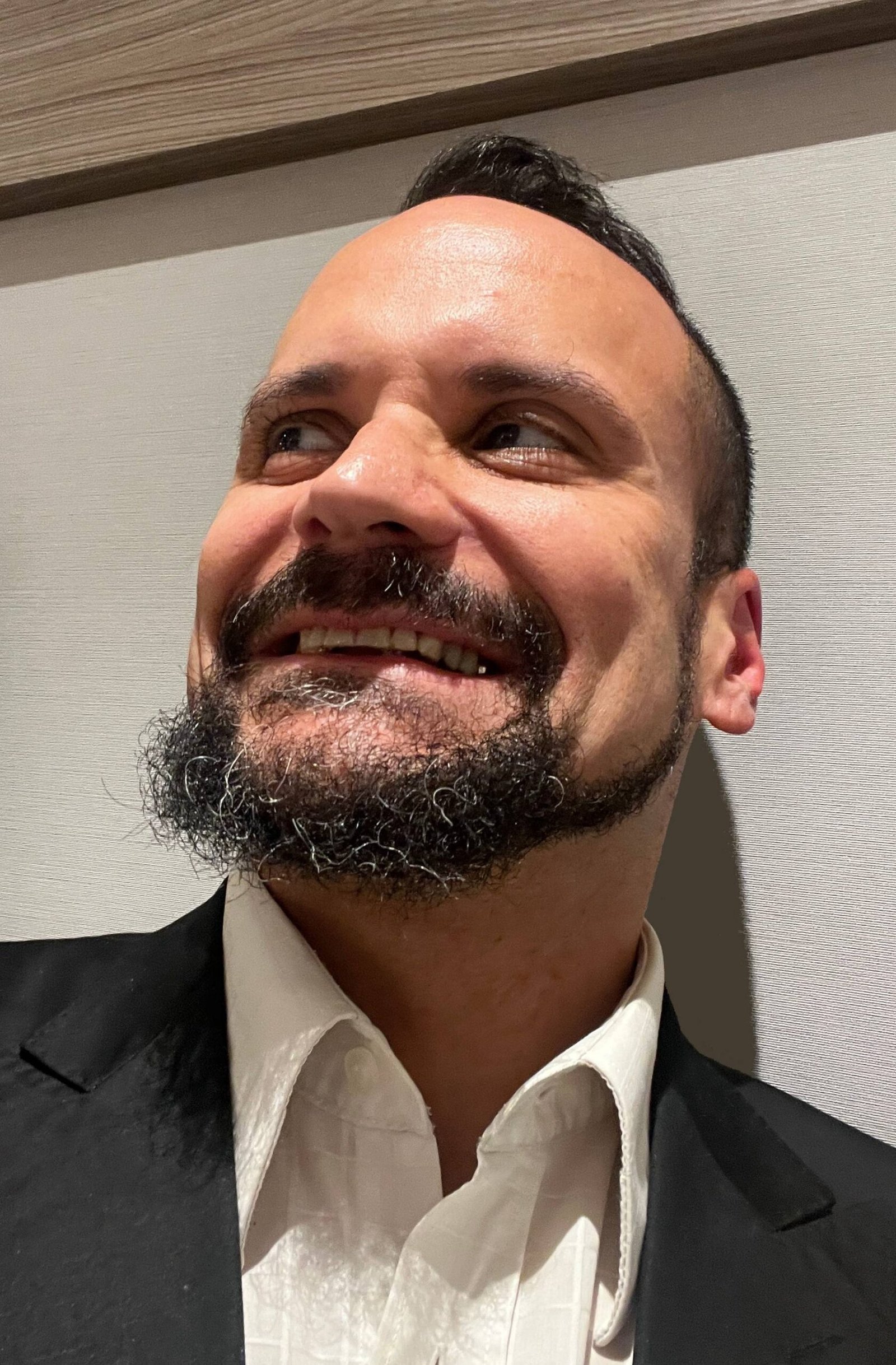









Munir (Lebanese actor and writer Georges Khabbaz) is a middle-aged Arab. He has a thick beard and big pearly eyes with a distinctive sparkle of sadness. He talks to his mother on the telephone and promises her that he will return for a visir. He then lands in Langeneß, a remote municipality in northern Germany (Wikipedia reveals a population of just 132 inhabitants). The coastal landscape is dotted by a few houses. These sparse constructions stand on little mounds known as halligs. The landscape often gets flooded, and these elevations turn into little islands (keeping locals safe from maritime harm).
It is not clear where Munir mother is. In fact, it’s not even clear whether she exists. We’re never told where Munir comes from, how he ended up in Germany, and why he decided to travel to such an unlikely location, which leads absolutely nowhere. This is a movie that fuses dream and reality, while constantly drawing parallels to the immigrant experience. Human beings are in constant motion, and their experience is elusive and transitory, the story seems to tell us repeatedly. This message of transitoriness and aimlessness is perhaps explained by the fact than that 33-year-old director Ameer Fakher Eldin was born in Ukraine to Syrian parents, and lives in Germany. He is a genuine “citizen of nowhere”.
Our meandering protagonist seeks refuge in the local bed and breakfast, run by Valeska (Fassbinder veteran Hanna Schygulla, now aged 81). At first, the woman comes across as rude and unhelpful, perhaps even racist. She refuses to give him a room because he did not have reservation (despite the obvious absence of guests). Munir begs for help: “please, please”. Her heart suddenly melts and she opens the doors to the quiet and mysterious man, who speaks broken German with a strong foreign accent.
Initially, it is awkwardness that prevails. Gradually, they develop a genuine affection. On the other hand, their verbal communication remains extremely frugal. Valeska’s only child Karl (Tom Wlaschiha) does not get on with the new guest, particularly after catching him having dinner half-naked with his mother. Valeska had insisted that Munir took off his wet shirt (presumably from the rain) so that he did not catch a cold. The Arab eventually breaks the ice and bonds with the reserved young man, and even with the other locals. The nature of their relationship is fully manifested in a strange wrestling contest. The unexpected integration comes full circle when Valeska plays Arab music in an old CD-player, and Munir becomes spiritually entranced (in one of the movie’s most beautiful scenes).
The photography of this little-known area of Germany is spectacular, particularly after a storm causes the waters to rise by nearly nine metres. The region becomes inundated, and the life-saving function of the halligs more prominent. There are abundant slow takes and long shots of the landscape. This is a meditative movie with a duration of more than two hours. It partly relies on the twists and turns of nature in order to drive the narrative forward.
Similarly to last year’s Who Do I belong To (Meryam Joobeur), which also premiered in the Official Competition of the 75th Berlinale, Ameer Fakher Eldin’s film is bursting with references to Arab culture and spirituality, which non-Arabs may not grasp. Sepia-coloured images of a shepherd, his sheep and his wife on a desert environment intersperse the developments on German soil. There are repeated references to a man with “no mouth, no nose and no ears”, and occasionally with “no eyes”. Is this an allegorical omen? Memories from Munir’s mother? Or a hallucination? The mysterious signifiers do not compromise the viewing experience. Yunan is movie open to interpretation. A sensory, unworldly experience. And a very personal return journey… to a place you never left!
Yunan premiered in the Official Competition of the 75th edition of the Berlin International Film Festival, when this piece was originally written. Also showing in the 5th Red Sea International Film Festival.