








In the year of 1858. Bologna’s inquisitor Father Pier Feletti violently removes Edgardo Mortara (Enea Sala) from his large Jewish family (mother, father and five siblings) after a former servant alleged that she secretly baptised him as baby. Despite his parents’ desperate plea for help, and the international commotion that the case generated (indignant newspapers across Europe and the United States demanded that the child is returned to his family, even gathering support from some Catholics). Edgardo was sent to Rome to live with other stolen children, under the direct purview of the Pope. The leader of the Catholic Church had personally ordered his abduction of the young boy, at a time when the government of Bologna was directly controlled by the Catholic Church. And he was unlikely to change his mind, having instituted the controversial doctrine of Papal infallibility just a few years earlier. Not quite a man of compromise!
Edgardo’s allegiance switches back and forth as the little chid attempts to adjust to his new life, particularly when his father and the his mother pay him a (heavily monitored) visit. He tells her that he still prays in Hebrew twice a day, evoking the fury of his tormentors. As time goes by, Stockholm syndrome begins to set in. Just a year later, Bologna is annexed by Italy, in what was the beginning of the country’s Unification (Risorgimento).This rekindles the Mortaras’ hope to be reunited with their child. Father Feletti goes on trial for abduction, but it seems that only the Capture of Rome that would enable the family to become whole again. Rome would fall 11 years later, in 1870. But would that be too late? Would an Edgardo in his late adolescence have been irreparably brainwashed? What happens next is particularly significant not just for the film’s narrative arc, but also for the history of Italy and the Catholic Church.
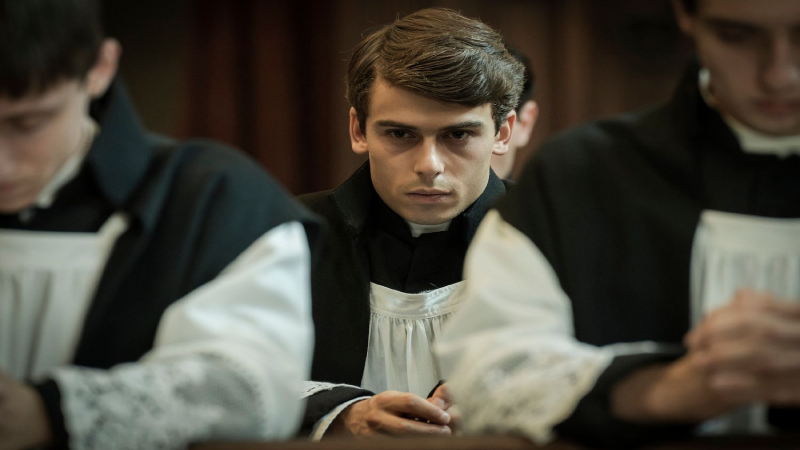
This is a straightforward historical drama, narrated in strictly chronological order, devoid of lyrical freedoms and unusual narrative devices. The only symbolic imagery are in the two dream sequences: one of Edgardo freeing Christ from the cross (as he begins to make piece with his kidnappers), and another one of the Pope being circumcised (portraying the Pontiff’s fear that the Jews could exact revenge on him). The production values are very high, with a convincing recreation of Italy a century and a half ago. The streets of Bologna, the glimmering St Peter’s Basilica and the costumes look very convincing. I would hazard a guess this was done in studio combined with CGI, very much doubting that the Vatican would open their doors to a film that portrays one of the most important popes in history as an anti-semitic child snatcher.
Kidnapped deserves more praise for some interesting historical insights and a cohesive structure than for its dramatic abilities. The dialogues lack vigour, and no single performance deserves particular praise. The final scenes never reach their full potential, and – while educational – Marco Bellochio’s 28th film is unlikely to trigger any powerful emotional responses. It is the historical content that you will stay with you. In other words: Kidnapped works as a fit-for-purpose, educational film. It also serves to demonstrate the emotionally destructive power of religious doctrine and dogma. A quick Google search reveals that the major developments here portrayed to be historically accurate. Phew!
The 83-year-old Italian filmmaker has directed a string of historical dramas, including the equally auspicious The Traitor, which premiered in Cannes four years ago. Kidnapped showed in the Official Competition at the 76th edition of the most prestigious film festival in the world (Cannes), when this piece was originally written. Also showing at the Tallinn Black Nights Film Festival, and at the International Film Festival Rotterdam. In cinemas on Friday, April 26th. On VoD on Monday, June 24th.,