






The action takes place in Indianapolis, in the United States. On February 8th, 1977, disgruntled and bankrupt Tony Kiritsis walked into the office of mortgage company president Richard Hall, and took him hostage with a sawed-off shotgun wired to his own neck — a so-called “dead man’s wire,” ensuring that any attempt to stop him could turn fatal. Kiritsis blamed Hall for his ruin. Gus Van Sant`s latest film Dead Man’s Wire revisits this chilling true story, transforming it into a tense, character-driven portrait of desperation, rage, and a man pushed to the edge.
In an exclusive interview, Nataliia Serebriakova speaks with Swedish actor Bill Skarsgård, who plays Tony, about inhabiting such a challenging role, navigating its moral complexity, and bringing humanity to a figure often seen only through the lens of violence.
Dead Man’s Wire is in cinemas on Friday, March 20th.
…
.
Nataliia Serebriakova – What did you know about the real Tony Kiritsis case and did you approach the script?
Bill Skarsgård – There is a great deal of material available about the real case, from many different perspectives. I did quite a lot of research. The central issue revolves around his claim that the mortgage company deliberately exploited him in order to take his land. Naturally, there are conflicting accounts. The company denies wrongdoing and suggests that he was mistaken.
For me, as an actor, it was essential that Tony believed he was right. That became my truth while playing him. Whether that aligns with the objective truth is open to interpretation. I also had to familiarise myself with the concept of mortgage brokers, which we do not really have in Sweden. The idea that such intermediaries operate outside traditional banking structures felt somewhat questionable to me. That informed my understanding of the character’s situation.
NS – I heard you describe the film as a dramedy, and I do feel that it combines real drama and comedy. Could you tell me more about that?
BS – Yes, I think the film turned out to be funnier than we expected while we were making it. There was something about Tony that I personally found amusing from the beginning. As we continued shooting, he became even funnier. Even his anger can sometimes be funny, but it is also very important that it feels real and grounded. His anger may be humorous at times, but it can also be dangerous, even lethal, and at moments tragic. So it is a drama, a comedy, and even a bit of a thriller, specifically a hostage thriller. Ultimately, I hope it is anchored in something that feels authentic. But yes, I do think it is quite funny as well.
NS – You are well known for playing villains. What is the difference between your previous villain roles and this character?
BS – In this film, I did not approach the character as a villain. Depending on perspective, he might be seen as an antihero or a villain. In some films, the distinction between good and evil is very clear, but this film is much more nuanced. At the core, he is a desperate man who is cornered and very angry, but he is still a human being. So I never thought of him as a villain, even though he does terrible things.
NS – You share extensive scenes with Dacre Montgomery, who played Richard Hall. I know he has certain rituals in order to get into character. How did you work together?
BS – I have nothing but positive things to say about Dacre. We had a great time working together. He is a very thoughtful and intense actor, and I think I am similar in that way. We spent three days together with Gus, going through the script. That helped us build trust and mutual respect. We are both quite opinionated, so there were moments of strong discussion, and Gus acted almost like a calm, guiding presence, allowing us to explore until we found the right direction.
Dacre brought a great deal to the role, and I think he is excellent in the film. We influenced each other’s performances and developed a strong connection. In a way, even though the relationship between our heroes is complicated, there is a certain connection between them, and I think our off-screen relationship helped shape that dynamic. I think both characters are, in some way, victims of the same system. Especially in the scene with the father, played by Al Pacino, it almost feels like two estranged sons seeking attention and approval.
NS – Your character Tony feels that he has always tried to be a good citizen, but society, and particularly the bank, does not treat him fairly or show compassion. Do you think that in certain cases injustice can justify violence against those in power?
BS – I want to be very clear that I do not justify Tony’s actions. I believe that violence is almost never the answer, and there is usually a better path. However, that does not mean his actions are not understandable. Tony is a deeply pressured individual, and when that pressure builds over time, it can lead to dangerous outcomes. He feels that he has worked his entire life toward a promise, something like the American Dream, which suggests that hard work will eventually lead to success. But that promise is not always real, especially within a system that can be unfair. So while his actions are understandable, they are not justified.
NS – Watching Dead Man’s Wire, one is naturally reminded of Dog Day Afternoon (Sidney Lumet, 1975), one of the greatest films in the hostage genre. Was having Al Pacino, the star of Dog Day Afternoon, involved in this project helpful? Did it create any pressure for you? Did you have a chance to discuss Dog Day Afternoon with him? Your scene together felt like the emotional core of the film. It was truly beautiful.
BS – Thank you very much. I only met Al once in person. It was at a restaurant in Los Angeles. Sam Pressman, our producer, was there with him. I was not originally at the table, but Sam came up to me and asked if I wanted to meet Al. Of course I said yes.
Al was just about to leave, so we had a very brief interaction. Sam introduced me and said that I play Tony in the film. Al responded, “Oh, so you are my son.” I said, “No, I am the other guy.” He replied, “Oh, the other guy. I am coming after you. I am going very dark with this”. That short exchange meant a lot to me.
Later, we rehearsed the scene together. Al was not physically present, but we had a session over video call. It was myself, Dacre, and Al, reading through the scene. At first, it felt a bit awkward, as these things often do, but gradually we became more immersed in it. At a certain point, we were fully performing the scene together.
There were moments when we would pause and realise that we were acting in a scene with Al Pacino. It was incredible. What struck me most is that despite his extraordinary career, he remains very playful. He clearly loves acting and performing. I found that deeply inspiring. I hope I can maintain that same joy in my own work over time.
NS – Gus compared you to Lon Chaney, which is an incredible compliment. How do you feel about that, and why do you think directors are drawn to you in this way?
BS – I do not know, you would have to ask Gus. As for the comparison to Lon Chaney, I am very flattered. He was known as “the man of a thousand faces,” and that is a wonderful legacy to be associated with.
Working with a director is a crucial part of what we do. When you meet a director who inspires you and challenges you, it helps you to grow as an artist. That was certainly the case with Gus. I learned a great deal from him, and I would gladly work with him again.
NS – Would you ever like to play a more “normal” character, perhaps in a romantic comedy?
BS – To be honest, “normal” often feels quite uninteresting to me. However, after playing an intense character like Tony, there can be a desire to explore something more restrained or subtle. I enjoy variety. That said, I have never been particularly drawn to conventional roles. Perhaps one day I will surprise you and appear in a romantic comedy.
NS – You come from a very artistic family [he is the son of iconic Swedish filmmaker Stellan Skarsgård, and the brother of Richard, also a renowned thespian in his own right]. Where do you see yourself within that family, both personally and professionally?
BS – Personally, I would say I am number four among several siblings. I have three older siblings and four younger ones.
NS – And artistically?
BS – I do not really think about it in that way. It is not useful for me to rank myself. Others may have their opinions, but for me, I am simply one member of the family.
NS – During the award season, you were competing with your father Stellan [who starred in Joachim Trier’s Oscar-crowned Sentimental Value]. How do you feel about that, and what advice has he given you?
BS – I do not really know. It is a rare situation. Not only does Stellan have one of his best performances in recent memory in an excellent film, but my brother Alex as well, in Pillion [Larry Lighton]. It is quite special that the three of us all have these independent films this year. I think the main thing I feel is that I am missing out, because I have been working in Australia. I see Stellan and Alex attending festivals together, spending time together, enjoying it, while I have been away working. So more than anything, I feel a sense of missing out.
…
.
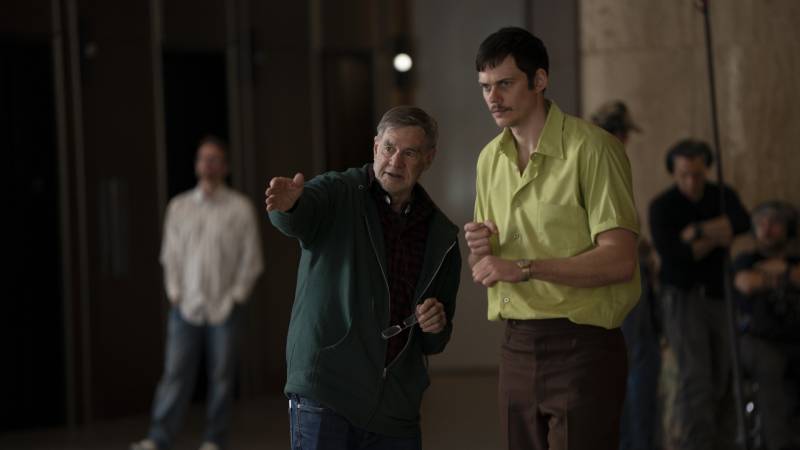
Bill Skarsgård is pictured at the top of this interview, in a still from Dead Man’s Wire. The other image is of Bill and Gus Van Sant on set.