







Thirty years after the release of Dutch director Alex van Warmerdam’s The Dress (1996), the clothing industry has become faster, more opaque, and vastly more productive. The consequences are now so visible that even the European Union has begun intervening in order to address the mounting volume of textile waste. Against this backdrop, the film becomes an early meditation on the ethical and material burdens clothing carries.
The Dress begins neither with a character nor with a moral dilemma, but with production instead. For several minutes, the camera lingers on cotton plants swaying in the wind, before a cutting machine moves across the field. The sequence gestures toward the origins of the garment without dwelling on them; just as the process of making is about to unfold, the film cuts away. What matters here is not a complete account of production, but the insistence on material beginnings. Long before the dress acquires social meaning, it must first take material form. Clothing appears here not as identity, but as matter shaped by systems of production – systems that are invoked, yet never fully shown.
The fashion industry presented here is not driven by artistic vision, but by the desire to sell a garment with the “right” pattern and colour. The textile designer does not invent the motif; he copies it from an Indian textile, translating it by hand into something that can be sold. Creativity appears as reproduction, and not originality. Compared to today’s globalised supply chains, the garment’s material footprint appears relatively modest – a reminder that the film belongs to a moment before synthetic fibres came to dominate global production. That was a time when the origins of a garment were still more easily traceable and the maker remained identifiable.
…
.
Words unspoken
Violence lurks beneath this seemingly transparent production. The fashion designer’s abusive and dehumanising behaviour is witnessed by a courier who has just delivered the fabric sample from which the dress will be designed. He sees what happens – and says nothing. His silence is a device of the status quo. His word carries little weight, and the risk of unemployment outweighs the moral impulse to intervene. No reckoning follows, no interruption takes place. This silence resonates uncomfortably with parts of the contemporary fashion industry, where the social and environmental costs of production are similarly suppressed. The unspoken acquires an extra layer of significance.
The dress enters social life through a woman deemed “too old” to wear it. Age, desire, and decorum converge, yet she makes her choice independently. The dress does not restore youth, and it does not rescue her from death. Before she dies, however, she leaves precise care instructions: wash by hand, in cold water, hang outside to dry. These instructions matter. They anchor the garment in a regime of slowness, skill, and attention – a form of knowledge that precedes both automation and disposability.
The wind carries the dress away. What follows is a linear journey for the garment, but not for the humans who encounter it. When the dress lands in the hands of a gardener, the film makes something quietly evident: garments do not simply disappear. There is always somewhere for them to go, and with every material object comes responsibility. Recognising the dress’s value, the gardener attempts to locate its owner, but without success. Instead, he passes it on to a cleaner, setting off another chain of encounters.
.
A long journey
Eventually, loaded with bad memories, the dress is donated for Africa. Its stains are dismissed, as though imperfection were acceptable once the garment is destined for elsewhere – for a place imagined as distant, undemanding, and other. The remark encapsulates a familiar moral logic: relief achieved through distance. The film then reveals the infrastructure behind such gestures – warehouses, sorting centres, resale by weight. Charity reveals itself as commerce.
It is from one such warehouse that a second-hand shopkeeper retrieves the dress, shortens it, and offers it for sale. A young girl buys it, though her mother withholds approval – echoing an earlier moment in which an older woman chose the same dress despite being told it was too youthful. Then, as now, the garment appears to promise transformation. Yet clothes cannot suspend time, secure validation, or deliver the futures projected onto them.
Soon after, the dress is stolen by a homeless woman. Here, clothing sheds its symbolic weight entirely. The dress becomes insulation, performing its most fundamental task: keeping a body warm. When the woman dies, a familiar male figure tears a strip from the fabric and wears it as a scarf. The fragment shifts from bodily protection into an object of memory, while the remaining garment travels with the body to the incinerator – where clothes so often end up.
The scarf is eventually caught in a lawnmower, returning to the environment as fibre, thread, residue – matter awaiting another transformation. The loop appears closed, yet never fully is. Much like today, only a fraction of textiles ever becomes something new. The dress is painted and displayed in a museum, where the image is vandalised. Restoration remains possible. Today, in the age of social media, the photographed dress would likely circulate endlessly online. What we rarely consider is that such images accumulate. They create digital debris.
.
Creation outlives creator
The titular garment reappears, resists closure, outlives its owners, and refuses moral resolution. It exceeds human narratives. The dress does not care who deserves it, who desires it, or who suffers because of it. It persists. And precisely because material objects outlive us, responsibility cannot end at the moment of creation.
The film confronts us with an uncomfortable inversion: humans pass through the garment’s life, not the other way around. Skills disappear. Bodies age. People die. The dress endures – changing form, function, and meaning, yet never entirely disappearing. The Dress reflects on how textiles circulate beyond intention and control – and on the quiet yet enduring responsibilities they leave behind.
…
.
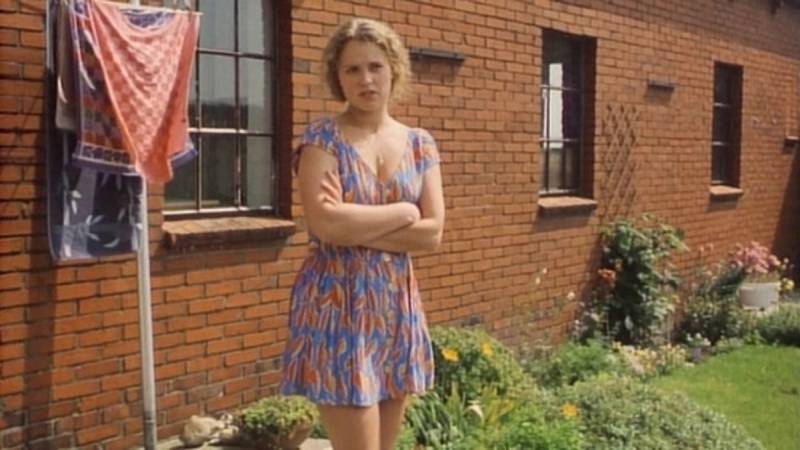
The images on this article are stills from The Dress.