






Sara Summa is a Franco-Italian filmmaker currently residing in Berlin. Her debut feature The Last to See Them, had its world premiere at the Berlinale in 2019. She delivered her sophomore feature Arthur and Diana – about a small family unit travelling across Europe in a shared vehicle fours years later at the Toronto International Film Festival.
Arthur & Diana has been selected to the 10th edition of the ArteKino online film festival, and it is available to stream for free during the entire month of December 2025.
Click here in order to watch Arthur & Diana now.
…
.
Eoghan Lyng – Please tell us about the genesis of Arthur & Diana!
Sara Summa – I always start projects from an image that forms in my mind and gets stuck there, until I accept to take it seriously enough, and see if it could become a movie. In this case it was a blurry frame of my brother and myself in movement, full of colours and very dynamic. That eventually inspired me to think of this cinematographic set-up, where I am in front of the camera instead of staying hidden behind, and I try to create a world from up there… I also really wanted to share a creative adventure with the people I love, we were coming from long corona-years of restrictions, and I wanted us to spend time together, feeling free and playful. So I decided to just throw myself into this image with Lupo and Robin and a lot of other important people from my life, who however all stayed behind the camera! But the idea was to put something very real (real family members) in contact with something completely crafted and fabricated (a fiction with actors and invented storylines and places), and see what could come out of this mix, in the contrast between the two. In my experience, that’s part of how life can happen in film – and I feel like it somehow did!
EL – In terms of schematics, did you decide to shoot it like a documentary from the get-go, or was that an organic development?
SS – I’m always very happy to hear the film comes off as something organic and real! However I wouldn’t really say we shot it like a documentary at all actually. I think of it more like the opposite of a documentary in the form. The way the film was shot is very artificial and it took a lot of work from every department, to get this natural vibe going – if you look at the details, it’s extremely composed and crafted. Every shot is colour-coded, between the props, the costumes and the sets; almost every position and movement is choreographed; there are details that are happening besides the main action in the image, that create side narratives or gimmicks that you can discover when you watch the film a second time. The camera is always static and positioned quite carefully. There is an alternance of postcard-like long-shots, with pretty intensely in your face close-ups.
What probably gives it this “documentary” vibe, is maybe the feeling that one is watching “found-footage” on some level. The formats we decided to shoot on, take part in creating this 90ies home-movie video vibe I guess, and that was a very decisive choice from the get-go in fact. It was an enormous challenge using these different vintage video cameras (plus some 16mm), and then also printing the entire result on 16mm. We had to do a lot of tests before shooting, and during post-production again. And these cameras gave us a certain freedom and lightness in shooting, but they also limited us a lot in some choices and kept on breaking along the way, and having to be replaced, or sometimes just messed up entire takes. The post-production process was also very complicated and extensive, technically speaking.
Besides the general somewhat nostalgic vintage look – that we however really put a lot of effort into breaking constantly inside the shots, using modern props like ugly plastic bags, and smart phones, etc – the acting is maybe the other element that carries a lot of weight in making the film feel direct and unfiltered. I would say that probably mainly comes from Lupo’s character, who was two years old at the time of shooting, and who is practically in every scene and most shots of the film. He set the tone for something more immediate I think, and I’m incredibly thankful to him for that.
EL – How comfortable was your brother in divulging a side to himself that reflected some of his personal life?
SS – In a way that was never a topic that we had to address in the making process. Because the film it not conceived as an auto-biography, but rather an auto-fiction. So it was more like performance art, throwing ourselves in front of the camera together, in our real family constellations, but into a fiction. So Arthur and Diana are proper characters, they are not us. One could say they are a filmic/comedic caricature of ourselves in some respects, but also very different in other ways. And the conflicts and stories we tell in the film are not our own. The movie is entirely scripted and the storyline is very much made up. The topics we tackled were however close to home obviously, be it family relationships, motherhood, childhood, the search for freedom, or of course mourning. I wouldn’t make a film about something I don’t connect with, or feel like I haven’t experienced in some way.
As for the work as actors, we also spent time together with my brother Robin in rehearsals prior to shooting, to develop our characters further, and give them as many fictional elements as possible, distancing ourselves from them. But, of course, as an actor you end up putting a lot of yourself into a part, and that’s what makes a performance good and real and beautiful, if you succeed. But that’s true in any type of film I think. I think we were very much working and acting out a fiction while making the film, and didn’t really think so much of the personal aspect of it all.
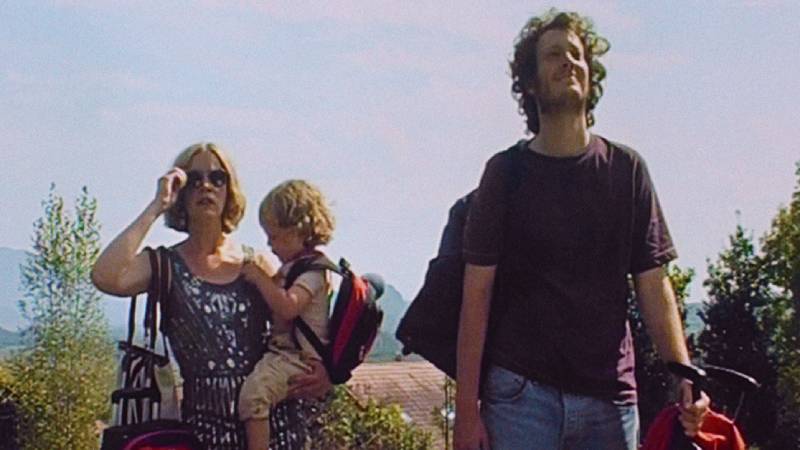
EL – How did the toddler react to the setup of a film; did he need coaxing? This movie is reminiscent of the Coen Brothers, especially Inside Llewelyn Davis (2013). Is that a fair comment?
SS – So, as you know, the toddler is my son and he was two at the time of shooting. He was very aware of being part of a film, and that he was working and playing a part in something. In the morning he would even ask me if the clothes I’d laid out for him to wear were his clothes for the day or his costume (he was on set with us every shooting day, but only did half-time). So he was very keen and super happy to be a part of this adventure with us. The team was also made of people who were his friends, so to speak (he knew many of them prior to shooting), so he felt very at ease. Anyway, he was aware of the process, but actually once we rolled, he would completely forget the camera and just be in the moment “here and now”, like most children are. Especially since he was always with his mum and his uncle in the scenes, it just felt very real and natural to him. I could steer him in the direction I needed, by being his acting partner and his mum on screen.
I also wrote the role for him, so it mainly reflected who he is to begin with. And the most surprising thing is that he repeated the same actions and reactions take after take, but always in a very spontaneous way, because he was just reacting again to the same thing in the same way, it wasn’t an act. He also came up with lots of actions of his own, which were great, and since he could tell we loved that, he would also repeat those as well, take after take! Of course he got tired after a bit, so we always made sure to do his shots first, so that he could be done fast, and we’d continue the scene without him.
As for the Coen brothers: very interesting, I actually really never thought of it that way. I guess maybe you’re referring to a certain type of playfulness that is also in their films? I saw “Inside Llewelyn Davis” when it came out, but never again since, so my recollection of it is a little blurry, but I will look into it again now!
EL – Is there potential to remake Arthur & Diana as a series?
SS – That sounds fun! I can totally imagine a sequel to the film or, as you say, maybe a serial format that deals with these same themes, with real-life characters that we see growing along the years! Lupo has a little sister now, and I’ve been waiting for an opportunity to have her do her on-screen debut, so maybe you’re onto something… I’m kidding obviously, but if anyone has money to finance the adventure, I’m ready!
EL – What were the most difficult scenes to film? For example, was it difficult to light inside of a car, and in other natural environments?
SS – Yes, the car was a challenge light-wise and grip-wise, not to mention sound-wise! The space was very limited and we wanted to have as much flexibility and possible. It’s also not clear if we always had all the permits needed to shoot the way we did, so that created an extra element of tension. But we had a great team who was very dedicated and really did an amazing job at it all. For some of the natural environments, when it was day time, we shot with available light and mainly a lot of mirrors. But at night it got tricky, especially because of the cameras we were using, that are not light sensitive at all, yet we wanted to preserve the natural look and not start lighting up an entire forest. So we decided to work with the darkness and embrace it in a way, play with it once again.
Bigger crowd scenes are obviously always a bigger challenge as well, like the party or the cemetery and wake, but actually I think they were also mainly a lot of fun. A scene that became particularly tricky, was the sequence in the car, when they drive around with their mother Betty. I wanted it to be all in one shot. We were on a trailer of course, but the path we were taking was super complicated and to go back to the starting point was very time-consuming. It was a challenge in terms of acting, to get all the lines right and everyone’s best performance, including Lupo’s reactions (he was prompted to react the way he did, because he knew it was all pretend), with very little time at hand, in as few takes as possible, and a camera that would sometimes work, sometimes not! And at some point the sound started failing as well (connection problems throughout traffic)! We had set base in a peripheral neighbourhood where it felt like some tension was in the air, and a lot of the locals really wanted to interact with us and understand what was happening, which we tried to facilitate, but we also had to work and it wasn’t optimal. Plus I had bronchitis…! So, yeah, that sequence got pretty stressful. But maybe it was a good thing, as the scene is a tense one, and it probably reflected that.
EL – Was it tempting to write the screenplay to incorporate aspects that belong in the realm of magic realism?
SS – Well, that was definitely part of the fun of making this film – being free to go in all directions. The concept aesthetically and in terms of storyline was very much to go crazy, and to be as playful and eclectic as possible. We mix different layers of time, as the film is about present, past and future, and that had to be present in the look and the entire essence of the movie. I’m not really one for fantasy as a genre, but magic realism is really a beautiful part of film and, I think, life. So, I really enjoyed opening these other doors and leaving a lot of space for imagination there, also in terms of what we give the viewers and what we leave unanswered. Is it all a dream? That golden owl story was really a gem for me in terms of script writing. It’s something my brother told me about at the time I was inventing the film, because it’s a real treasure hunt that exists and that he had taken an interest in. It felt perfect for us, not just as a gimmick, but to express Arthur & Diana’s relationship arch in a way. And funnily enough, the real owl was actually finally found, after over 30 years of search, practically on the day of the German cinema-release of our film!
EL – Did this style of movie allow for improvisation; can you describe examples of it?
SS – We wanted to remain free and leave some space for that from the start. But, as often, our shooting schedule got crazy intense, too many shots for too few shooting days, and with all the traveling in between… so I feel like the way improvisation finally made its way into the film was through Lupo, who didn’t always follow script. He gave us lots of treasures that we were able to catch and react too, both with the camera and with our characters, acting with him in the directions he lead us in. Then I had to decide how much to keep of that in the editing process, but I really still think this is one of the biggest strengths of the film. A type of beautiful imperfection that mirrors life so very much.
EL – In your view, what are some of the strides European indie cinema has made in the last few years, and how do you relate to them?
SS – Wow, that’s a very broad question, but maybe the first thing that comes to mind is a sort of hybridation of films, with a blend of fictional and documentary elements, sometimes even some experimental ones. I mean, that’s definitely not new strictly speaking, but it seems to be making a sort of come-back, and you can observe its development in the films of more and more independent European filmmakers (Carla Simon, Radu Jude, Pedro Pinho, Pietro Marcello, Valeska Grisebach, etc). It’s obviously something that is close to my cinema as well, and which I find to be a very interesting approach. I’m not just thinking of “Arthur&Diana” in my case, but also my previous feature “The last to see them”, and the ones to come as well…!
EL – Are you working on a new film at the moment?
SS – I am working on three new films to be exact, but all taking what feels like forever to develop, or more exactly to finance! That’s just it with independent auteur-cinema, it’s not that straight-forward in the making-process… But anyway, I can try and divulge a little bit: one is a tragic love story with lots of music, set in a snowy landscape in Canada, and against the backdrop of a (real) small town, haunted by the monster of economic-decay and unemployment. Another is a German – partly historical – film, that looks back at the late ’80s, and accompanies a young woman on a crazy flying-mission across the iron curtain – a reflection on identity and hope in times of war. And a third one is a sort of contemporary western set in the South of France. Hopefully you’ll find out more soon enough…
…
.
Sara Summa is pictured at the top of this interview. The other image is a still from Arthur & Diana.


