






QUICK’N DIRTY: LIVE FROM TALLINN
In Harald Hutter’s experimental Leleka, Sasha – a Ukrainian sculptor based in Paris – is quietly consumed by loss and the distant echo of war. After her grandmother’s death, she crafts a commemorative sculpture and sets off for home to pay tribute. Her Belgian friend Margaux joins the journey with a vintage Bolex camera in hand. As they travel, the boundaries between dreams and reality blur, unfolding through fragments of Sasha’s diary that reveal the emotions she can’t voice aloud. Nataliia Serebriakova talked to the Canadian filmmaler and the Ukrainian actress who played Sasha.
…
.
Nataliia Serebriakova – First of all, I would like to ask how the idea for the film originated, and how the concept evolved from a visual impression into a narrative.
Harald Hutter – The idea first emerged when I met Olga. We were introduced by a mutual friend, and she began telling me about her experience of leaving Ukraine and arriving in Paris. She also shared stories about her friends, family members, and other Ukrainians affected by the war. What struck me most in these conversations was the question of what it means to live in exile and to grieve from afar. It is an extremely specific kind of experience – being forced to leave your country not out of desire, but because of war.
Even though Olga came to Paris, a beautiful city with many advantages, she repeatedly said, “Yes, it is beautiful, but my city is Kyiv, and I want to return there”. I found that deeply moving. As we continued talking, Olga shared more personal stories – her own experiences and those of people close to her – and I took notes constantly. Gradually, these stories formed the foundation of the film.
I had seen many films about the war in Ukraine, including powerful documentaries and fiction works by Ukrainian filmmakers and others directly involved in the conflict. It was never my intention to make that type of film, because I have not lived through the conflict myself and did not feel I had anything meaningful to add to that conversation. However, I realised that I could contribute by portraying the perspective of a Ukrainian living in exile. That became the heart of the project: an intimate exploration of grief and displacement.
The road trip structure became a way to investigate alienation, longing, and the emotional landscape of exile. Olga and I spent about a year and a half meeting every two or three weeks for coffee or a drink. She told me about the challenges of navigating French bureaucracy as a refugee—health care, finding a doctor, dealing with paperwork—and I continued taking notes. Those notes became the backbone of the story, although we never created a traditional script. Instead, we had a general narrative arc.
When we finally set off on the road with the team and with Margot, the second character, we developed scenes day by day. Each morning we chose locations that felt meaningful, discussed what might happen there, and either improvised within the space or wrote a few lines for Olga and Margot to internalize. The film grew organically from those conversations and moments.
NS – Olga, what experience did you have as an actress before this project?
Olga Kviatkovska – Before this project, acting had been my profession. I graduated from Karpenko-Kary University and spent a year working at the Vasilko Theater in Odesa. Later, I returned to Kyiv and began working mostly in film, especially television series. When the full-scale invasion began, I decided to take a break from acting. The circumstances were completely different: you leave your country without knowing where you will end up, and suddenly you are in a place where you do not speak the language and must start from zero. This film became a kind of homecoming for me, and I am very grateful to Harald for the opportunity.
NS – Why did you choose this title Leleka?
HH – The title emerged quite naturally. It originally had a completely different working title, but during the shoot, Margot and Olga were having a conversation – the one that appears in the film – about the “leleka”, the stork, and its importance in Ukrainian culture [“leleka” is the Ukrainian word for stork]. I knew nothing about this symbolism until Olga explained it.
I realised that the character of Sasha, in many ways, is like a stork trying to fly home – yearning for home but unable to return because of the war. The metaphor felt powerful and beautifully aligned with the entire concept of the film, both emotionally and sonically. That is how the title found its place.
OK – When I was preparing for the role – because Sasha and I are quite different – I wrote down certain Ukrainian symbols that might guide me. Since the story deals with homesickness, I naturally thought of the “leleka”. Around the same time, amid all the terrible wartime news, I remember a small, bright story about a village where a storks’ nest had been destroyed by shelling, and the local people rebuilt it for the birds. That image stayed with me. For me, Sasha immediately became the stork.
NS – Olga, did you suggest to Harald the poem by Ukrainian writer Lesia Ukrainka?
OK – No, actually. Not at all. He found it himself. I was genuinely shocked. One day, when we met, he brought a book of Lesia Ukrainka’s poems translated into French. So it was entirely his idea.
HH – Yes, it was complete luck, really. I didn’t know the poet before. During the editing process, I was in a bookshop in Paris, and there was a whole table dedicated to Ukrainian authors. I saw a book of Lesia Ukrainka’s poetry in French translation and thought, okay, this is a sign. So I bought it, read it, and discovered her work — and it was extraordinarily beautiful.
When it came to choosing the specific poem, I spoke with Olga. I asked her to give me more context – what the poem means to her personally and how Ukrainians interpret it. I had initially chosen a different poem, and Olga advised me not to use it because of certain cultural connotations.
So I picked another one and asked her how she felt about it – and how she thought Ukrainians might respond. She said that this one had the right tone for the film. Then I brought Olga into the sound-mixing studio, and we recorded her reading it. I felt it would serve as an opening gesture, leading the audience into the emotional landscape of the Ukrainian struggle.
NS – It seems to me the route from France to Ukraine was a bit long. You could have gone by car through Poland – it’s shorter. Why did you choose this particular route?
HH – So, yes – if you check any navigation app, the fastest route is indeed through Germany and Poland. But that route consists almost entirely of highways, which are very expensive. And we had extremely little money.
So instead of taking the fastest way, which would have cost a fortune, we chose the slower one. It was also more interesting visually, because it wasn’t just highways. Highways all look the same across Europe – you could be anywhere. By taking national roads, we avoided tolls and also discovered more varied and meaningful landscapes.
Since we didn’t do any location scouting beforehand, I hoped we’d come across interesting places to film. Staying off the highways gave us that possibility.
OK – And it also worked for the story. Sasha goes on this trip with Margot – a documentary filmmaker. Margot has her own project, her own agenda, while Sasha has hers. This contrast is visible in the film: Margot’s vision is more colourful and direct, and she keeps filming people along the way. So narratively, it made sense for them to take the slower, more exploratory route.
HH – Exactly. Margot, the character, is based on the real Margot Dauby – an experimental filmmaker who works with a Bolex camera. She makes short experimental films that have traveled to many festivals. I met her two years ago at Cinéma du Réel in Paris, where she screened a short film. We got along immediately.
When I was developing the project, I asked if she’d like to be one of the characters. I explained that Olga would be the main character. Margot was quick to agree and proved invaluable to the film.
NS – But you shot on a digital camera, right?
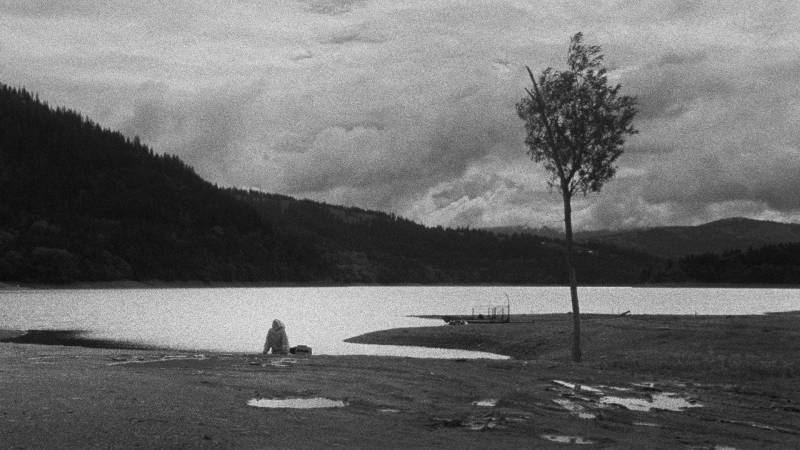
HH – Oh no. Everything was shot on film. All of it. We used Kodak Double-X black-and-white negative 16mm for the main body of the film – that represents Sasha’s point-of-view. And then Margot’s point-of-view appears in colour 16mm stock that punctuates the narrative.
So there are two visual perspectives: Sasha’s monochrome and Margot’s color. But none of it was digital. Everything was shot on 16mm film.
OK – That of course added a bit of pressure. When you’re shooting on film, you can’t do endless takes. We usually had two or three – maybe four at most.
HH – Yes. Because of our limited budget, we had a very small amount of film stock. On average, we managed three or four takes per scene. Some important scenes got more – for example, the dream sequence with the slow zoom. I think we did five or six takes there because it was crucial. But generally, two to four takes was the limit.
NS – Olga, please why your destination poin in the film is Okhtyrka, a small town in Sumy Region? Actually, I also was born in Sumy region…
OK – When we were preparing for the project, I spoke with many Ukrainians – not only friends but also people I had never met before. I went to a refugee centre in France and talked to people staying there at the time. That’s where I met a woman who told me her story.
She was from Okhtyrka. At the beginning of the full-scale invasion, she and her family were constantly sheltering in a basement. She had heart problems and eventually managed to get onto the last evacuation bus. She later decided to leave Ukraine and go to France, but her whole family – including her son —-stayed in Okhtyrka.
Her son was around 25. He had lost many friends on war and developed severe psychological issues. She eventually brought him to France for rehabilitation because he suffered from acute PTSD. For a while, things seemed better: they moved near the seaside, started learning French together, began building a new life. One day, he said, “Mom, I want to go for a walk alone”. She agreed, of course – he was an adult. He went for a walk and never came back. When I met her, he had already been missing for a year.
This story stayed with me because the character of Sasha is built from many real stories, and this one captured how the war poisons you even when you’re far away from it. They were already in France, safe but the war was still inside them. A year after I first met her, I contacted the woman again to ask how she was. She told me that her son’s body had been found. He had died. No one harmed him; something happened during one of his episodes. His PTSD was severe, and he had developed schizophrenic symptoms.
This is how the war destroyed him – even far from home.
NS – Terrible. Harald. I want to ask you about the film’s references. To me, it feels like Chantal Akerman meets Peter Hutton.
HH – Well, thank you very much. Those are beautiful references. To be perfectly honest, the main influence we discussed with Alexandre Neville, the cinematographer, in terms of visual strategy, was Iranian filmmaker Abbas Kiarostami. Before shooting, we watched a lot of his films to understand how to create compelling images from inside a car, how to approach landscapes, things like that.
That said, Chantal Akerman has always been a huge influence on my work. In this film, her presence is more of an unconscious reference than a deliberate choice. Yes, the static tripod shots are very Akerman-esque, but it wasn’t like we were consciously thinking, Let’s shoot this scene the way Akerman would. It came naturally.
There was also the reality of our extremely small budget. The crew was tiny, and we couldn’t afford sophisticated camera movements – no gimbals, no elaborate rigs. Because of these limitations, we had to be very precise and approach the film with a painterly aesthetic: the camera locked on a tripod for 90% of the time, relying on the blocking and the information within the frame to carry the scene.
That’s where Akerman resonates – she could hold a static shot for a long time without ever boring the viewer. That was the challenge for us as well. So her influence was less conscious, but definitely present.
NS – I want to ask you about the finale. Why does the film end at the Moldovan border? And why end with water — with the river? What does it symbolise for you?
HH – You mean the final shot, with the slow pan? For me, it was important that the audience be left with questions rather than with a closed ending. In a conventional narrative, the film would end with the boat drifting down the river, and that would be it – a sealed conclusion. But I didn’t want to close the conversation that way. The pan across the landscape keeps the narrative open. It invites the viewer to think, to interpret, to remain unsettled in a productive way. It keeps the door open.
…
.
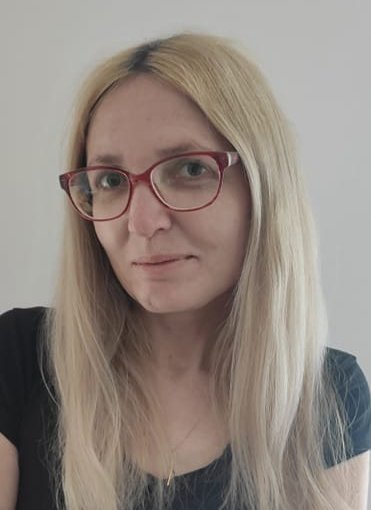
Harald Hutter and Olga Kviatkovska are pictured in Tallinn at the top of this article. The other image is a still from Leleka.