






The highly inventive director of Bait (2019) and Enys Men (2023) attended one of the world most prestigious film festival for the first time, where he showcased his latest creation I Saw The Face of God in the Jet Wash. This 17-minute movies is “a kaleidoscopic travelogue of the Celtic world”. It consists entirely of footage that Mark himself captured in the past 20 years or so on his trusted Super 8 camera.
Victor and Mark met at the press room of the Thermal Hotel, at the very heart of the 59th Karlovy Vary International Film Festival.
…
.
Victor Fraga – Please tell us about the genesis of I Saw the Face of God in the Jet Wash!
Mark Jenkin – It’s got a funny genesis.As you can see, it’s made up of a lot of footage that’s shot at different times. Stuff I shot in the year 2000, and it’s got stuff from The Isle of Man in about 2016, and then bits in Britanny, France from around that same time. Plus some stuff I shot in Los Angeles in 2023. Whenever I shoot Super 8 stuff, I always want to do something with it. But for a long time, I don’t know what that’s going to be. It takes me ages to work out what to do with it.
I’ve finished my new feature film, which I delivered six or seven weeks ago. I’m quite aware that I go into a bit of a downward spiral when I deliver a film because I’ve quite an intense, period of production, and because I do most of the post-production myself. I’m working very intensely on the film until the minute it’s delivered. And then there’s a long pause while you wait for news about where it’s gonna go. So I thought: “I’m gonna make something. As soon as I’ve finished the feature film, I’m gonna make a short film!”. And I had this idea for I Saw the Face of God in a Jet Wash. I actually filmed the title card years ago.
VF – How many years ago?
MJ – Maybe nearly 10. Okay. And I’d always liked the title. I’d always wanted to make a film that was called that. I didn’t quite know what the film would be. So I thought if I made this film that was going to have random chapters of my unwritten autobiography. It could be called I Saw the Face of God in the Jet Wash because you never need to know what it actually means. The day I decided to make the film I took the title card and I put it on Instagram. Just so that for my benefit, it was on record that I was going to make this film.
VF – So you finished the film in well under six weeks?
MJ – That’s when it got a little crazy, People started messaging me saying: “can we see it?”. And a lot of the people messaging me were people from festivals. So I then got my producer Denzil Monk on board. I just said: “do you want to produce this new short?”. And he answered: “yeah, sure”. And then about 48 hours later, he sent me a message saying: “I suppose I better come over to the studio and see what I’m producing, see the cut”. And I said: “well. I’ve got to make it first”. Because there was nothing. So then we had these people waiting for a screener. So then that was the that was the deadline. So I made it, I edited it, Then I wrote it. Then I reedited it.
VF – Does your film contain any archive footage? In other words: is there stuff shot by other people?
MJ – No, everything is mine.
VF – Tell us a little bit about your relationship with Karlovy Vary. Is this your first time here?
MJ – This is my first time here. This is one of the festivals that I’ve always been interested in. They kind of missed out on Enys Men. If they had seen the film in Cannes, I would’ve probably been here earlier. I only got here yesterday, but just having been out and about last night and and just seeing how the Festival is and the size of the audiences, I messaged Denzil and said: “next time we open a film in Cannes, we’ve got to make sure we come here [afterwards]!”.
VF – Cornwall, Ireland, the Isle of Man, Brittany, I can see a Celtic connection here. Enys Men has a Cornish title. I think it has some Cornish dialogue as well, if I’m not mistaken. Can you talk a little bit how the Celtic connection shapes this film?
MJ – I think the Isle of Man connection was that footage from about 2016, maybe 2017. And I was on the Isle of Man for the Celtic Media Festival. The Brittany link was the British Film Festival in Dinard. I’ve had a relationship with them for about 18 years. And some of the Brittany stuff we shot when we were on holiday, because that’s where we do go on holiday. There is that strong connection between Cornwall and Brittany. Because you can just get a ferry straight from Cornwall straight over to Brittany. So that’s that Celtic connection. And Dublin. Yeah, I don’t know about Dublin. That was from like 25 years ago. I can’t even remember really why I was there.
I think the key to your question is the Celtic connection. I think the word connection is as important as the word Celtic because the whole film is about trying to work out, find connections in this footage. Because I shoot the footage without thinking what the narrative and the voiceover are going to be. Only when I watch the footage and then I’m able to find these connections.
Everything goes back to Big Wednesday [John Milius, 1978]. Hopefully people see that everything links back to that film. And I find all of these different links, whether it’s sort of Bruce Surtees who shot Big Wednesday, also shot the third Planet of the Apes [J. Lee Thompson’s Conquest of the Planet of the Apes, 1972]. We were at the location of the original Planet of the Apes [Franklin J. Schaffner, 1968]. The fact that somebody shouted: “fuck you Freddy Krueger” at me because they thought my silhouette looked like Freddy Krueger’s. And that’s Robert England, the narrator from Big Wednesday. I’m interested in connections. Everything goes back to Cornwall but I’m always looking at something else within it.

VF – My family are from Galicia, in Spain, the seventh Celtic nation. Have you ever been there?
MJ – I’ve met filmmakers from Galicia at the Celtic Media Festival. But that’s my only connection.
VF – You’re now returning to the medium of short film. I think it’s the first short film you’ve done in five years. Can you talk a little bit about that? Is that just a fleeting pleasure or do you miss doing short films?
MJ – I love doing short films. I’m not a filmmaker who started off making short films and then made feature films and then has gone back to short films. The first film that I made was a one-hour-long film. I did that wheb I first left college because I didn’t see the point in short films. I thought: “if I’m gonna put all of that stuff together to make a film, I might as well make a feature-length film”. I discovered short films later when I went back to shooting Super 8 , and I was building up a bit of an archive and I wanted to I wanted to do something with it.
There was a short I made called Dear Marianne [2016], which was the first time I took found footage, then repurposed it into something else. And I found this little way of making short films that were able to be entirely me, entirely my perspective. I I didn’t have anybody commissioning them or giving me any kind of notes, or anything like that. So it became quite a nice counter to the other side of filmmaking, where you’ve got a lot of input from people. And that can slow down the process a bit.
It’s not like with actors and a script and all of that kind of stuff. It’s a very quick process. I love the fact that I’ve made another short film since making the feature film. And also, on a really cynical level, it allows me to come to places like this. I was saying to somebody last night at the party: “it’s so nice to be at a festival where you get all of the luxury, you get flown over and you get put up in a hotel and all that kind of stuff, but you don’t have the pressure of a feature film dictating whether you’re going to be able to make your next work!”. This is just fun!
VF – You said during the Q&A, that you get depressed once you finish a film. Virginia Woolf famously said: “the truth is that writing is the profound pleasure and being read the superficial”. Do you think that also extends to film? Do you think the profound pleasure is in making film?
MJ – No, I don’t think so. I’m just impatient. That’s why I have that dip when I’ve delivered the film. Because of the way I work. I write my films. And then we go into the development process, which slows everything down. But then as soon as you’re green lit, you go into a shoot and it’s like the most intense thing. I do most of the post-production myself: I cut the film, I do the sound design, I do the score, the ADR, everything. And so the intensity of the shoot just continues through post-production. And whereas the shoot is six or seven weeks, the post-production is months and months and months. And then right up to the last minute, getting a note from somebody saying “change this, change that”, going to another test screening, putting it in front of an audience, doing a technical check, remixing bits, watching it again. And then suddenly everybody’s in the room and they say: “right, it’s done, we’re delivering it!”. And after it gets delivered, and I just go home, and it’s like: “what’s next???!!!”.
What I want is for somebody to say 10 minutes later: “this festival has offered us a slot!”. But it doesn’t work like that. This takes weeks, or months. It’s that period of time when I haven’t got the motivation and the collaborators around me. And my producer Denzil isn’t quite ready to work on the next thing. He’s still delivering the film and working with sales people. So I feel like I’m just left on my own. And then I have to just get on and make something. I’m impatient to put it in front of the audience. So [unlike Virginia Woolf] I find a lot of pleasure in being with the audience. A lot!
When we finished Bait and we screened it for the first time, I watched it in front of an audience and people laughed all the way through it. And I sort of forgot that it was funny. With Enys Men, it was difficult to watch with an audience because there were no laughs. So I had no idea whether the audience are going with it or not. Now, with this one, it was great because I heard people laugh.
VF – People were laughing when you said you did not approve of Hitchcock’s screen adaptation of Daphne du Maurier’s The Birds. How dare you?
MJ – If I didn’t know the short story, The Birds [1963] would be a fine film, you know? It’s a high bar that I’m measuring it against. Because it’s Hitchcock and he’s a master. It’s nowhere near his best work.
VF – Which one is his best work for you?
MJ – I suppose stuff like Rear Window [1954], Vertigo [1958], and Psycho [1960]. Everything that I saw the first time just stays with me. The Birds just isn’t up there!
VF – I would argue that the colours in your films are very tactile, and that I can almost smell the sea. I think that you mix up the five senses in your films. Is it possible that you suffer from synesthesia? That was the topic of the film that won the top prize in Karlovy Vary last year, A Sudden Glimpse to Deeper Things, by your countryman and and namesake Mark Cousins, whom I interviewed. The film investigates the life of Scottish painter Wilhelmina “Willie” Barns-Graham, who suffered from this strangely-named condition. This means that she mixed up her senses: she could see smells, feel colours, and so on.
MJ – I think that’s the definition of cinema. Because film only works with two senses. That’s right, isn’t it? The other three senses are for cinema to transcend. Good films evoke the other three senses [smell, taste and touch]. Even though they’re not directly working with them. After a guy watched Enys Men in Brighton he told me: “the sound of your film went through my body, and it damaged my internal organs!“.
VF – That’s quite extreme! Did he take you to court for GBH?
MJ – Not quite. I spoke to him afterwards and he told me he’s neurodivergent, and he experienced a sensory overload. he literally felt the sound waves! I have to look that up [synesthesia]!
VF – Is there anything you can tell us about the upcoming feature?
MJ – I don’t think I’m allowed to. At least not past the press release that Deadline put out. It’s with George MacKay and Callum, and it’s called the Rose of Nevada. It’s a ghost about time travel, and a social realist musical.
VF – Well, that sound mighty promising. I look forward to seeing, feeling and smelling the Rose of Nevada!
…
.
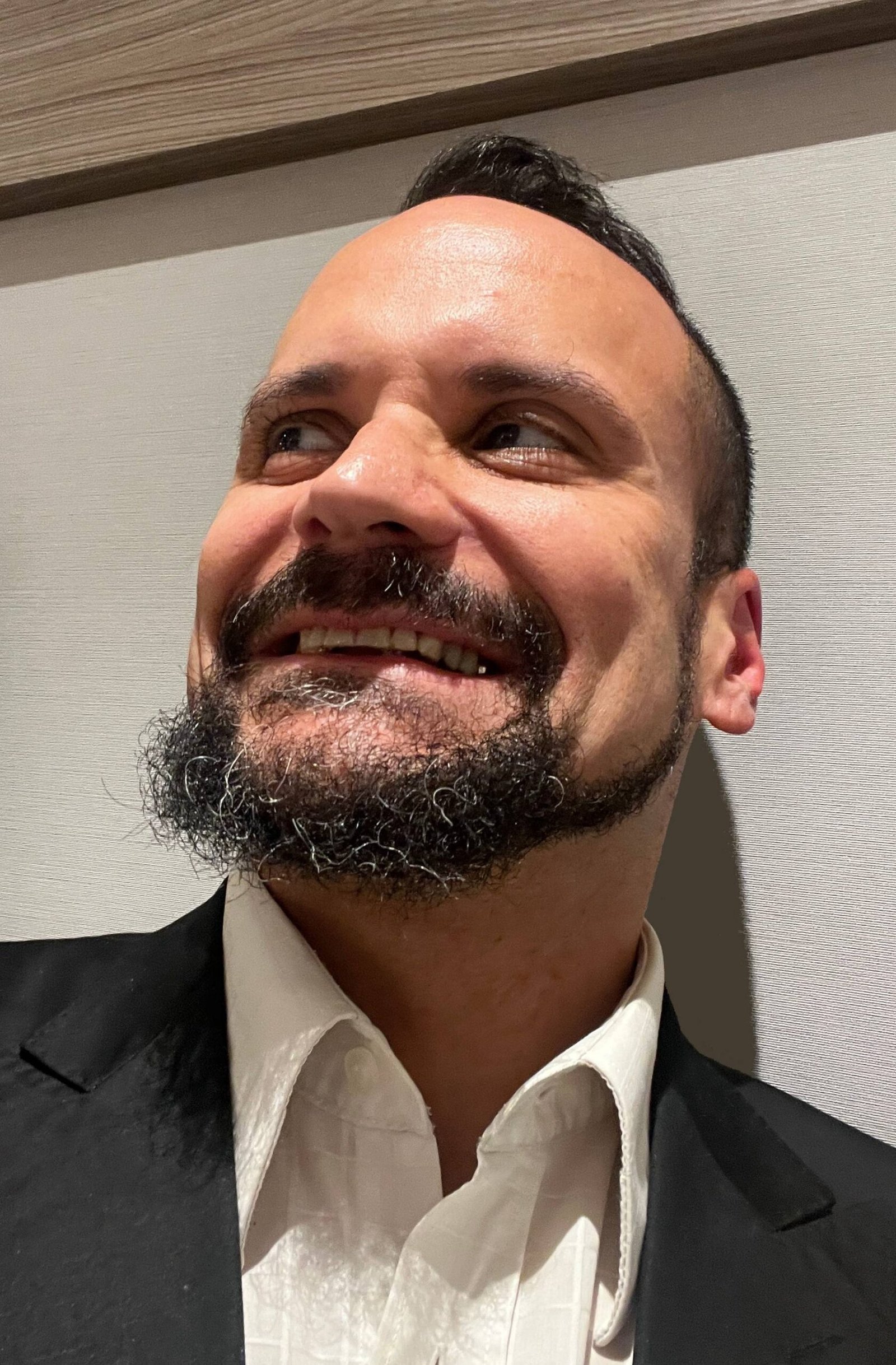
Mark is pictured on both images on this interview. The one at the top was snapped by interviewer Victor Fraga himself, while the second was taken during the film premiere, courtesy of Film Servis Karlovy Vary.