






The 59th edition of the Karlovy Vary International Film Festival (Kviff) takes for nine days, between July 4th and 12th in the charming spa town two hours from the Czech capital. DMovies returns to the event for its entire duration, ensuring that the dirty gems receive love from our readers worldwide. Kviff is an a-list festival, as accredited by Fiapf (International Federation of Film Producers Associations).
DMovies’s founder and editor Victor Fraga had a very enjoyable Zoom chat with the man at the forefront of the action, a couple of weeks before the events begins
You can check Kviff’s programme by clicking here. DMovies will be covering the action in loco during the entire Festival.
…
.
Victor Fraga – You have been at the helm of Kviff for 16 years. Could you please tell us about the Festival’s biggest milestones since?
Karel Och – I think one of the biggest achievements is that we maintain the same enthusiasm of our audience. This always bring us back to the original purpose of the film festivals in general: to facilitate the meeting between the filmmakers and audiences. Unlike many other festivals of the similar size, we do give a lot of space to films from other festivals. I’m talking 60, 70 films from between Venice, Cannes, etc. So we’re trying to balance this.
VF – Is there a specific milestone, something recent which was never done before?
KO – Yes, I remember a few milestones. They are the titles that we were happy or lucky enough to launched. I’m talking for instance about The Boiling Point [Philip Barantini, 2021], which we launched in the Main Competition. The filmmaker is responsible for the revolutionary Netflix show Adolescents, which is shot in one single shot. We are very happy to be in the beginning of the career of such people, supporting their filmmaking, their aesthetic approach. These are the moments that have created the recent history of the Festival, which started in 2001 with Amelie [Jean-Pierre Jeunet; the film won the Crystal Globe and went on to become one of the most commercially successful non-English language movies in history]. We also premiered Joachim Trier’s first film Reprise [2006]. When you see what happens afterwards, it gives you a certain perspective on your past and something to be proud of.
VF – Let’s talk about the challenges. Other than the pandemic, what were the biggest difficulties you’ve encountered in the past 15 years?
KO – Finances might be one of the challenges, but I’m happy to say that it’s not that much of a concern to us right now. Unlike maybe our colleagues from different festivals. The financing of the festival has been quite stable throughout the years. We are 75-80% funded by the private money, by the sponsors, partners of the festivals who are faithful to us throughout the years. We also rely on a beautiful support of the state, region and city. But that’s not our main source. This means that we enjoy certain type of independence. We need to plan ahead, you know? Maybe because we want to make some technological changes, like database or or a system.
I also think that the streamers might considered as a challenge, but we don’t want a fight. I think there can be a collaboration.
VF – Does this mean you will show Netflix movies?
KO – Absolutely, we will show Netflix movies, and we have done it in the past, too. We will show any content that we consider suitable for the big screen. Many streamers are working closely with the filmmakers. A year ago we closed the Festival with a movie that was released on a platform 10 months earlier.
VF – Please remind us which film that was?
KO – It was called Fingernails, by Greek filmmaker Christos Nikou.
VF – Oh, yes. I remember seeing that in San Sebastian.
KO – Yes, I think that was in Competition in San Sebastian. We knew people would love it if we put the film back on the big screen, and this was supported by the filmmaker himself. When a streamer and a festival collaborate, that’s because both of them want to make the filmmaker happy.
VF – Who are your biggest sponsors st present?
KO – This is not entirely my territory! You can see them on our website. There are 53 in total. There’s an energy company, Vodafone, BMW, and many more.
VF – What is your annual budget?
KO – It’s about €8.5 million.
VF – You have two major competitive strands, Crystal Globe and Proxima, with relatively few entries (about 12 each). That’s relatively few compared to five strands in San Sebastian or six in Tallinn, and with a lot more films in each section (nearer 20 each). Please comment!
KO – There was a moment when we had a third competitive section, for documentaries. But we realised that the documentaries that we are after can easily compete with narrative fiction films. Or dramatic films, as they call it in North America. We thought it was fair to mix them. And so for a few years now, since the pandemic, we have fiction and documentary in the same competition.
Going back to what I said before, there is a third part of the official selection, which is called Special Screenings. That’s where we give plenty of space to films that do not meet the Fiapf criteria. This is to say that they are neither world nor international premieres. Wet they’re often a European premiere, so we create a gala element. So we have these three sections, and we keep the numbers are roughly a dozen films each. It’s very important to us that the jury watches the films with the regular audience. We premiere two films per day, and that’s just about manageable. We want to overload neither the jury nor the spectators. If you put too many films in one section, that takes the attention away from another section. We don’t want people to be stressed. You can take it easy, watch a couple of films from different sections, and be enriched by the films in general.
VF – How large is your selection committee?
KO – There are six of us, with two associated programmers. Plus a number of supporting experts. We receive around 2,000 films, and we want all of them to be properly considered. We have a bunch of pre-screeners, people who watch the films for us. They then write a report. We get to watch many films in a small cinema, with our colleagues. The core number [of the selection committee] is six plus two.
VF – Would you describe yourselves as an auteur-driven festival?
KO – A friend producer came to Karlovy Vary a few years ago and said: “I think your selection is gently edgy!”. I like the combination of these two words: “gently edgy”. This might be our way of seeing contemporary cinema and our way of, of supporting arthouse cinema. We are definitely an auteur-driven film festival. We consider filmmakers auteurs. We’re excited about their vision and their quest for the original film language.
At the same time, we want to stress the fact that we very much care about not building a wall between a film and the audience. Sometimes, a certain type of auteur-driven filmmaking might be a little bit detached from audience interest. If there is a challenge, provocation, or something difficult to swallow, there has to be some sort of communication between the film, its maker and the audience. I don’t want to use the word “accessible” because we often play very tough films, but “gently edgy”.
VF – What about genre? Is it fair to say that you are not a genre-driven festival?
KO – Yes, I think it’s fair to say we are not genre-driven. But we do not close ourselves to genre cinema. We do every now and then have a genre film in one of the competitions.
VF – Are there any this year?
KO – This year we have films with genre elements, specially in the Proxima Competition. There’s the German title Rain Fell On The Nothing New [Steffen Goldkamp], and it works well with the crime drama genre elements, but I wouldn’t say there’s a particularly elevated genre. I the past years, we had a big budget budget, uh, philosophical sci-fi film and even a musical.
VF – Do you have any targets for this here? Such a number of admissions, or anything else?
KO – As far as the admissions are concerned, we’re lucky to be kind of sold out throughout the year. That’s around 140,000 admissions. Of course, sometimes people don’t show up even if they have tickets. That’s why the open the gates minutes before the screenings. And we let in people with badges, without tickets so that seats are filled up. We cannot expand any further because we have a limited number of venues. I want to say with modesty every year that we approach each year with the same type of energy and dedication.
VF – That’s indeed a big achievement. Not all festivals manage to sell out. I’ve seen it myself. Even the cinemas, which are a bit further away, they’re completely full. Congrats, you’re doing very well indeed!
When I interviewed Mark Cousins last year, just before he won the Crystal Globe, he said he has fond memories of loud audiences in the past. He also remembered when it was so hot people attended the screening in their bathing suit and their underwear. Do you anticipate people in their bathing suits and their underwear this year?
KO – [laughs] No! We was referring to one of those itinerant cinemas we had to use at some point, and the air con didn’t work at all. That’s why half of the people were half naked. We expect improvised, original and crazy moments, because that’s what happens at festivals. Yet our main interest is to be a respectful as we can towards the films and the filmmakers. In the end of the day, that’s the reason why we exist. It’s why all the people come. We can have a lot of fun, uh, while being respectful towards our artists.
VF – What are your key performance indicators once the Festival is finished? How do you measure whether the Festival and the individual films were successful?
KO – In reality, our biggest performance indicator is the feeling of the filmmaker after the screening. Because the filmmakers have always been our biggest ambassadors. They tell their colleagues: “you know, this is a festival that’s respectful. They take very good care of you. So you might consider launching your film there”. It’s a reputational thing. The figures might impress some people, but they are really relative and and difficult to compare. That’s why words and the feelings are the strongest performance indicators for us.
VF – You decided to postpone the announcement of an Iranian film this year ror security reasons,. Have you experienced any retaliation from Iran or any other countries?
KO – Thankfully not! At least not yet. Which is good because the last thing we want is to put someone’s life in danger. That’s why we agreed with the filmmakers to postpone the announcement. So that they are not in trouble and can leave the country to attend the Festival [this interview was conducted two days before Israel attacked Iran, and the country closed its airspace].
VF – Phew, that’s great news. Are you showing Panahi’s new film [It Was Just An Accident, which won the Palme d’Or last month]?
KO – Yes! And I’m so happy to see that he won the “Golden Palm”! I was lucky that at my first festival in 2001, I was the secretary of both juries, and Jafar Panahi was a member of one of them. It was a real treat working him, as a human being, as a filmmaker, as an artist. Those meetings were unforgettable!
VF – Is film political always and should film festivals accept movies with all political tendencies?
KO – I think that every film is political. Anything that concerns human beings, even the most intimate things, is seen as political. Because we are not isolated, we live in communities. Of course some films are more politically explicit than others. We prefer to give space to films less explicit in their politics. Through personal and individual stories, which are an indirect commentary on certain tendencies.
At the same time, I want to mention a documentary in the Main Competition called Divia, by a Ukrainian filmmaker [Dmytro Hreshko]. It’s a film without words, just with the very strong audiovisual elements, using mostly the drone techniques in order to show the terrible effects of the Russian aggression on the ecosystem and nature. Because that’s something which is not being discussed and shown as much as, obviously, human beings. It’s one of the most politically explicit films in the programme.
VF – Is it correct ro affirm that you are more inclined to select political films that are character-driven?
KO – yes, it is.
VF – What about activist cinema, such as Raoul Peck’s [the director of I’m Not Your Negro, from 2017, and Orwell: 2+2=5, from this year]?
KO – I’m convinced that any type of film can be good or bad. This includes activist cinema. I’m sure there are sophisticated activist films, and also superficial ones, the non-intelligent, flag-waving type of movie. We don’t really exclude any type of films! I just need agree with my colleagues that it’s a film bringing something. enriching the discourse, content and form.
VF – Please allow me to be a little controversial. Would you show Russian and Israeli films?
KO – This is the time when we are working on the sidebar sections, and we don’t exclude Israeli films from consideration. We did not have Russian films for consideration this year. We would never consider Russian films supported by the Russian state in any way.
VF – But the same doesn’t apply to Israel?
KO – It’s not only about the artistic qualities, but also the funding schemes. We don’t issues boycotts, but we are very careful about who we would support. We are not applying the same criteria, the same thoroughness [as on Russia] on Israel because the funding is a little more complicated there. In general, we want give a certain space to certain issues, and to present it with honesty, so that people can come up with their own opinion.
VF – Let’s talk about British cinema. Obviously Mark Cousins won last year. Could you please tell us a little more about your history with British cinema?
KO – When I started one of my personal very favourite movies was Ken Loach’s Kes [1969]. Then I found out that I was working for a Festival where Kes won the main award decades earlier. That filled me with joy and pride!
To be honest, British films are not as frequent and we would love them to be. The UK belongs the countries, like France or Italy, that have certain objectives: Cannes, Venice or Berlin. So we need to go out there and proactively search for the films, and build personal relationships. Which is the case with Mark’s film [A Sudden Glimpse to Deeper Things]. He sent me the screener himself!
I also mentioned The Boiling Point – that really was one of the milestones of the recent history of the Festival. We do not have a British world premiere this year. But we do have a brilliant European premiere, Paul Andrew Williams’s Dragonfly, just after it premiered in Tribeca! That’s a very tender but also a very tense film, with two amazing performances, by Andrea Riseborough and Brenda Blethyn. One of the most unpredictable films this year. And also touching and charming!
VF – Thanks for the tip. I will be watching it for sure. And thanks a lot for your time!
…
.
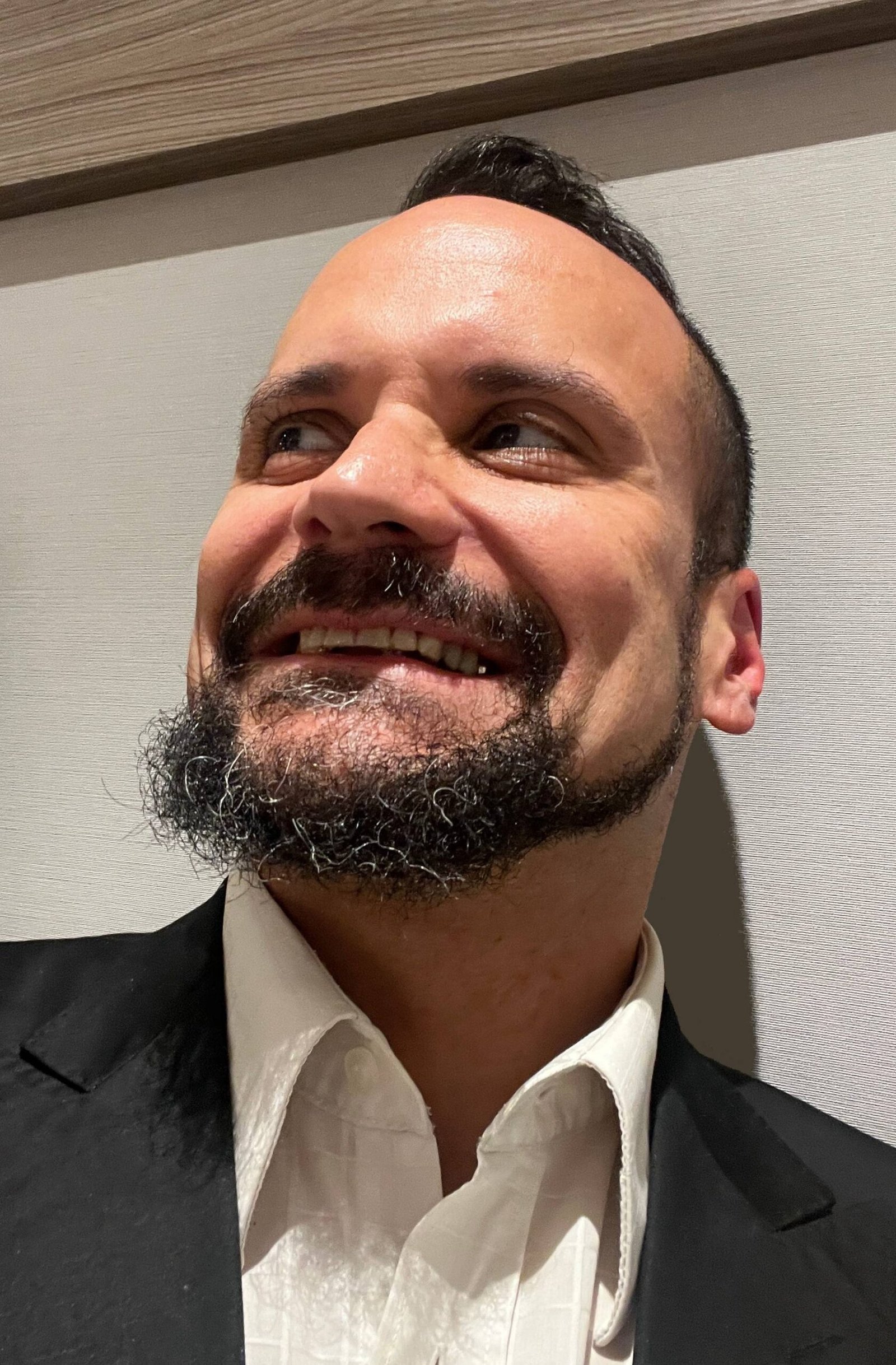
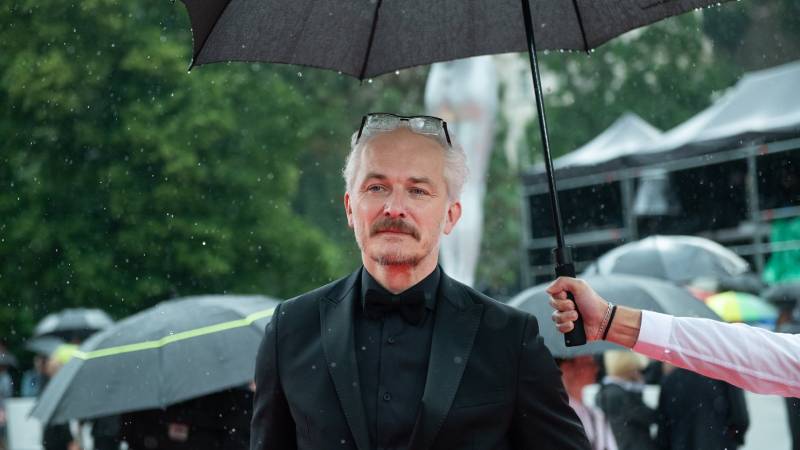
Karel is pictured on both images illustrating this interview.