







Considering his work on Monty Python: Almost the Truth – The Lawyers Cut (2009) and It Was Fifty Years Ago Today! The Beatles: Sgt. Pepper & Beyond (2017), documentary filmmaker Alan G.Parker seems well equipped to direct a film about pop’s radicalist John Lennon. Long time Beatle fanatic Eoghan Lyng caught up with Parker to discuss his challenges during Covid, as well as the experiences he gleamed recalling the most fondly remembered songwriter in The Fab Four.
Parker’s latest film Borrowed Time: Lennon’s Last Decade is in cinemas on Friday, May 2nd.
…
.
Eoghan Lyng – Congratulations on the film
Alan G.Parker – Thank you. Normally, when you make a movie, if you’re unlucky you can make a movie between 16 to 18 months. You can often make one in 12 to 14. But we’ve been on this for close on six years, so beyond a labour of love!
EL – Christ!
AGP – You know it ain’t easy, you know hard it can be!
EL – According to people like May Pang and Mark Lewisohn [ex girlfriend and Beatle historian, respectively], Lennon could be full on and sweet, depending on the day. Fair comment?
AGP – It’s funny: I was reading one of the early reviews, it says, “It’s almost like Parker has observed Lennon’s life like an onion, and peels away the layers“. A lot of layers; one of the most complex people who lived.
EL – What was “Whispering Bob” Harris like to interview for the documentary?
AGP – Incredible. I will tell you a fun story. I did the interview, which I think was just over two hours, and Bob turned over to one of the team and said, “That was probably the best interview anyone has done with me”. He turned to my line producer and asked ‘Where are the questions?’ He said he didn’t see a sheet. My line producer laughed, and said: “If you know Alan like I know him, if he had questions, he would say he wasn’t the right man for the job”. The crew call me “the rock’n roll Rain Man. It’s all in my head!
EL – Harris did a brilliant interview with Lennon in the 1970s.
AGP – Amazing interview. Bob says when the call came through, it was Elton John who said he would be the right man for the job. Elton said, “If you have a new album coming out, and don’t want to speak to every interviewer in England, the best man to go to is Bob Harris”. John rang him personally; no press agency! There’s a funny story with the fee, which you can see in the film.
EL – Double Fantasy producer Jack Douglas has said he was writing songs for “The boys.”
AGP – Totally. There’s even been a good bootleg for years. Before Nobody Told Me, he says, “leave this aside; this is for Ringo”.
EL – His image as a house-husband permeates Double Fantasy. Did he warm to that image?
AGP – The story I got from people who were around at the time, when John planned to go back into the studio, he had written 10 numbers for an album. That’s why we got Milk and Honey, the posthumous album. As far as he was concerned, it was going to be like Mind Games or Walls & Bridges etc. There was a hoo-haw in Dakota, apparently, although I don’t have the full story, as Yoko presumed if they were coming back then it was going to be like the early days: a John & Yoko album. Apparently there was a ‘ding-dong’ about it, which the group were a party to a certain degree, which is why there were two albums of five Lennon songs.
EL – To be fair, some of her songs on Double Fantasy are superb a la ‘I’m Moving On’.
AGP – She’s certainly on her game. There were a lot of Beatle fans who bought the thing and listened to it all the way through, but the problem if you were a hardcore Beatle fan, as I was at that stage being 15 going on 16. The difficulty for me was listening to the album and presuming it was ten new songs by him because he’d been away for five years, that was a disappointment at that age. There were only five Lennon songs.
EL – Going back to Yoko Ono: Has time treated her more kindly considering the thinly veiled racism she received in Britain during the 1960s?
AGP – I think time has done her some favours. I think the core of the thing where the problems relate from… Ray Connolly, the journalist, covers this quite well in the documentary. After the Long Weekend [a period of separation for Lennon and Ono during the 1970s], they moved into the Dakota full time, and there’s a lot of revisionism during that time. It’s almost like he didn’t have an affair with May Pang or make an album with Phil Spector. What makes it more difficult to swallow is that in radio interviews during the last three to five months of his life, John’s agreeing with it all. A lot of “This didn’t happen..”, “That didn’t happen”.
I think that’s partially what gave the people a bad taste about Yoko, besides others saying she split The Beatles up, despite everyone around the band saying that couldn’t be further from the truth. They were splitting up anyway. From a filmmaker’s point-of-view, there were open goals there for Yoko, but I wasn’t looking to make a film to go after John or Yoko. I was looking for stories and facts from people who had known The Beatles for years.
EL – Let’s talk about Richard Nixon. Why was his administration fearful of Lennon?
AGP – The one I always turn to, and it is well documented in the books, is that after he moved to New York city, Nixon had given a rally speech that could be described as ‘Pro-Vietnam.’ And the number that turned up is something like 18 or 19,000. Three weeks later, John gave a vocal anti-Vietnam speech in central New York, and 190,000 kids turned up. By doing that, people like Jerry Rubin were there to meet him. They knew he had walked down Oxford Street, shouting for ‘Peace’. Paul, George & Ringo were not as outwardly political as John Lennon, but they might have felt the same as he did. So these activists must have looked at John Lennon arriving in New York, and thought: “There is a God after all!”.
EL – Lennon was chummy with Michael X for a bit in England.
AGP – John, at the end of the day, like people say in the film….People like Philip Norman, who researched him backwards and forwards, say the reality was John wasn’t as wise in those circles as he made out in interviews. There’s a famous story that I’d known for years, which is why I got [music journalist] Chris Welch in to tell it. John’s in a meeting with Michael X, and he’s asked to write a cheque for the cause in Ireland. John writes this cheque, presuming it’s for the peace campaign, and it’s only a few weeks later that [Beatle associate] Neil Aspinall says, “You do realise that money probably went for guns?”. That was the nature of what was going on back then. So, I think there was some naivete from Lennon.
EL – It was the same for McCartney with ‘Give Ireland Back To The Irish’. He didn’t realise the backlash he was going to get.
AGP – Totally! It’s easy being a rockstar thinking, “I’ll have my say”. John had that Luck of The Irish song on Some Time In New York City. NME, I think, said it couldn’t have been less well received by the Irish population if John Lennon had turned up in a town square in Dublin riding a pig and playing the tin whistle wearing a hat. You need to do a bit of reading before you go down that road.
EL – There are some stand-out moments on that record. The guitar playing is stunning, and I feel it’s been unfairly maligned.
AGP – It’s funny, people have cast it off as “Old rubbish”. It wasn’t, because it was someone who thought he was being political, and this wasn’t a single like Give Peace A Chance. This was a whole album. Probably my favourite Yoko Ono song, Sisters, O Sisters, is on that album. A great track! But imagine buying that as a teenager, and though parts of The White Album were difficult, Some Time In New York City was way too political for anything I knew at that age. I mean, you could imagine them shaking the sleeve: “Where’s the manual?”.
EL – Your film touches upon the fiery track How Do You Sleep?. Was Paul McCartney hurt by that composition?
AGP – The stories I used to hear from various engineers at Abbey Road studios was that he was hurt by it. Who wouldn’t be? This is your former best mate having a go at you on a major album; Imagine was a huge album. Doing your research, the more you read, the more you realise that there is a story that’s missed out on. A year earlier, Paul put an album out with a song that John, in his heroin and coke-fuelled addiction, thought was a real dig at him. So, John’s not having a dig at him out of the blue. It’s more like, “The Ram album has Dear Boy, which is about me, so I’m going more vicious”.
EL – Sure. Allen Klein has a nefarious reputation.
AGP – Oh God! We did 60 interviews, maybe 62, and I don’t think I could find one good word about him. A lot of people were mates of John Lennon’s in that movie, and nobody had a good word; syllable, even.
EL – In more recent years, he interfered with Richard Aschcroft and Bittersweet Symphony.
AGP – He struck me as someone who always arrived at the party late, and with an agenda. People like that are always going to be difficult for anyone to come good. There’s Steel & Glass which John Lennon thought was about Klein, and he realised it was about himself. John could write songs that were so out there, before realising the person he was singing about was the guy in the bathroom mirror.
EL – A case could be made for Sexy Sadie, as much a finger-wag at himself as it was the Maharishi in India.
AGP – Totally! We made a film about the Sgt.Pepper album a few years ago, and the whole Maharishi is like an overly besotted love affair. As early as summer of 1968, only George is still enchanted by him, as the other three have gone,’It’s all shop-window, and no stock inside.’ But he’s another complex character. It’s hardly a coincidence that when Brian Epstein, all these characters arrive. We have Maharishi, Klein, Magic Alex…People saw an opening because Brian was no longer there.
EL – What challenges did Covid present?
AGP – By the latter part of 2018, the publicity on the It Was Fifty Years Ago Today! The Beatles: Sgt. Pepper & Beyond machin. It staggered all around the world, so by the latter part of 2018, we thought about the next project. We realised in 2020 that Lennon would be dead as long as he lived; 40 years. Why don’t we do a documentary that goes into cinema on December 8th, 2020? By late 2019, with a lot of research behind us, we went looking for an investor. You find an investor and start shooting. And then, the whole world closed down [in 2020], which you couldn’t have predicted in a million years! We were quite a decent size film crew, and there’s normally six to nine people on one of our sets. [With Covid restrictions], we could not film it all until we got the all clear.
We missed the deadline, because we hadn’t finished filming. But on the plus side, it gave us more research time, and brought up things like the 1981 tour, which hadn’t been part of the idea. And because people were sat at home doing nothing, they had the chance to see the Sgt.Pepper film. So people volunteered it. By the time we started shooting again in May 2021, the list had shot up from 25 names to 54. So, Covid had been a blessing and a curse!
EL – McCartney was both the Beatle that glued them together, and pushed them apart.
AGP – It’s odd, isn’t it? They’d had this meeting with Allen Klein, and the plan was that they wouldn’t tell anyone they were splitting up. John tells Ray Connolly, a friend and trusted journalist, in September 1969 that The Beatles are over; “Don’t write about it”. Ray’s thinking “This is the biggest scoop of my life”, and rings John every week to ask when he can write the story. And this goes on until March 1970 when The Daily Mail pick up on Paul’s press release: “The Beatles are Over”. Typical John, he rings Ray and asks why he didn’t print the story [laughs].
EL – Lennon worked with Richard Lester on How I Won The War. Would he have acted more if he lived?
AGP – The more I’ve read about John, that film was his way of doing something before he went back to Abbey Road and back to The Beatles. It was just something to do, and I don’t think it was a great acting thing. There’s an interview with Art Garfunkel, who knew John Lennon quite well. Apparently John had asked him “Why?” when he’d done some acting. John ran to Richard Lester because he wanted to get away from the scenario The Beatles hated: touring.
EL – Last two questions: Is there a follow up?
AGP – Not a follow-up, but we are hoping to be shooting a film by June or July. I can’t tell you what it is because we’re under NDA.
EL – What will Beatle fans learn from Borrowed Time?
AGP – One of the first reviews through the door asked: “is it humanly possible that Borrowed Time is the most honest, direct and well-made Lennon/Beatles film to date?’ I think the reason they said that is because we’ve no axe to grind. We’re just telling his story. I think I said in the original press release that these are stories you would hear over a pint, but then you go home and read the latest Beatle book, or see the latest film, and you’d go, “Those stories are watered down”. So, when it came to this, I’d say, “Any chance you could tell the stories like they were told over lunch, or like the first time they were told to me?”. I think that is what has given Borrowed Time some edge. Record Collector journalist Joel McIver said he enjoyed Borrowed Time much more than the totally inferior Becoming Led Zeppelin (Bernard MacMahon, 2025), well, I nearly fell off the sofa! Beautiful of him to say that, but that’s where we’re at.
…
.
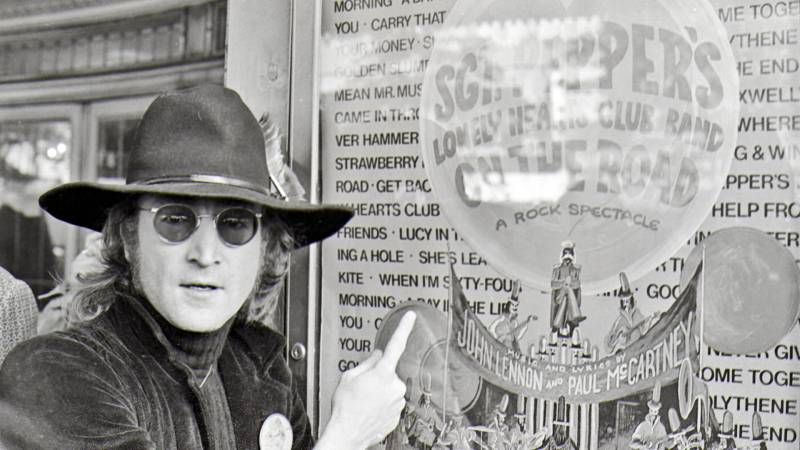
Alan G. Parker is pictured at the top of this interview. The other image is a still from Borrowed.


